

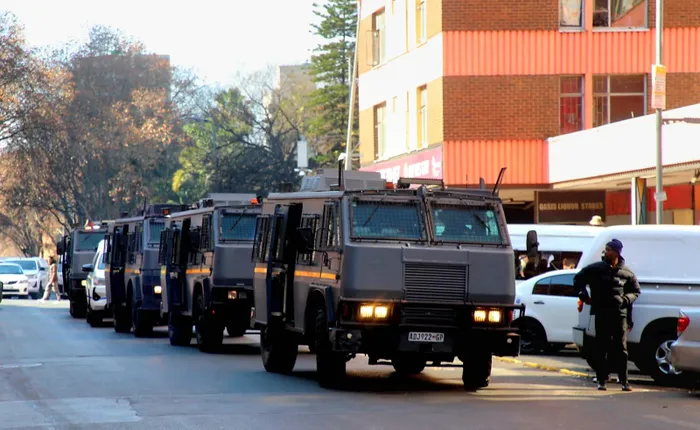
The South African Police Service (SAPS) says the country remained stable in the 24 hours leading up to the planned 30 June protests as the Justice, Crime Prevention and Security Cluster activated its national operational plan.
Image: Timothy Bernard / ANAStudio
The South African Police Service (SAPS) says the country remained stable in the 24 hours leading up to the planned 30 June protests as the Justice, Crime Prevention and Security Cluster activated its national operational plan.
Addressing a media briefing on Monday, Lieutenant-General Tebello Mosikili said Operation June 30 had entered its full implementation phase, with law enforcement agencies deployed across all nine provinces.
Mosikili said the National Joint Operational and Intelligence Structures, provincial command centres and operational teams were functioning around the clock, while Public Order Policing units, specialised response teams and the SAPS Air Wing were on standby to respond to any incidents.
She said intelligence structures were monitoring developments in real time and operational commanders were receiving continuous updates to enable rapid decision-making.
"The State is ready. Law enforcement is ready. South Africa is ready," Mosikili said, adding that contingency plans had been tested and there would be "no security vacuum".
Mosikili stressed that authorities would protect lawful and peaceful demonstrations but warned that criminal acts would not be tolerated.
She said no individual or group would be allowed to intimidate communities, shut down the economy, prevent people from going to work, school or healthcare facilities, damage infrastructure, loot businesses or attack law enforcement officers.
She added that dangerous weapons, including firearms, knives and traditional weapons, would not be permitted at demonstrations in terms of Section 17 of the Constitution.
Providing an update on arrests, Mosikili said four people had been arrested after allegedly entering the home of a Congolese family in Rosettenville, Johannesburg, over the weekend. They are facing charges of public violence and house robbery.
Since 1 March, police have registered 103 cases linked to anti-foreigner sentiment, resulting in the arrest of 195 suspects.
KwaZulu-Natal recorded 39 cases and 11 arrests, followed by the Free State with 29 cases and 153 arrests, the Western Cape with 15 cases and 14 arrests, the Eastern Cape with 12 cases and nine arrests, Gauteng with four cases and five arrests, and Mpumalanga with three cases and three arrests.
Mosikili said the leader of the Abahambe-linked march, Simphiwe James Bonile, remained in custody following his arrest in May. His case has been postponed to July 2.
She also said more than 2,800 people believed to be in South Africa illegally had been arrested during the past week, bringing the total number of such arrests since January to more than 50,000.
Four fatalities linked to anti-foreigner sentiment have been recorded this year, with two in KwaZulu-Natal and two in the Western Cape.
On repatriations, Mosikili said more than 25,000 foreign nationals had been repatriated to date.
She said buses transporting deportees were travelling under continuous law enforcement escort to designated ports of entry, with verification checkpoints established along routes to confirm passenger numbers, identities and nationalities.
According to Mosikili, the buses would not make unscheduled stops in an effort to ensure a secure, orderly and lawful repatriation process.
Thousands of law enforcement officers from SAPS, metro police departments and provincial traffic services have been deployed nationwide, with specialised units strategically positioned to protect critical infrastructure, transport routes, airports, ports of entry, healthcare facilities and shopping centres.
Mosikili said authorities were also monitoring online content, warning that incitement to violence is a criminal offence and that investigations were already under way where criminal conduct had been identified.
She urged organisers and participants to protest peacefully, cooperate with law enforcement and adhere to agreed routes and conditions.
Calling on South Africans to remain calm, Mosikili urged the public not to be intimidated by threats circulating on social media or to spread misinformation.
She said those who resorted to violence, looting, intimidation, road blockades or attacks on public officials should expect immediate law enforcement intervention, with arrests, investigations and prosecutions to follow.
"The Republic of South Africa is governed by the rule of law, not by threats, fear or intimidation," she said.
IOL