

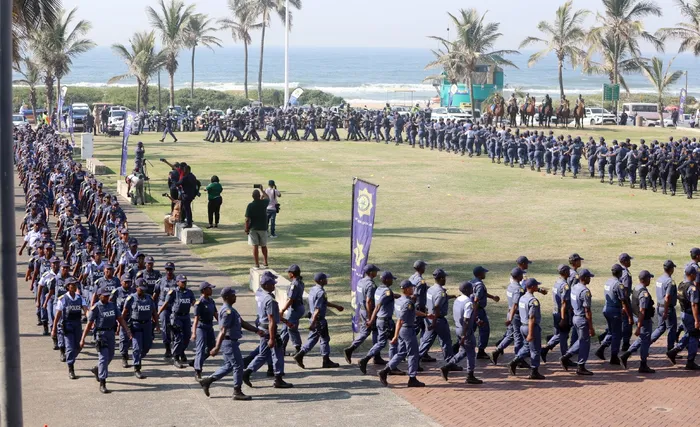
Troops prepare for deployment at the Durban amphitheatre, ensuring public safety during the upcoming demonstrations.
Image: Tumi Pakkies/ ANA Studio
As security tensions rise ahead of the June 30 marches regarding the status of undocumented foreign nationals, government and law enforcement officials have confirmed a significant security deployment across KwaZulu-Natal to ensure public order.
On Sunday, Acting Police Minister Professor Firoz Cachalia, KwaZulu-Natal Premier Thamsanqa Ntuli, KZN acting police commissioner Major General Phumelele Makoba, and divisional commissioner for Visible Policing and Operations Lieutenant General Maropeng Mamotheti sent off troops which will police June 30 marches during a multidisciplinary law enforcement state of readiness parade at the Durban amphitheatre.
Cachalia said the South African Police Service is not being deployed to prevent lawful and peaceful demonstrations.
“We are deployed to ensure that demonstrations, which is our right, take place safely, securely, in an orderly manner that respects the security of the country, its peace and stability and the rights and dignity of all who live in our country which includes, and maybe this is a difficult question for some to admit and accept, that includes the dignity of people in our country who are here illegally,” he said.
He said undocumented migrants are rightly required to leave and be repatriated, but it must be done respectfully.
“The police are here to protect life, safeguard property, prevent criminality, and respond swiftly, should any person seek to exploit the legitimate grievances of our people to commit acts of violence, intimidation, vandalism, incitement to violence on social media platforms, and any other offence under the law,” he said.
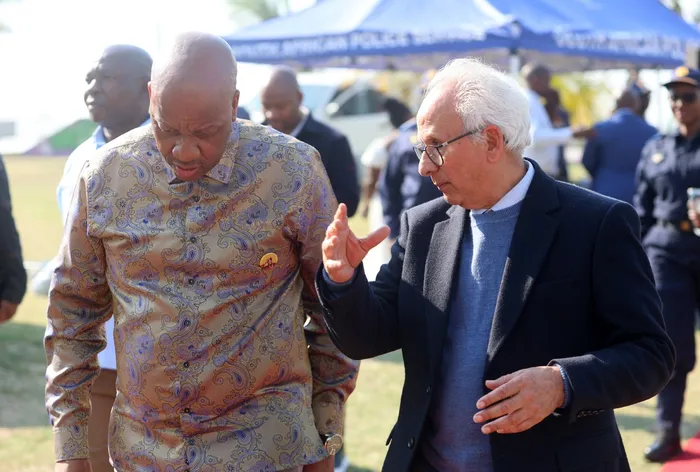
KwaZulu-Natal Premier Thamsanqa Ntuli and Acting Police Minister Professor Firoz Cachalia during a multidisciplinary law enforcement state of readiness parade at the Durban amphitheatre.
Image: Tumi Pakkies/ ANA Studio
Cachalia said marches on June 30 and subsequent days, where participants are exercising their constitutional liberties, can continue under the protection of the law.
“Let’s draw that distinction through a clarity of thought, clearly and unambiguously because I see on many social media platforms, which are also platforms for misinformation and abuse, that the police service are now being pitted against our people. It’s not correct. That’s misinformation, that’s misrepresentation, that’s distortion, that is false,” he said.
He encouraged the police to act decisively where the law is violated, where the rights of other persons to their dignity, their bodily integrity, and their self-respect, their property is under attack and under threat.
“Criminal conduct, regardless of who commits it and under what banner, under what flag, under what justification, must be responded to firmly and lawfully because it’s our responsibility to defend the interests, the well-being of our people,” Cachalia said.
Ntuli said: “There will be heavy presence of the police in all areas in particular where there are hotspots, resources that are employed at a rate which we are convinced as the government of KwaZulu-Natal that they are going to assist us. I would not be divulging the police information in terms of the numbers, how many police and how many members of the army.”
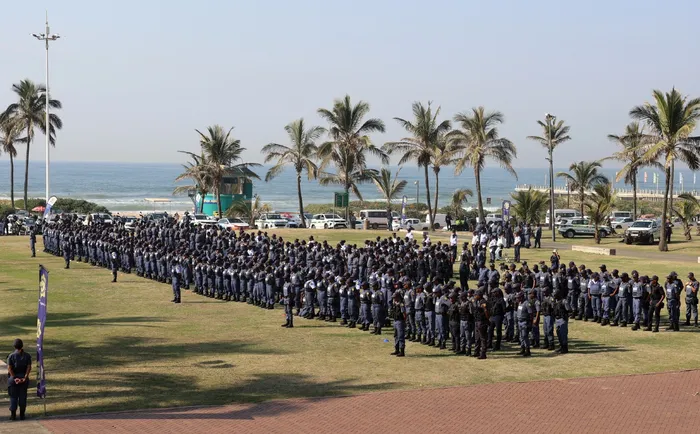
Troops which will police June 30 marches during a multidisciplinary law enforcement state of readiness parade at the Durban amphitheatre.
Image: Tumi Pakkies/ ANA Studio
Acting police commissioner Major General Makoba could not say how many officers would be deployed, but assured the community that police and other law enforcement agencies were already in place.
She said: “We’ve got the maximum number of deployments, and as SAPS, we are collaborating with other agencies, all law enforcement including private security."
She said law enforcement officers are ready to work with marchers on June 30.
“We have issued an instruction to our ground forces, including our communities that partner with us in the fight against crime, that crime must not be committed in their presence.
“We will guard against crimes such as acts of intimidation, incitement, unlawful searching of civilians by fellow civilians, assaults, as well as looting. Anyone found to be committing crime will face the full might of the law,” Makoba said.