

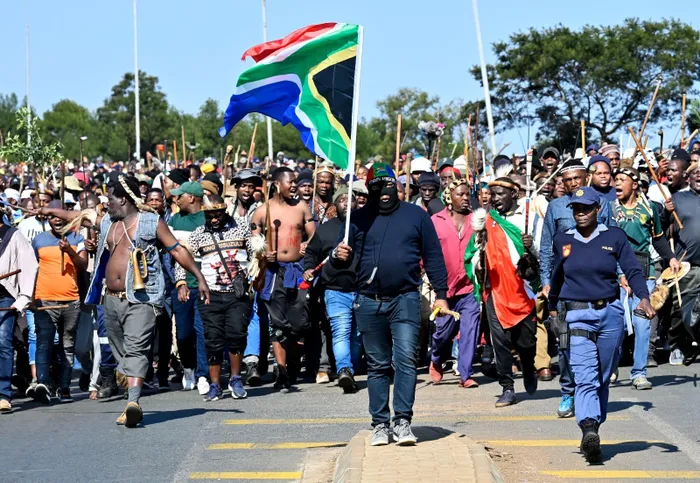
Key moments from South Africa's protests against illegal immigration.
Image: Itumeleng English
South Africa's nationwide illegal immigration protests concluded on Tuesday, 30 June, under a heavy security presence, with authorities reporting that demonstrations across much of the country remained largely peaceful despite weeks of mounting tensions, and the displacement of thousands of foreign nationals.
The marches, organised by groups including March and March, alongside other anti-illegal immigration organisations, followed months of demonstrations demanding tougher action against undocumented migrants. Protest organisers argued that illegal immigration has contributed to rising unemployment, crime, and pressure on public services, and had set 30 June as a symbolic deadline for undocumented immigrants to leave the country.
The government repeatedly stressed that the deadline had no legal standing and that only the state has the authority to enforce immigration laws.
Ahead of the demonstrations, the South African Police Service (SAPS), supported by the South African National Defence Force (SANDF) in identified hotspots, deployed thousands of officers nationwide to prevent a repeat of previous outbreaks of xenophobic violence.
The Inter-Ministerial Committee on Migration reiterated that the government remains committed to enforcing immigration laws through constitutional and lawful means.
"Our objective remains clear, we want a South Africa where immigration laws are respected and enforced, where borders are secure, where communities are safe, where businesses compete fairly, and where human dignity and constitutional values are upheld," the committee said.
By Tuesday evening, Justice and Constitutional Development Minister Mmamoloko Kubayi said the demonstrations had remained "largely peaceful and non-violent", thanking communities, organisers, religious leaders, and law enforcement agencies for ensuring that the protests did not descend into widespread unrest.
Although Tuesday's demonstrations were mostly peaceful, isolated incidents of looting, intimidation, and clashes with police were reported in parts of Gauteng, KwaZulu-Natal, and the Western Cape.
SAPS confirmed the arrest of 10 people after opportunistic looting broke out in Delft. While marches in the Cape Town CBD, Kraaifontein, and other parts of the metro remained largely peaceful, Delft became one of the day's few flashpoints after opportunistic criminals allegedly targeted a shop on Main Road in Voorbrug.
In Gauteng, members of the SANDF were deployed to Hillbrow in Johannesburg following escalating tensions.
SANDF members were deployed in support of SAPS as efforts continued to stabilise the situation and prevent further unrest.
Businesses owned by foreign nationals closed their doors in anticipation of the demonstrations. While isolated incidents of looting, intimidation, and clashes with police were reported in parts of Gauteng, including areas of Johannesburg, authorities said widespread violence had largely been prevented through the extensive security deployment.
In KwaZulu-Natal, five more suspects were arrested for allegedly breaking into tuck shops owned by foreign nationals and stealing goods. Three were caught in the act by private security officers before being handed over to police.
Two additional suspects were arrested in Mountain Rise, while another man was arrested in Melmoth after allegedly robbing foreign nationals at a home while threatening them with a stick.
Police also arrested a woman on charges of assaulting police officers and intimidation, while another man was arrested for intimidation after officers intervened during the alleged assault of a foreign national at an informal settlement in Sydenham.
While the protests concluded without any reported protest-related fatalities, a foreign national died while allegedly hiding from protesters on Margaret Mncadi Avenue in Durban on Monday, 29 June.
It is alleged that three foreign nationals had broken into a storage facility and remained inside the premises for three days.
On Monday night, the group reportedly heard noises and believed they were being targeted.
One of the men allegedly jumped from the eighth floor of the building and sustained serious injuries, including broken limbs. He was declared dead at the scene.
One of the other individuals reportedly fled the scene, while the third remained behind.
The identity and immigration status of the deceased and the other individuals are still being verified by authorities.
Even before Tuesday's demonstrations, thousands of foreign nationals had already begun leaving South Africa amid growing fears of violence.
According to the latest figures, authorities have repatriated 4,286 foreign nationals and deported a further 419 people from affected provinces as part of ongoing enforcement operations.
Meanwhile, the Border Management Authority reported that more than 9,000 Malawian nationals and about 3,000 Zimbabweans had been repatriated or deported through the Beitbridge Port of Entry over a five-day period before the protests.
Separate figures released by the authority showed that more than 8,200 foreign nationals had been processed for repatriation between 12 and 24 June.
March and March leader Jacinta Ngobese-Zuma announced that supporters will take to the streets every Thursday until the government takes action to remove undocumented immigrants from South Africa.
Addressing protesters outside SAPS Point in Durban on Tuesday after thousands marched through the city, Ngobese-Zuma said the campaign would continue weekly until government responded to their demands.
"For as long as they haven't left, we are marching every Thursday," she told supporters.
She also warned that if authorities continued deploying large numbers of police officers to monitor the demonstrations, the cost to the state would continue to rise.
"We hope government has budget for another R600 million," she said, adding that the continued presence of undocumented immigrants would require ongoing security operations.
IOL News