

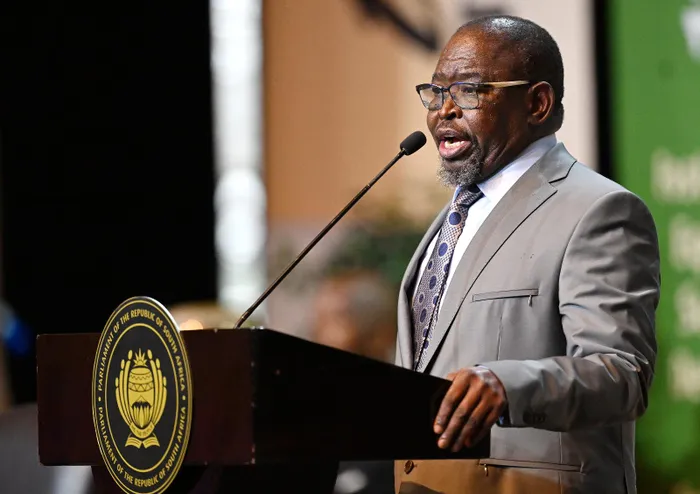
Finance Minister Enoch Godongwana delivered his Medium-Term Budget Policy Statement (MTBPS) last year. Godongwana on Thursday acknowledged growing global and domestic uncertainties, saying Treasury was reviewing its baseline economic assumptions despite signs of resilience in the local economy.
Image: Phando Jikelo/ Parliament of SA
Finance Minister Enoch Godongwana has indicated that National Treasury is reassessing South Africa’s economic growth projections ahead of the Medium-Term Budget Policy Statement (MTBPS) as rising geopolitical tensions and surging oil prices threaten to undermine the country’s recovery.
The National Treasury is currently projecting real gross domestic product (GDP) growth of 1.6% in 2026 and 1.8% over the medium term, reaching 2% by 2028, a significant improvement from the 1.1% in 2025.
Speaking at the Nedbank Top Empowerment Conference, Godongwana on Thursday acknowledged growing global and domestic uncertainties, saying Treasury was reviewing its baseline economic assumptions despite signs of resilience in the local economy.
“We are in the process of assessing our baseline numbers for the Medium-Term Budget Policy Statement on 21 October 2026. Like the global economy, the South African economy is demonstrating some resilience, as the first-quarter figures show,” he said.
Godongwana’s comments come after South Africa recorded stronger-than-expected economic growth in the first quarter of 2026, with GDP expanding by 0.5% quarter-on-quarter on a seasonally adjusted basis and 1.9% year-on-year.
However, economists have warned that the escalating conflict in the Middle East and its impact on global oil markets could force Treasury to lower its current growth forecast of 1.6% for 2026.
In his address, Godongwana noted that the recent Middle East conflict had “triggered sharp increases in energy prices, renewed inflationary pressures, and fueled expectations of tighter monetary policy”.
Investec chief economist Annabel Bishop said South Africa’s first-quarter growth performance reflected improvements in logistics and freight operations, which had previously constrained economic activity.
She noted that the stronger outcome was partly due to a weak comparative base in the first quarter of 2025 when several industries were affected by inadequate rail and port capacity.
According to Bishop, improved freight capacity has since supported economic activity, but emerging risks linked to the Middle East conflict are already weighing on business sentiment and production decisions.
“Higher import costs from oil and oil-related price hikes may have a moderate effect on GDP growth, depending on how long the war in the Middle East lasts,” she said.
Bishop added that Investec had already revised its economic growth outlook for South Africa lower.
“While the economic growth outlook has dropped to 1.3% year-on-year from 1.5% y/y previously, this reflects the negative impact on the trade balance from the doubling in oil and petroleum import costs and weaker investment. Higher inflation will also eat into real expenditure from a purchasing power parity point of view,” she said.
Bishop's assessment suggests that Treasury may need to adopt a more cautious growth outlook when presenting the MTBPS later this year.
Momentum Investments chief economist Sanisha Packirisamy also believes a downward revision to South Africa’s 2026 growth projections is becoming increasingly likely.
“A downward revision of South Africa’s 2026 growth projection is warranted given the mounting pressures on consumer purchasing power, which directly constrain economic activity,” Packirisamy said.
She explained that rising fuel and diesel prices, triggered by global energy market disruptions, were eroding household disposable income while simultaneously raising operating costs for businesses.
“These developments have translated into significant cumulative increases in petrol and diesel prices domestically and consequently higher interest rates, eroding disposable incomes for households and raising input costs for businesses,” she said.
“As a result, consumers are forced to allocate a larger share of their budgets to essential goods like fuel and transport, leaving less for discretionary spending and investment.”
Packirisamy argued that the combination of higher fuel costs, inflationary pressures, persistently high unemployment and weak fixed investment would likely dampen economic activity in the near term.
Despite these challenges, Packirisamy remains optimistic about South Africa’s longer-term prospects, citing the government’s structural reform agenda.
Meanwhile, Godongwana highlighted four key pillars underpinning the country’s growth strategy — macroeconomic stability, structural reforms, infrastructure investment and building state capacity — saying these were beginning to yield results.
He pointed to improved sovereign ratings outlooks from major credit rating agencies and six consecutive quarters of economic expansion as evidence that reforms are gaining traction.
Packirisamy said these reforms, together with efforts to modernise infrastructure, streamline regulations, strengthen public-private partnerships and develop future-focused skills, could support stronger investment and productivity growth over time.
BUSINESS REPORT