

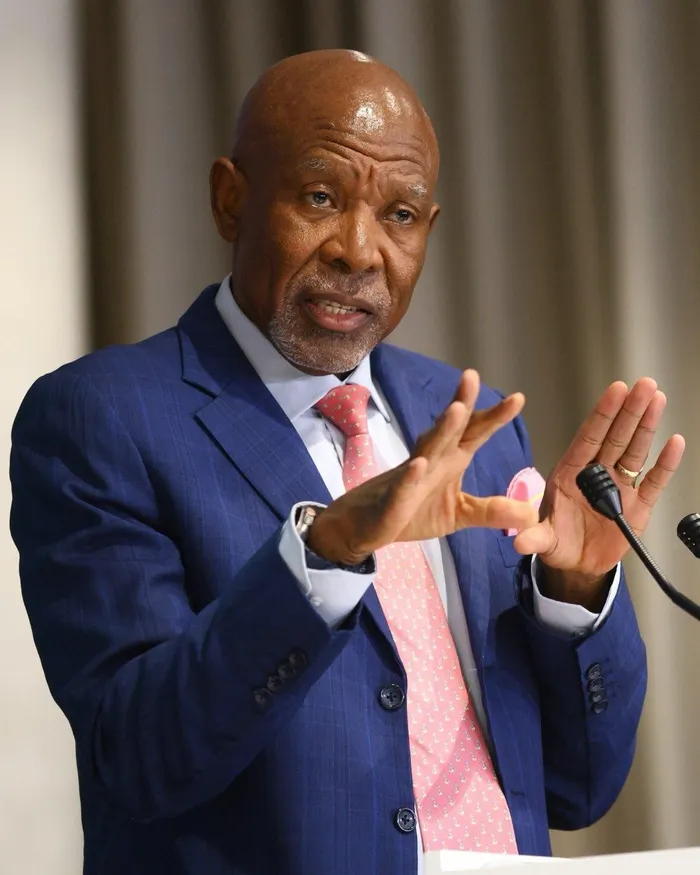
Sarb Governor Lesetja Kganyago said the outlook had deteriorated significantly since the central bank's previous review in November 2025, largely due to the escalating conflict in the Middle East and its impact on the global economy.
Image: Facebook/SARB
The South African Reserve Bank (Sarb) has warned that rising geopolitical tensions, higher oil prices and growing global uncertainty are increasing risks to the domestic financial system, although South Africa remains better positioned than many of its peers to weather the storm.
Speaking at the release of the first edition of the 2026 Financial Stability Review (FSR) on Wednesday, Sarb Governor Lesetja Kganyago said the outlook had deteriorated significantly since the central bank's previous review in November 2025, largely due to the escalating conflict in the Middle East and its impact on the global economy.
"When we released the previous edition of the FSR in November last year, the outlook was positive. South Africa had been removed from the FATF greylist; we had our first sovereign credit rating upgrade in almost two decades; there was growing evidence of progress in implementing structural reforms; and fiscal dynamics were improving," Kganyago said.
However, he noted that global conditions had changed dramatically.
"The Middle East crisis that began in late February is just one of those exogenous shocks, like Covid and the Russia-Ukraine conflict, that you can't really forecast but which nonetheless transform the outlook. We had oil at $60 a barrel, inflation at 3%, and we were cutting rates. Now oil is around $100 a barrel, inflation at 4% and rising, and we have raised rates."
According to the FSR, the conflict has tightened global financial conditions, increased market volatility and weakened growth prospects worldwide. The report identifies intensified geopolitical conflict and policy uncertainty as the biggest risk facing South Africa's financial system over the next year.
Kganyago acknowledged that the outlook was now more adverse than six months ago.
"We must now accept that oil prices will not be back at February levels any time soon. The world economy is in for a bumpy ride, taking South Africa along with it. This reality unfortunately suggests we will see pressure building up in the financial system in the coming months."
Despite the worsening global environment, he stressed that South Africa's financial sector remained resilient and well-capitalised.
"The current shocks seem to be reiterating the lesson we have learnt across many previous shocks: South Africa's financial system is tough. Our big institutions are well capitalised and liquid."
Kganyago pointed to several factors underpinning that resilience, including improved fiscal dynamics, modest external debt levels, limited trade imbalances and record foreign exchange reserves.
The FSR noted that the country's financial institutions remain well-capitalised and liquid despite heightened risks.
Kganyago also announced a new measure aimed at strengthening market stability by making Sarb deposit facilities available to central counterparties (CCPs), institutions that play a critical role in financial market transactions.
"There is no safer and more liquid asset than a central bank deposit, so this step will make our system just that little bit safer," he said.
The governor further highlighted the growing importance of operational resilience, warning that future financial crises could emerge from technological disruptions rather than traditional financial weaknesses.
"My second message is that operational resilience has become a key part of financial stability. We are all used to the traditional risks, like bad loans and bank runs. But the next financial crisis may well result from an operational incident rather than a financial one."
The FSR specifically flagged advances in artificial intelligence as a growing source of risk, particularly through the potential for sophisticated cyberattacks targeting critical financial infrastructure.
Kganyago said South Africa compared relatively favourably with many advanced economies despite the challenging environment.
"In absolute terms things are worse than they were six months ago – but in relative terms, South Africa is not faring so badly. The exchange rate has been surprisingly stable, and our terms of trade are still quite favourable. Our long-term borrowing costs are trending down not up, in contrast to those of most developed countries."
He added that South Africa's greatest long-term challenge remained its weak growth potential, but expressed confidence that ongoing reforms in electricity, rail, logistics and local government would gradually improve economic performance.
"South Africa's biggest problem is that our growth capacity is very low. This is slowly being addressed with reforms that get cities working again, that get network sectors like rail and electricity functioning like they should, and that control costs."
Concluding his remarks, Kganyago said the country's financial system had repeatedly demonstrated its ability to withstand crises.
"Our financial system is nothing if not battle-tested. The famous American economist Hyman Minsky used to say that 'stability is destabilising', because complacency kicks in. I can say confidently, we have not had this problem."
BUSINESS REPORT