

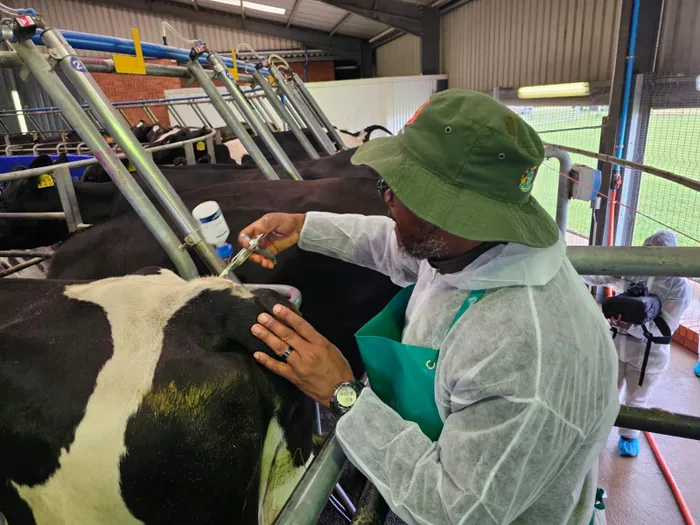
Agriculture Minister John Steenhuisen has already indicated in a press conference that at least 4-million of these 14-million vaccines will be distributed through government channels. But farmers are also going to need access directly through veterinarians.
Image: X
Andrew Morphew
As Foot-and-Mouth Disease (FMD) continues to spread across SA, infecting thousands of cattle and causing millions of rand in losses, there is at least one point on which both the government and farmers agree: the disease must be brought under control.
The ultimate goal is for SA to regain FMD-free status from the World Organisation for Animal Health (WOAH), allowing beef exports to resume and signalling that the disease is no longer circulating among livestock- causing untold suffering.
To do this the private sector and the government need to be able to work together.
The question is how to get there.
Unfortunately, relations between the state and commercial farmers have become increasingly adversarial. Farmers and agricultural organisations were forced to turn to the courts after the government refused to allow private-sector vaccination efforts.
The tensions between the government and the agricultural sector obscure a simple reality: South and central American countries that have successfully controlled FMD rely on both the government and the private sector. Each has a distinct role to play.
If SA is serious about eradicating FMD, it needs a practical partnership rather than a legal standoff.
The court found that vaccination by private parties is not clearly prohibited by law. The first challenge commercial farmers face, now that they are allowed to vaccinate is vaccine access.
The latest batch of 14 million vaccines is expected within the country in about three months. Agriculture Minister John Steenhuisen has already indicated in a press conference that at least 4-million of these 14-million vaccines will be distributed through government channels.
But farmers are also going to need access directly through veterinarians.
Some reports, that have been circulated widely among farmers, have suggested the emergency Section 21 import permit, allowing these vaccines, will not allow the private purchase or private sale of vaccines. A close examination of the permit shows this is not true. The permit gives the
Director of Animal Health licence to direct vaccines to whoever he chooses.
In fact, the department of agriculture has already provided vaccines to the private sector by offering them to certain organisations. Instead of vaccines being offered to select organisations, they should be widely available at private veterinarians.
Currently, commercial farmers rely entirely on the government deciding who gets vaccines when and at the current slow pace of vaccination this is entirely unsatisfactory. Restricting distribution to selected organisations, as is currently the case, or state-controlled channels gives the government control over who receives vaccines and when. Some select farmers have had access to vaccines, but plenty have not. This inequitable approach does not necessarily maximise the speed or scale of vaccination.
In fact, in the last few weeks of May, KwaZulu-Natal provincial authorities did not make vaccines available to commercial beef farmers, leaving 90% of commercial beef cattle unvaccinated in that province - underscoring the need to make sure private veterinarians can access and sell vaccines to all farmers. The private sector should be allowed to purchase, distribute and administer vaccines through veterinarians and existing agricultural supply networks. Farmers already vaccinate their animals against numerous diseases buying vaccines from vets. FMD should not be treated differently. Legally, there is nothing stopping the Director of Animal Health ensuring widespread access to the vaccine.
In a show of good faith, the government could also make more vaccines currently in South Africa available to the private sector.
An estimated two-million vaccine doses from Turkish manufacturer Dollvet are expected to arrive in South Africa imminently. FMD Response SA has called on the government to make these vaccines available to private veterinarians and farmers. Those requests, made publicly in a press statement and directly to the minister of agriculture, have so far gone unanswered.
It is important to point out allowing private-sector participation in vaccination does not mean the government has no role.
In fact, the government's role becomes even more important.
The state should make vaccination compulsory and establish strict vaccination windows. Vaccination campaigns need to occur within a limited period, a maximum of two months, to create simultaneous herd immunity across regions.
The objective is therefore not merely to vaccinate individual animals over many months, but to vaccinate enough animals at the same time to dramatically reduce viral circulation.
Epidemiological modelling suggests that around 80% of cattle require simultaneous immunity to interrupt transmission effectively. Achieving that level of protection may require close to 100% vaccination coverage in a short space of time to account for animals that fail to develop immunity and the few that may be overlooked.
If vaccination is staggered over many months as it currently is, the virus simply finds new hosts and continues spreading.
Even vaccinated cattle can become infected if exposed to exceptionally high viral loads making simultaneous immunity even more important.
The government is uniquely positioned to ensure communal cattle herds are vaccinated.
Provincial and national authorities must also maintain auditable records that will ultimately be required by WOAH when SA seeks to regain FMD-free status.
In other words, the government should regulate, coordinate and verify.
What it should not do is unnecessarily interfere in the private sector's ability to purchase, distribute and administer vaccines.
SA faces stark choices.
It can allow FMD to become endemic. It can pursue eradication and work towards restoring FMD-free status and reopening export markets. Or it can continue with the current approach and allow the disease to spread further, imposing ever-greater economic losses and animal suffering.
The solution is neither purely state-led nor purely private.
Winning the fight against FMD requires clearly defined roles, mutual trust and a shared commitment to getting vaccines into cattle as quickly as possible.
Right now, farmers are willing to vaccinate. The problem is that many still have nowhere to obtain the vaccines.
That is a problem the government can solve immediately.
* Andrew Morphew is a commercial dairy farmer and spokesperson of FMD Response SA - a group of commercial dairy, beef and pig farmers who formed to encourage private sector involvement in beating Foot-and-Mouth Disease.
Image: Supplied
* Andrew Morphew is a commercial dairy farmer and spokesperson of FMD Response SA - a group of commercial dairy, beef and pig farmers who formed to encourage private sector involvement in beating Foot-and-Mouth Disease.
** The views expressed do not necessarily reflect the views of IOL or Independent Media.
BUSINESS REPORT