

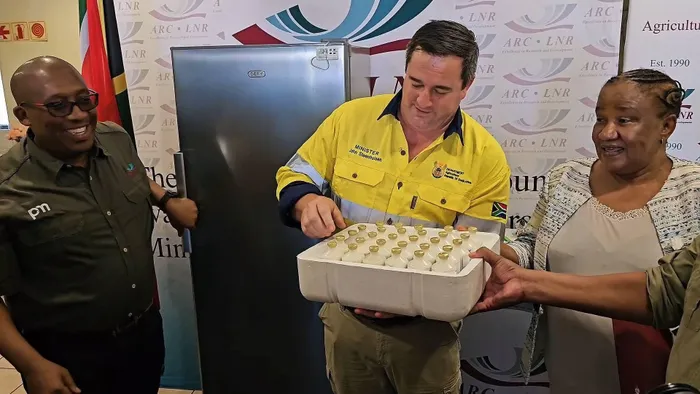
Minister of Agriculture John Steenhuisen receiving a batch that is part of 13.5 million doses of FMD vaccines received in just four months.
Image: Supplied
The KZN Agricultural Union (Kwanalu) has cautiously welcomed a recent Gauteng High Court ruling relating to the private procurement and administration of Foot and Mouth Disease (FMD) vaccines.
However, the union on Thursday warned that the judgement should not be interpreted as immediate approval for unrestricted vaccine imports or rollout.
The ruling, handed down on Monday is being viewed by the agricultural sector as a potentially significant development in efforts to improve South Africa’s response to recurring FMD outbreaks, particularly in KwaZulu-Natal where livestock producers continue to battle vaccine shortages and ongoing disease pressures.
However, Kwanalu stressed that several legal, regulatory and operational hurdles still remain before any practical implementation can occur.
“The ruling represents an important legal development in the ongoing effort to strengthen South Africa’s FMD response, particularly in KwaZulu-Natal, where producers continue to face severe pressure from vaccine shortages, uneven vaccine access, and ongoing outbreaks,” Kwanalu noted.
Kwanalu chairperson PJ Hassard said producers and stakeholders should avoid drawing premature conclusions about the immediate impact of the judgement.
“While the judgement is a positive development in principle, it is important that the industry remains cautious in how it interprets the ruling. This matter is far from implementation,” Hassard said.
“The government still has an opportunity within the next 20 days to submit changes or respond further to aspects of the ruling, and there are additional legislative and regulatory processes that would still need to take place before any expanded vaccine access framework becomes operational.”
Hassard added that one of the most critical considerations remains traceability and the control measures required for a regulated animal disease such as FMD.
“FMD vaccine management cannot operate without proper oversight and monitoring. One of the biggest challenges is maintaining a reliable paper trail and traceability system for every vaccinated animal and owner,” he said.
“There would need to be clear regulatory controls, including mechanisms such as a new Section 21 process and proper Veterinary Services oversight, to ensure accountability, vaccine integrity, and credible disease management. This cannot become an unmonitored process.”
Kwanalu said that FMD remains a controlled animal disease and that any vaccine procurement, handling, and administration would still need to occur within a coordinated and regulated veterinary framework.
The organisation also cautioned against misinformation and premature assumptions surrounding the ruling.
Hassard added that in situations like this, misinformation spreads very quickly. “Producers are understandably desperate for workable solutions, but it is important that communication around the ruling remains factual, responsible, and grounded in the actual legal and regulatory realities.”
Hassard said that Kwanalu will continue to engage constructively with government, veterinary services, and industry stakeholders to ensure that producers receive credible, fact-based information as this process develops.
He said that Kwanalu has consistently raised concerns around vaccine shortages and uneven vaccine access in KwaZulu-Natal, warning that prolonged limitations in vaccine availability threaten food security, market stability, and the sustainability of the livestock sector.
“The organisation maintains that practical, science-based, and properly regulated solutions remain essential if South Africa is to strengthen disease control and stabilise the outbreak effectively,” Hassard said.
BUSINESS REPORT