

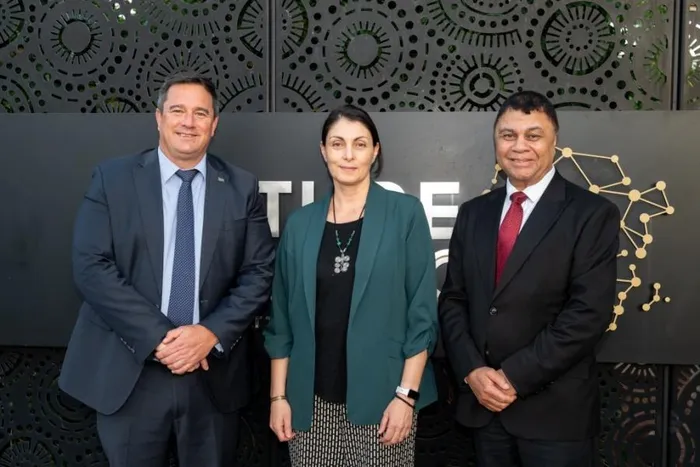
Minister of Agriculture John Steenhuisen, Professor Armanda Bastos, director of the Hans Hoheisen Research Centre in the Department of Veterinary Tropical Diseases at the UP, and Dr Peter Evans, appointed lead veterinarian of the RMIS Operational Centre.
Image: Supplied
A new study conducted by researchers from the University of Pretoria (UP) in partnership with Red Meat Industry Services (RMIS) and Zoetis has produced findings that could significantly reduce costs for South Africa’s livestock and meat-processing sectors while improving the management of Foot and Mouth Disease (FMD).
The research found that offal meat from recovered cattle previously infected with FMD tested negative for the disease, raising questions about the necessity of some of the strict slaughter requirements currently imposed on producers and abattoirs.
The study was led by Professor Armanda Bastos, director of the Hans Hoheisen Research Centre in the Department of Veterinary Tropical Diseases at the UP. The project, known as the 5th Quarter Research Project, examined whether certain parts of cattle slaughtered after recovering from FMD continue to pose a disease risk.
The project’s name refers to parts of the carcass—including the head, feet, tongue and offal—that currently must be discarded or specially treated when cattle from FMD-infected premises are sent for controlled slaughter.
The study focused on cattle that had fully recovered from infection and were slaughtered after the mandatory waiting period designed to minimise disease transmission risks.
Bastos explained the origins of the study and the extensive testing process involved.
“Together with partners from the private and public sectors, 1,800 samples were collected from 90 cattle, sent for early slaughter at day 16 post Day Zero, and analysed for FMD virus,” she said.
“All 90 cattle had been infected with the virus and were vaccinated 7-9 days later in order to identify Day Zero, which is defined as the day that the last animal was vaccinated or the day that the last animal showed clinical signs, whichever of the two comes last.”
One of the most important findings from the research relates to the current requirement that carcasses from recovered animals undergo deboning before entering the market. According to the study, laboratory testing found no evidence of the virus in bone marrow samples.
“This is a significant finding because the current controlled slaughter regulations mandate deboning, which is expensive and difficult to carry out and represents a major cost and logistical burden for the industry,” she said.
“These results showed it is unnecessary for slaughterhouses to carry out deboning, deglanding, or to dispose of the tongue or offal when fully recovered cattle are sent for slaughter at day 16 post Day Zero, as regulations currently require.”
The implications could be substantial for abattoirs and meat processors, many of whom face significant costs associated with compliance with existing regulations.
Bastos said that a further proposal is to introduce one controlled slaughter phase rather than the current two.
“The single phase should be carried out between 16 days and three months after “Day Zero” has been declared. In the next phase of the research, the focus will be on what are considered to be high-risk sites in the head where the virus has been shown to persist at low levels in cattle that become carriers.”
While the study offers encouraging news for the livestock industry, Bastos cautioned that South Africa still faces a long journey toward regaining its previous FMD-free status.
“To regain its former FMD-free status, the country would need to vaccinate 80% of its 14 million cattle, representing a massive outlay of resources,” she said.
Bastos added that it would also be vital to dramatically increase laboratory capacity for post-vaccination monitoring, as this would add to an already overburdened diagnostic system.
“Other priorities are to protect FMD-free buffalo from “reverse infection” by cattle, to address FMD in pigs and the slaughter regulations that apply to them, and to consider establishing regional approaches to ensure the strategic allocation of vaccines to areas where they will have the greatest impact.”
Meanwhile, Dr Peter Evans, appointed lead veterinarian of the RMIS Operational Centre, outlined plans for vaccine distribution as part of the national FMD vaccination campaign.
“The RMIS data exchange platform, and specifically the vaccine ordering portal, has been appointed by the department to facilitate ordering and distribution logistics,” he said.
“Livestock industry bodies, such as the Red Meat Producers Organisation, will collate vaccine requirements from their members. Orders for allocated vaccines must then be placed on the portal by the farmer's veterinarian or veterinary practice.”
He added that the process will be tracked using QR-code technology and linked to farm location identifiers to ensure accurate distribution and reporting of vaccination coverage across the country.
BUSINESS REPORT