

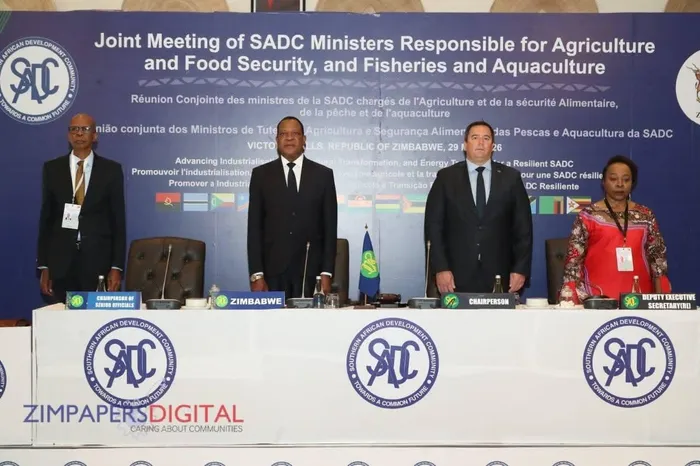
The Joint Committee of the Southern African Development Community (SADC) Ministers of Agriculture and Food Security, Fisheries and Aquaculture at the ministerial session held in Victoria Falls, Zimbabwe, on Friday looked at challenges facing the region such as food security, agricultural production and animal health.
Image: Department of Agriculture Facebook page
Southern African Development Community (SADC) ministers have called for greater regional cooperation to strengthen food security, improve agricultural productivity and combat the growing threat of animal diseases, as the region grapples with economic uncertainty and climate-related challenges.
Addressing the Joint Committee of SADC Ministers of Agriculture and Food Security, Fisheries and Aquaculture in Victoria Falls, Zimbabwe, Minister of Agriculture John Steenhuisen on Friday said the issues under discussion directly affect the daily lives of millions of people across the region.
“Food security, agricultural production, animal health, fisheries, and rural livelihoods are not abstract policy discussions," he said.
“They determine whether families can afford food, whether farmers can remain productive, whether young people can find economic opportunity, and whether our region can withstand an increasingly uncertain global environment."
Steenhuisen noted that the meeting was taking place amid significant geopolitical and economic volatility, marked by supply chain disruptions, rising fertiliser costs, inflationary pressures and growing competition for strategic resources.
He warned that these global challenges are increasingly overlapping with climate-related disasters, including droughts, floods and disease outbreaks, placing additional pressure on agricultural systems across Africa.
Although recent regional assessments indicate an improvement in cereal production and food security compared to the severe drought conditions experienced in the previous season, Steenhuisen said approximately 58 million people across SADC member states continue to face acute food insecurity due to challenges related to food access and affordability.
“One area where I believe we can no longer afford delay is the harmonisation of the Fertiliser Regulatory Framework across SADC,” he said.
A key issue highlighted by Steenhuisen was the need to accelerate efforts to harmonise fertiliser regulations across the SADC region. He argued that recent global crises, including the COVID-19 pandemic, the Russia-Ukraine conflict and instability affecting Middle Eastern shipping routes, have exposed the region’s vulnerability to fertiliser supply disruptions and price shocks.
Steenhuisen urged member states to fast-track the proposed Memorandum of Understanding on the Harmonisation of Fertiliser Regulatory Frameworks, rather than waiting until 2027.
“This is not simply a technical regulatory exercise. It is a food security imperative, a productivity imperative, and increasingly a strategic resilience imperative for the entire region.”
According to Steenhuisen, a harmonised fertiliser framework would improve investment certainty, enhance fertiliser availability and affordability, support regional production capacity and shield both smallholder and commercial farmers from future external shocks.
He also stressed the importance of building resilient and sustainable food systems through regional coordination.
Referring to South Africa’s presidency of the G20, Steenhuisen said the country had promoted an Ubuntu-based approach to food security, recognising that the resilience of one country is closely linked to that of its neighbours.
“If we are serious about food security and economic growth in Southern Africa, then agricultural transformation cannot remain an aspiration. It must become a measurable regional growth strategy rooted in execution, competitiveness, and regional cooperation.”
Steenhuisen said that the scale of the current Foot and Mouth Disease (FMD) outbreaks across Southern Africa should concern everyone.
“Eleven SADC Member States have reported outbreaks, with severe consequences for livestock production, rural livelihoods, trade, and regional food systems,” he said.
“For many families across our region, livestock are not simply commercial assets. They are stores of wealth, sources of nutrition, draft power, school fees, and household survival. When animal disease spreads unchecked, the impact reaches far beyond the farm gate.”
Steenhuisen welcomed SADC’s decision to prioritise the development of a Regional Coordination Framework for FMD control, emphasising that animal diseases cannot be effectively managed through isolated national responses.
He said that one of the recommendations currently under consideration is the establishment of a SADC Regional FMD Vaccine Bank.
“The principle behind such a mechanism is straightforward: preparedness is always less costly than prolonged outbreaks and delayed responses,” he said.
“International experience from regions that have successfully managed FMD demonstrates that regional cooperation, coordinated vaccine access, and rapid deployment capacity are essential components of long-term disease control.”
BUSINESS REPORT