

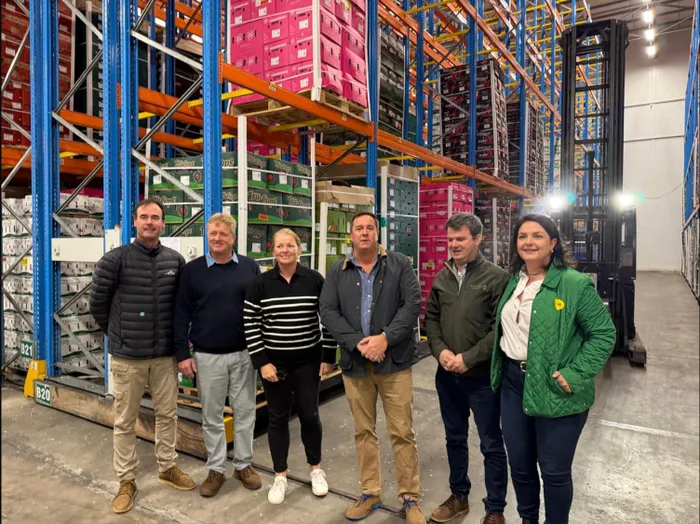
The storm and flooding crisis in the Western Cape prompted a visit this week by the Minister of Agriculture John Steenhuisen to the Ceres region to assess the impact on the apple and pear industry and surrounding farming communities.
Image: Supplied
Severe storms that battered the Western Cape province last week have triggered a major electricity and infrastructure crisis in the province’s agricultural heartland, placing hundreds of thousands of tonnes of export fruit and thousands of jobs at risk.
Tru Cape Fruit Marketing on Tuesday warned that the Witzenberg region is facing a critical power shortage after between six and 10 electricity pylons collapsed in the Waaihoek area between Wolseley and Worcester during the storms.
The damage has left the region with severely constrained electricity supply at a time when more than 300,000 tonnes of freshly harvested export fruit are being stored in cold rooms that depend on uninterrupted power to maintain quality standards for international markets.
The crisis prompted a visit this week by the Minister of Agriculture John Steenhuisen to the Ceres region to assess the impact on the apple and pear industry and surrounding farming communities.
Industry leaders told Steenhuisen that the estimated four-week repair timeline for the damaged electricity infrastructure poses a major threat to the fresh fruit sector, which relies heavily on refrigeration, packhouses and processing facilities.
Pieter Graaff, chairman of Tru-Cape, said the destruction caused by the storms would have severe long-term consequences for the agricultural economy.
“The storm’s impact has been catastrophic. As rivers swelled, roads, homes and lives were swept away. The damage to infrastructure will take years to repair and cost billions of rand. This disaster has set our province back significantly, but with strong leadership, we will prevail,” he said.
Graaff warned that there are more than 300,000 tons of freshly harvested export fruit currently in cold storage that require electricity to maintain market quality.
“There is insufficient generator capacity to keep these cold stores operational, while diesel costs are placing enormous financial pressure on businesses. If the fruit deteriorates, it cannot be packed, which could result in thousands of job losses and major export revenue losses.”
Graaff said that the town is currently receiving electricity from an alternative source, but that it supplies only approximately 15% to 20% of the area’s total demand.
He added that Ceres Fruit Processors faces mounting pressure, as the facility still needs to process more than 100,000 tons of apples and pears into concentrated fruit juice while operating on costly generator power.
Meanwhile, Steenhuisen undertook to engage with both Western Cape government officials and national counterparts to escalate these issues, identify solutions, and assist the industry.
Steenhuisen said he was impressed by the determination and resilience shown by farmers and communities during this difficult period, committed to ensuring they receive the necessary support and relief.
“Help is on the way. Moving forward, it is critical that the government remains nimble and adaptable in the face of an increasingly volatile climate, and that all future investment in infrastructure and development is undertaken in a sustainable and resilient manner to protect local economies and the livelihoods they support,” he said.
Dr Ivan Meyer, Western Cape MEC for Agriculture, Economic Development and Tourism, said the storms had caused widespread agricultural and infrastructure damage across the province.
“In addition to crop losses, farms have sustained serious infrastructure damage. Irrigation systems, access roads, and bridges have been compromised, while power disruptions have affected irrigation, storage, and packhouse operations. In several instances, farms have been cut off entirely due to flooded rivers and damaged transport routes,” he said.
Meyer added that several farming areas had been completely cut off due to flooded rivers and damaged roads, while export supply chains for fruit and wine were expected to face disruptions.
”Delays in harvesting and transport are likely to reduce yields, affect export quality, and increase financial losses across the sector," he said.
"In several affected areas, contractors have already been appointed to begin repairing critical road infrastructure. Mopping-up operations, including the clearing of roads and ongoing humanitarian support, will continue as part of the coordinated provincial response.”
Meanwhile, Standard Bank announced a R1 million donation to the South African Red Cross Society to support flood relief efforts in affected provinces, including the Western Cape.
BUSINESS REPORT