

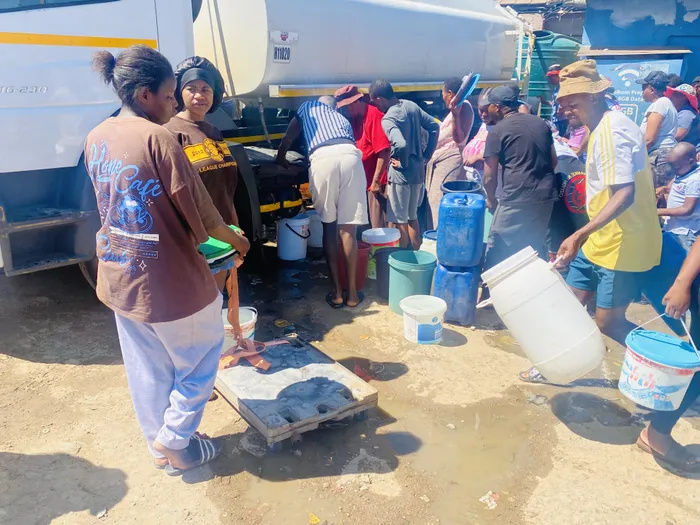
President Cyril Ramaphosa has launched the National Water Action Plan, a government strategy aimed at tackling South Africa's worsening water crisis by addressing failing municipal infrastructure, reducing leaks, attracting investment, and cracking down on corruption in the water sector.
Image: Simon Majadibodu / IOL
As more than 2,000 water experts, engineers, policymakers, and municipal leaders gather in Cape Town this week for Southern Africa's largest water conference, President Cyril Ramaphosa has unveiled an ambitious National Water Action Plan aimed at overhauling the country's failing water systems, tackling corruption, and ending chronic water outages.
The plan, released on Thursday following a meeting of the National Water Crisis Committee (WATERCOM), comes as delegates at the Water Institute of Southern Africa (WISA) 2026 Biennial Conference and Exhibition discuss practical solutions to South Africa's ageing infrastructure, deteriorating municipal water services, and growing climate-related water security challenges under the theme "Rethink Amanzi – Securing Our Future".
The government said the National Water Action Plan sets out a coordinated programme of short-, medium-, and long-term interventions designed to ensure a reliable supply of quality water while addressing the structural failures that have left many communities facing recurring water outages.
"By acting boldly and decisively to improve the performance of Eskom and reform our energy system, we were able to end load shedding and achieve a secure and reliable energy supply," Ramaphosa said.
"Now, we are applying the same approach to the water crisis that has been unfolding in many parts of our country. The National Water Action Plan outlines a clear, practical and focused approach to ensure water security for all South Africans, no matter where they live."
The Presidency stated that the action plan was developed by WATERCOM, which was established following the president's 2026 State of the Nation Address, to coordinate the government's response to increasingly severe water supply interruptions affecting municipalities across the country.
According to the plan, the country's biggest challenge is not a lack of water resources, but failing municipal systems that are unable to reliably deliver water to households and businesses.
"The real challenge lies not in the availability of water, but in getting water to people's taps," the document states, adding that continuing with the current delivery model is no longer sustainable.
The report paints a stark picture of the country's water sector.
It found that 74% of water services authorities scored either poor or critical in national drinking water or wastewater assessments, while 46% of municipal water systems recorded poor or bad microbiological water quality compliance in 2023, compared with just 5% in 2014.
It also found that 81% of municipal wastewater infrastructure is in poor or critical condition and that nearly half of all treated water is lost before reaching consumers through leaks, theft, or faulty metering.
To reverse the decline, the government has identified five priority areas.
These include:
One of the most significant reforms will require municipalities to ring-fence revenue generated from water sales so that it is spent exclusively on maintaining and expanding water infrastructure instead of funding other municipal functions.
The government also plans to amend the Water Services Act to separate municipalities' oversight role from the actual provision of water services by introducing licensed water service providers that will be required to meet minimum technical standards.
The plan also seeks to unlock greater private sector investment in water infrastructure.
The Department of Water and Sanitation is developing a pipeline of projects for private sector participation, with at least three expected to be brought to market before the end of the year.
Meanwhile, the National Treasury is establishing an Infrastructure Finance and Implementation Support Agency to help accelerate investment in critical water projects.
The government said corruption and criminality have become major contributors to the country's water crisis.
The action plan specifically targets water tanker mafias, infrastructure theft, vandalism, and procurement corruption, with these crimes set to be tackled through the National Joint Operational and Intelligence Structure (Natjoints) working alongside law enforcement and anti-corruption agencies.
The document also identifies several major infrastructure projects expected to be completed by the end of 2026, including R1.7 billion in upgrades to water pump stations and water treatment works in George in the Western Cape, alongside large-scale water supply projects in KwaZulu-Natal, Limpopo, Mpumalanga, North West, and the Eastern Cape.
WATERCOM, chaired by Ramaphosa, will meet regularly to oversee implementation of the plan, monitor progress, and hold government departments and agencies accountable for delivery.