

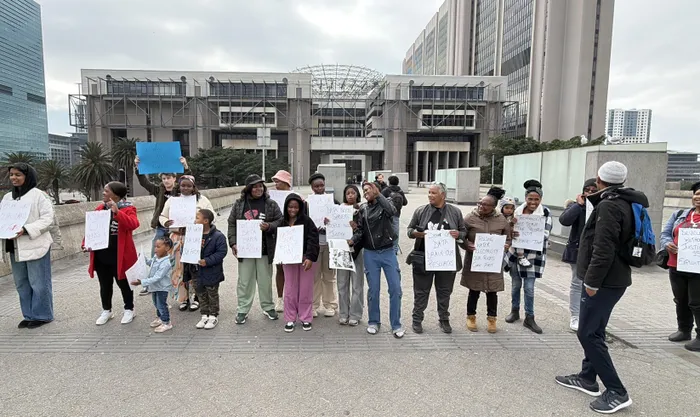
Activists outside Cape Town Civic Centre raising awareness about the need for more information on the construction of data centres in communities.
Image: Fouzia van der Fort / Supplied
The Department of Water and Sanitation said that while there’s no need to panic over plans for data centres in Cape Town, the municipality must inform its residents that the data centres will be paying for their water usage.
Concerns and questions have been raised after the City of Cape Town’s Municipal Planning Tribunal (MPT) supported an application for the rezoning of a hyperscale data centre development at King Air Industria.
The application paves the way for two new data centres totalling more than 120,000 square metres.
According to reports, the land use, subdivision, and consolidation application by King David Country Club, which owns the area known as King Air Industria, neither makes mention of how much water the giant data centres will use, nor does it detail energy supply and demand.
In a statement, the City of Cape Town said the MPT approved the application, but it is subject to several conditions. It added that it will issue a formal notice of the decision once it is possible.
The city stated that anyone who submitted a valid objection during the statutory public participation process will receive the decision and information on how to appeal.
Once an appeal is submitted, it will be considered through the city's prescribed appeal process before a final decision is made. If the approval is not appealed, the development cannot proceed immediately.
“The applicant must still obtain additional approvals, including the submission and approval of a Site Development Plan. As part of that process, detailed technical matters, including the provision of engineering services and infrastructure, must be assessed by the relevant city departments before any further approvals are granted.
The city noted concerns over water use, electricity demand, and environmental impacts, saying that these all “form part of the planning and regulatory processes, and are considered in accordance with the applicable legislation and technical requirements”.
While at the flagship WISA 2026 Biennial Conference & Exhibition, organised by the Water Institute of Southern Africa (WISA), which brings together delegates from across the water sector, departmental spokesperson Wisane Mavasa said that there is no need to panic, but that municipalities must be responsible.
“The department is responsible for raw water that gets allocated to all industries, all water users. Municipalities are among the water users that would have a licence, a water use licence, taking raw water from our system, and they use it according to their needs,” Mavasa said.
“Now, from the department's point of view, we only have two data centre applications for water use licence - for raw water specifically. How municipalities allocate those data centres their water must be the very same water that would've been allocated from the water use licence, if they have it available.
“However, they (data centres) must also make sure that, as they do so, it does not impact on water provision to communities. Because, at the same time, it benefits the municipality, it benefits development of that particular municipality, but at the same time there needs to be that balance.
“These data centres, when they apply for this licence, they don't apply to the department when they want water directly from the municipality; they must apply for it from the municipality,” Mavasa said.
She said that the data centres would not escape without paying their due as “if they would like to increase their water use licence, there is a process in place that they are aware of, which they need to apply for an increase from the department”.
“Because we’ve only received two water use licence applications, that indicates the demand is not that steep, and we are informed that in terms of the research that has been conducted, they are not using huge quantities of water, and that water gets reused within their system. So there’s really no need for panic.”
Mavasa urged water services authorities and municipalities to educate their communities on the purpose and significance of data centres in the nation’s development.
Furthermore, he highlighted the importance of disclosing the volume of water these facilities consume and confirming that they pay for it. From the department's standpoint, she emphasised that the water allocated to data centres must not compromise other economic and socioeconomic factors in the country.