

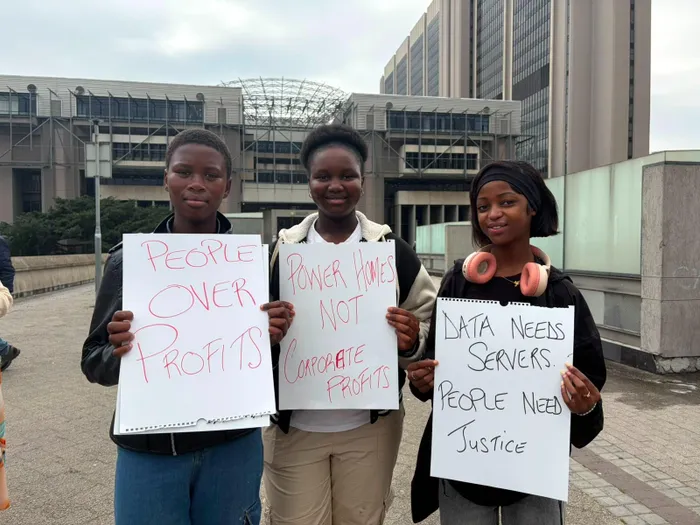
The City of Cape Town's Municipal Planning Tribunal has approved a contentious rezoning application for a new hyperscale data centre by Equinix, despite significant opposition from local groups concerned about environmental and community impacts.
Image: Supplied / Legal Resources Centre
The City of Cape Town’s Municipal Planning Tribunal (MPT) has supported an application for the rezoning of a hyperscale data centre development at King Air Industria despite opposition by Housing Assembly and Foxglove, who submitted that “people cannot eat or drink data, or network and connectivity”.
This is for a second data centre by Equinix.
They submitted a rezoning application from “Mixed Use” to “General Industrial” for the proposed development, which forms part of plans for a 174 MVA data centre facility at King Air Industria (KAI) - an industrial development on land owned by the King David Golf Club.
The Housing Assembly and Foxglove argue that the application does not provide adequate information about water consumption, electricity demand, emissions, diesel generators and fuel storage, air pollution, cooling systems, and the design and scale of the proposed buildings.
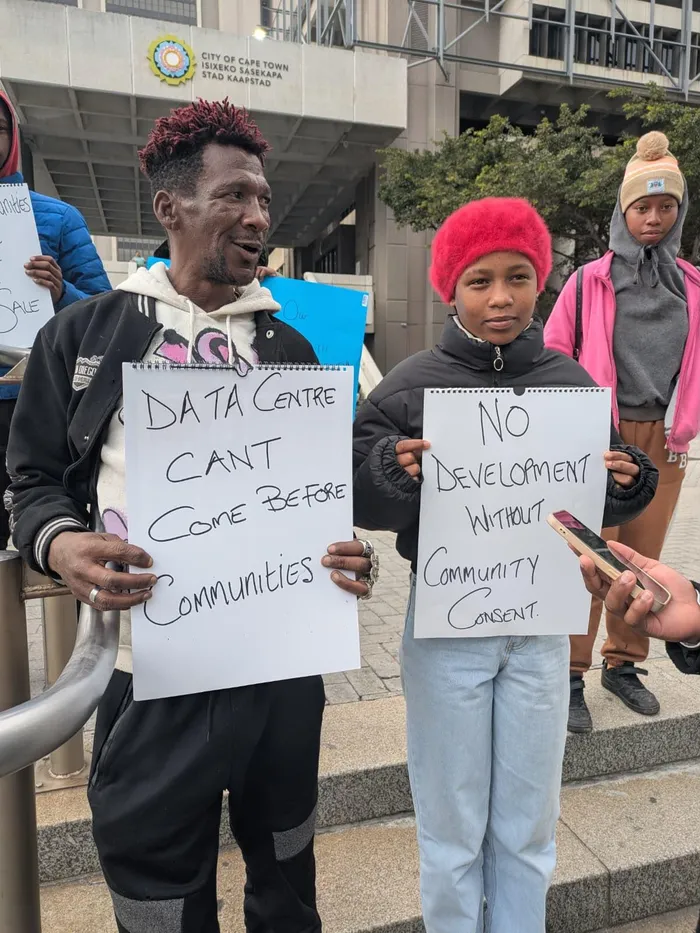
Members of the Housing Assembly demonstrated outside the Cape Town Civic Centre on Tuesday, as the City of Cape Town Municipal Planning Tribunal heard objections concerning a proposed 174 MVA hyperscale data centre development at King Air Industria.
Image: Supplied / Legal Resources Centre
They submitted that critical information remains unavailable.
Making submissions for Equinix to the MPT, Lisa van Aarde said the digital infrastructure proposed will enable the digital industry in Cape Town to thrive and flourish.
Van Aarde added that the KAI developer and Equinix are “fully committed to ensuring that development within KAI proceeds strictly in accordance with the provisions of the applicable legislated environmental and planning regimes”.
“To assume otherwise, as was done by the objector, is grossly unfair and contributes nothing to ensuring a transparent and procedurally fair development environment… The level of detail included in the current application is deemed to be appropriate and sufficient for the decision maker to assess and decide upon the application.
“All of the technical and design considerations will form part of the future Site Development Plan (SDP) application. If any requirement for additional information as mentioned by the objector is triggered in terms of National Environmental Management Act (NEMA), the Municipal Planning By-law (MPBL) or the National Building regulations, they will be prepared and submitted for approval to the appropriate decision maker at that stage,” said Van Aarde.
Making submissions for the objectors, Kimal Harvey from the Legal Resource Centre (LRC), said the definitional vagueness in the city’s by-laws is unhelpful to the MPT for its decision-making process.
Harvey said this was because the considerations for the rezoning and amendment of basket of rights for a micro-data centre as opposed to a hyperscale data centre are vastly different.
The objectors said the applicants failed to provide substantive information necessary to enable the MPT to “assess the desirability, socio-economic, and environmental impacts of this development on the general public and surrounding communities”.
The LRC argued that the MPT should reject the rezoning application outright and that the applicants should make a fresh application, which would provide significantly more information with respect to the potential impact this kind of proposed data centre will have on the surrounding communities and the general public.
On whether they would appeal the decision by the MPT to support the recommendation for approval, Harvey said: “We will be discussing with our clients and talking about next steps."
LRC also said: “Data centres of the size of this proposed Equinix development require an enormous amount of electricity to power their servers. In turn, the servers require a cooling system to keep them safe from overheating. The cooling technology relies on a steady supply of water to operate. Without information about the proposed cooling system, water source, and expected consumption, communities cannot assess whether the development may place additional pressure on Cape Town’s water and electricity supply infrastructure.
“These questions are not abstract for people who have had their power turned off, watched electricity tariffs soar above affordability, and had their taps run dry, travelled long distances to collect water or lived in homes without reliable access to basic services.”
Harvey said: “This Tribunal ought not to become a rubber stamp for an application that seeks to obscure the true nature and implications of the proposed development, while downplaying the constitutional rights and interests of the many residents who live in and around the proposed development site.”
Cape Times