

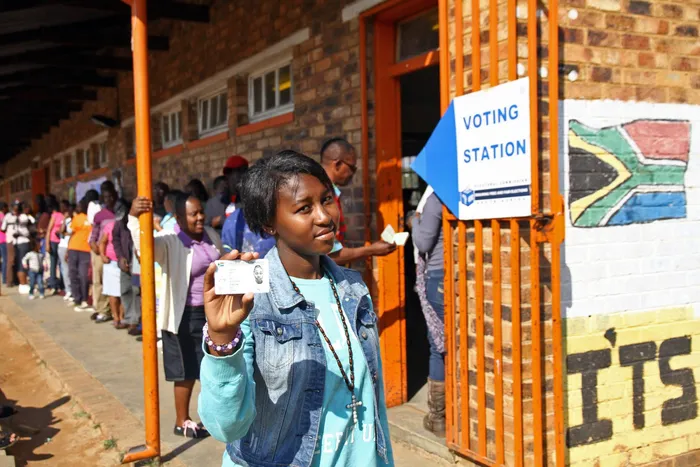
As South Africa approaches the 2026 local elections, where women consistently make up the majority of registered voters, gender activists warn that coalition politics could jeopardise decades of progress in women's political representation, highlighting the urgent need for stronger commitments to gender equality.
Image: Motshwari Mofokeng / Independent Newspapers
As South Africa prepares for the 2026 local government elections, gender activists and election experts are warning that hard-won gains in women's political representation are under growing threat.
While women remain the majority of registered voters, their share of political power is declining, raising concerns that coalition politics, violence, and weak enforcement of gender commitments could reverse decades of democratic progress.
The warning follows a presentation of the Commission for Gender Equality (CGE) report on the 2021 local government elections on Wednesday, which found that women's representation in municipal councils dropped from 41% in 2016 to 37% in 2021, the first significant decline in more than a decade.
Presenting the findings, CGE researcher Lieketseng Mohlakoana-Motopi described the drop as a worrying reversal.
"The 2021 election results demonstrated that the gains made in women's representation over previous election periods have been lost," she said.
The commission's research found that political parties with formal gender equality policies and quota systems generally performed better in promoting women candidates. However, researchers warned that progress remains vulnerable without stronger political commitment and accountability.
For Gender Links Gender and Governance Associate Susan Tolmay, the decline is part of a broader pattern that extends beyond South Africa.
"After many years of progress, we are now mostly moving backwards," she said.
Although women consistently account for between 55% and 56% of registered voters, leadership representation has fluctuated rather than steadily improved.
Tolmay pointed to the sharp decline in the number of women premiers, from 44% in 2004 to just 11% in 2024, as evidence of how fragile political gains can be.
She argued that political parties remain the primary gatekeepers to leadership opportunities. "Political parties are either enablers or inhibitors to women accessing decision-making positions."
The decline in representation, she said, was linked in part to the reduced electoral support for parties that had adopted voluntary gender quotas. Tolmay warned that numbers alone do not tell the full story.
"We need to look at what happens term to term. Do they leave halfway through? Are they experiencing barriers?"
One of the biggest barriers remains violence against women in politics.
Citing international research, Tolmay said 80% of women politicians surveyed reported experiencing psychological violence, while 67% experienced sexual violence.
More than four in 10 reported receiving death threats, rape threats, or threats of abduction.
"Those are pretty staggering statistics that we really need to interrogate and understand," she said.
She also highlighted the role of the media in shaping public perceptions of women leaders. Research presented during the webinar found that only 15.5% of sources quoted on election issues during the 2024 elections were women, down from 20% in 2019.
"There were more than 1,250 online attacks against journalists during the election period, and six out of every 10 victims were women," she noted.
Tolmay argued that South Africa's challenge is no longer the absence of progressive legislation but the failure to translate legal protections into lived equality.
"We don't lack legislation. The challenge is implementation," she stated.
She described the gap between law and lived reality as one of the defining challenges facing women's empowerment.
South African Local Government Association representative, Councillor Nozililo Mashiya, said the conversation must move beyond simply counting women in political structures.
"Having women in councils does not automatically guarantee gender-responsive governance," she said.
Mashiya acknowledged the significant gains made since 1994, but warned that representation does not always translate into influence.
Women continue to face patriarchal attitudes, exclusion from key decision-making spaces, and resistance when occupying positions of authority.
"In some instances, women may be present, but not fully empowered to shape outcomes," she added.
She said women remain underrepresented in many senior leadership positions and warned that progress achieved over decades could easily be reversed. "The next phase of transformation requires us to move beyond counting women to ensuring that women count."
The discussion also highlighted the experiences of women with disabilities, who remain among the most excluded groups in political life.
Thandile Butana from Blind SA said meaningful democracy can only be achieved when every citizen is able to participate equally in political and electoral processes.
"Women with disabilities represent one of the most marginalised groups in society," she said.
Butana noted that women with disabilities continue to face barriers, including inaccessible political information, economic exclusion, discrimination, and limited leadership opportunities.
"Women with disabilities are not merely voters. They are leaders, decision-makers, activists, professionals, and community builders," she emphasised.
Butana called on political parties and government institutions to ensure electoral processes are accessible and inclusive ahead of the 2026 elections.
A recurring concern throughout the webinar was the growing impact of coalition politics on women's representation.
Commission for Gender Equality Commissioner Mokgadi Mogane warned that coalition negotiations often come at the expense of gender equality.
"When we look through a gender lens, we see a darker truth. Women were the collateral damage of many of these backroom negotiations," she stated.
With coalition governments expected to become more common after the 2026 local government elections, Mogane warned that gains in representation could face further pressure.
"When political elites enter backroom deals to patch together majorities, gender equality is often the principle that gets traded away."
She noted that mayoral positions, speaker posts, and executive portfolios frequently become bargaining chips during coalition negotiations, leaving women sidelined from positions of influence.
The consequences, she argued, extend beyond politics.
"Local government is the sphere closest to the people, and when it fails, women and children often suffer first and suffer the hardest," she added.
Election management expert Terry Tselane said gender equality must be integrated throughout the electoral process rather than treated as an afterthought.
He warned that factors such as political violence, election administration, and access to participation opportunities can either advance or hinder women's representation.
"If the environment is such that there are areas regarded as no-go zones, or where violence is prevalent, that obviously hinders participation," he stated.
As the discussion concluded, Mogane stressed that the pursuit of equality should not be viewed as a threat to men.
"The rise of women does not mean the fall of men," she said. "The demands we are making are not polite requests for charity. These are constitutional imperatives."
Speakers agreed that reversing the decline would require more than political rhetoric.
Among the key proposals discussed were enforceable gender quotas for political parties, stronger implementation of existing equality commitments, and measures to ensure women are placed in winnable positions on candidate lists rather than symbolic positions.
Participants also called for greater financial support, mentorship programmes, and leadership development initiatives for women candidates, particularly young women, rural women, and women with disabilities.
There were further calls for safer political environments through stronger action against violence, intimidation, and online abuse, while coalition agreements should include safeguards to protect women's representation in executive leadership positions.
Thirty-two years into democracy, South Africa's record on women's political representation remains one of its most significant democratic achievements. Yet speakers repeatedly warned that those gains are proving increasingly fragile.
For Tolmay, the debate ultimately comes down to three questions that will shape the country's democratic future.
"Who is represented, who holds power, and who benefits from democracy?"
As political parties prepare for the 2026 local government elections, the answer to those questions may determine whether women continue advancing into leadership or become the casualties of an increasingly complex coalition era.
Have thoughts on this topic or other subjects you’d like us to explore? Want to share your experiences? Reach out to me at [email protected]