

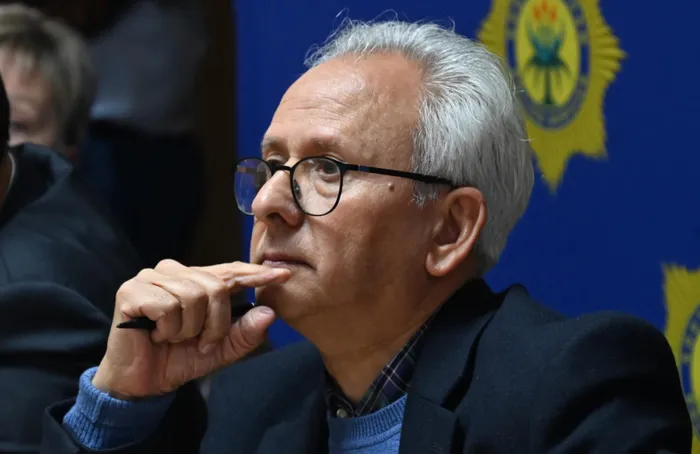
Acting Police Minister Firoz Cachalia has been requested to strengthen the capacity of the Political Killings Task Team (PKTT) following a spike in political killings over the weekend.
Image: Ayanda Ndamane / Independent Newspapers
Following a spike in political killings during a voter registration weekend ahead of the local government elections, acting Police Minister Firoz Cachalia has been requested to strengthen the Political Killings Task Team (PKTT) and prioritise the investigation of all politically related murders.
This is after the African Transformation Movement (ATM) and Amnesty SA called on Cachalia to ensure that the perpetrators behind these killings are brought to justice.
This followed a wave of violence, including four separate political murders occurring over a single weekend, which Cachalia admitted made him "angry" due to suspects continually escaping justice.
These include the murder of DA by-election candidate, Sinovuyo Dyokwe, who was shot and killed while walking home in Dunoon in Cape Town. The ANC ward councillor Sicelo Mleve, who was assassinated inside his office in Zwide, Gqeberha, while conducting a meeting, as well as two members of the MK Party who were gunned down in separate attacks in Bekkersdal on the West Rand of Gauteng.
South Africa is scheduled to hold its local government elections on November 4, 2026.
In a letter written to Cachalia on Monday, the ATM said it is concerned that despite years of commitments by the government to eradicate politically motivated violence, these killings continue to plague the country.
The party said while the SAPS established the PKTT to investigate politically motivated murders and related criminal networks, recent events suggest that more decisive action, enhanced resources and greater coordination may be required to effectively dismantle those who seek to advance their interests through violence and terror.
The party’s leader Vuyo Zungula said political killings are not merely crimes against individuals, but attacks on democracy itself. He said these create fear within communities, discourage political participation, undermine confidence in democratic institutions and risk plunging communities into instability and conflict.
Zungula added that such violence could erode public trust in the electoral process and threaten the peaceful conduct of future elections if left unchecked.
“The ATM therefore calls upon the Ministry of Police and the SAPS leadership to urgently strengthen the capacity of the PKTT, prioritise the investigation of all politically related murders, enhance intelligence-led operations against criminal syndicates linked to political violence, and ensure that perpetrators are swiftly brought to justice,” read the letter.
Zungula also urged greater collaboration between SAPS, the National Prosecuting Authority (NPA), IEC, political parties and community stakeholders to safeguard participation throughout the electoral period.
On the other hand, human rights organisation Amnesty International SA said reports of multiple killings, including the alleged targeting of ward councillors, are deeply concerning, saying the SAPS must urgently and thoroughly investigate these killings, establish the motives and ensure those responsible are brought to book.
“The government and SAPS must ensure the right to life is protected and civic space is safeguarded in the lead up to elections, and always. All political parties contesting the 2026 local government elections must ensure that they foster political tolerance to contribute towards preventing violence.”
Cachalia's spokesperson Kamo Mogotsi on Tuesday said the ministry has a programme underway and is unable to advise what time the department can submit responses.
The PKTT was formed in 2018 to address a surge of politically motivated assassinations. Its establishment was a direct response to a long history of political violence, driven by systemic corruption, tender fraud, and violent intra-party rivalries, particularly in the KwaZulu-Natal (KZN) province.
Suspended Police minister Senzo Mchunu issued a directive to disband the team in December 2024, but following a judicial inquiry and pushback, the task team remains active and funded.
Political killings were heavily tied to the apartheid regime's purges and the violent territorial conflicts between the ANC and the Inkatha Freedom Party (IFP), which largely militarised KZN in the 1990s.
However, after the initial calm following the 1994 democratic elections, assassinations began to re-emerge, but shifted in nature. Instead of broad inter-party clashes, the killings increasingly became targeted assassinations of local politicians, councilors, and whistleblowers linked to internal party factionalism and lucrative local government tender corruption.
Political analyst and governance expert Sandile Swana argued the PKTT has not solved political violence to date, adding that these killings are likely to increase over the next four months before the elections.
Swana said these killings are driven by the position of a councillor to open doors to interfere with tenders and procure processes to loot state resources.
He said this position also enables councillors to buy favours by making sure that their allies get jobs in the council and municipality area.
“It becomes a source of resources, and a place where you can allocate resources and use them to buy favours and enrich yourself,” he said.
Another political analyst Zakhele Ndlovu said the country is seeing more intra-party killings driven by competition over positions since 1994.
“Remember that most black people lack skills and see politics as a lucrative and high paying career. Most people are obsessed with material things and believe in taking shortcuts. I have seen so many people from poor backgrounds who come to university just to launch a political career through activism in student politics,” he said.
Meanwhile, ActionSA said incidents like these not only rob families and communities of their loved ones, but also discourage citizens from participating in political life. The party said without active citizen participation, the urgent task of fixing South Africa becomes even more difficult.