

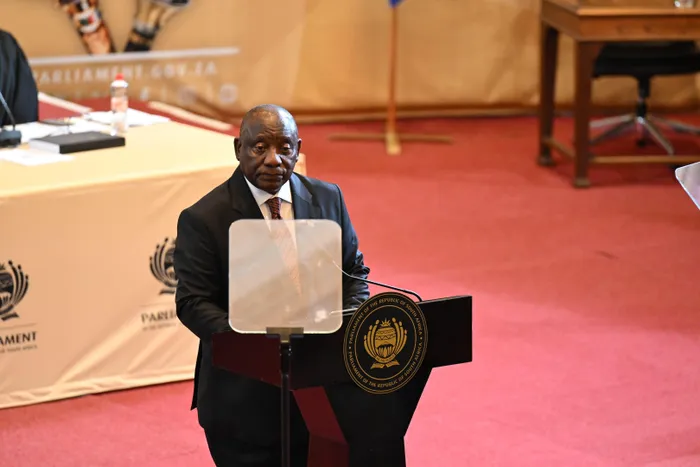
Civil society coalition says President Cyril Ramaphosa's claims about illegal immigrants were made without any evidence to back them.
Image: Henk Kruger / Independent Media
President Cyril Ramaphosa has been accused of failing to provide proof to back his claims during the Presidency's Budget Vote in Parliament, where he said illegal immigration puts pressure on public services, announcing a stricter crackdown on undocumented migrants, labour violations and corruption in the immigration system.
During his speech, Ramaphosa stated that unregulated migration heavily strains public infrastructure, particularly in the healthcare and education sectors.
He also warned of undocumented migration routes to organised crime networks, specifically noting illegal mining, extortion, drug trafficking and money laundering.
He acknowledged deep community frustration regarding foreign nationals operating spaza shops, noting that citizens feel economically squeezed out of their own local markets.
According to joint civil society groups, these assertions were made without the qualification of evidential grounding.
Leading groups in this coalition include Lawyers for Human Rights, Global South Against Xenophobia (GSAX), the Botshabelo Unemployed Movement, and the One Voice For All Hawkers Foundation.
The coalition warned that these claims are being made in a political climate already fueled by organised anti-immigrant campaigns, cautioning that the Presidency risks validating harmful narratives that have directly resulted in the harassment, forced removal, and violence directed at individuals who are often legally in South Africa and have the right to protection.
This is after activist groups targeted cities such as Johannesburg, Pretoria, and Durban, demanding the departure of undocumented migrants whom they accuse of straining public services and taking local jobs.
Some foreign nationals have already left the country amid growing fears of violence linked to the planned nationwide action at the end of June.
Ramaphosa’s spokesperson Vincent Magwenya did not respond at the time of this publication.
The groups urged President Ramaphosa to ensure future migration policies are based on hard facts. They demanded that government decisions reflect the actual economic contributions of foreign nationals, distinguish between infrastructure strain caused by migration versus local political failures, and acknowledge that undocumented migrants are often economic victims rather than attackers.
“The address makes no reference to the events of 18 to 21 May 2026 in Durban, where hundreds of refugees and asylum seekers, overwhelmingly documented, overwhelmingly lawfully present in South Africa, sought police protection from xenophobic violence and were met with tear gas, rubber bullets, and those same persons were subsequently transported by buses under police escort to the Durban Refugee Reception Office for collective ‘status verification’- of the approximately 300 to 460 persons processed, fewer than one percent were found to be undocumented,” read the statement.
The coalition noted that the government's claim to handle immigration strictly through official authorities is only believable if the state acts independently, adding that the government must not act on behalf of mob or vigilante pressure, and must ensure every action has specific legal justification and respects constitutional rights.
The society groups added that Ramaphosa’s speech failed to make this distinction.
The groups also called on the government to engage with civil society and affected communities before implementing any relocation of refugee reception infrastructure, and to commission a human rights impact assessment of the proposed model, adding that that corruption in the asylum system is a government’s failure, not migrants.
“Addressing corruption in the asylum and immigration system is not only a law enforcement It is a human rights protection imperative. We call on the government to acknowledge publicly that corruption in the Department of Home Affairs has been a primary driver of irregular documentation and documentation backlogs, and to invest in the systemic reforms necessary to address it.”
Governance expert and political analyst Sandile Swana also argues that the declining quality of public services in South Africa is a result of state failure, rather than the presence of undocumented immigrants. He places the blame squarely on domestic issues like government incompetence and poor management.
“Let’s take the issue of Tembisa Hospital for example, the voters and taxpayers of Ekurhuleni, including those of Tembisa, know that the government allocated a full budget to expand, renovate, and fund the hospital's operations. But that money was not used for that, it was taken by known identified people to go buy sports cars, mansions and other luxuries in front of the voters and taxpayers. The tenderpreneurs and comrades have taken money for the services, not foreign immigrants,” he said.
Swana added that the United Nations (UN) had made it clear that illegal immigration is normal and part of being human in all countries.
“It is a breach of administrative processes. It is not a crime under the United Nations of which South Africa is a prominent member. Our Constitution also makes it clear that nobody must do anything to any immigrant without the permission of the court. You are not supposed to go and ask people for their identities and arrest them, it is against South African law,” he said.
Another political analyst Zakhele Ndlovu said the root problem is widespread public anger driven by severe economic hardship and the inability to afford basic necessities, adding that the post-apartheid promise of an improved quality of life remains unfulfilled.
“Now they are venting and directing their anger at immigrants who are also running away from poverty in their countries,” he said.