

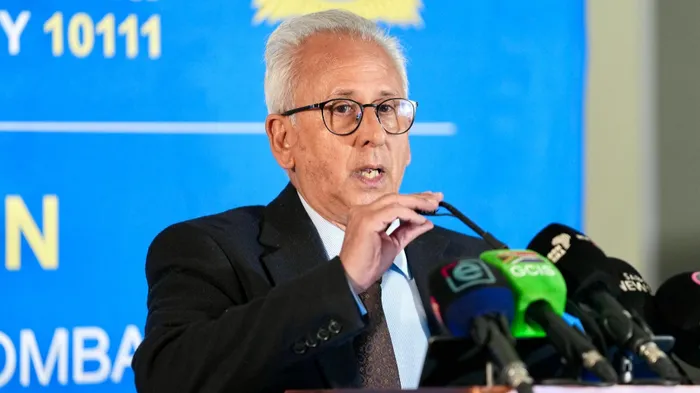
Acting Police Minister Firoz Cachalia tabled the budget vote for the SAPS in the National Council of Provinces on Tuesday.
Image: Supplied
Acting Police Minister Firoz Cachalia on Tuesday reiterated statements made by President Cyril Ramaphosa, that only the police and the Border Management Agency are allowed to arrest people for immigration offences.
Tabling the SAPS budget vote for 2026 in the National Council of Provinces, Cachalia said one cannot build a country that effectively implemented the rule of law, by breaking those same laws.
“As much as the police are directed to enforce the law against those who are in South Africa illegally, they are directed to do the same against anyone who acts violently or attacks people during protest action,” he said.
Cachalia made the statement two days after Ramaphosa addressed the nation stating that the responsibility for enforcing immigration laws rests with the state alone.
Cachalia said the government acknowledged that illegal immigration was unacceptable, and that strong measures are required to strengthen border control and to enforce immigration laws.
“Our country’s sovereignty, and the rule of laws are not negotiable. But I must make myself absolutely clear, we condemn any violent protest action, targeting people from other countries.”
Warning about the damage caused by threats to foreigners, Cachalia also said South Africa was part of a continental and global trading economic system.
“When images of people being harassed and threatened in our streets go around our region, our continent and the world, it harms our reputation and our national interests. It limits foreign investment and undermines our chances to grow our economy and create jobs. It also could harm the cooperation we need with our regional neighbours to address organised criminal networks that bring drugs into our country and that traffic people across our borders.”
Cachalia applauded the suspension or dismissal of top SAPS officials, saying holding people to account is part of the bold Police Reset Agenda and the recent suspensions by Acting National Commissioner Puleng Dimpane, were in line with SAPS internal investigation.
“The Acting National Commissioner and I are fully aligned in pursuing consequence management,” he said.
Cachalia also appreciated the majority of police members who were focused on the job at hand and those killed or injured while doing their jobs to serve the community.
Commenting on the recent crime statistics released last month, Cachalia said the downward trend in most major contact and property crimes has largely been sustained for two years.
“I am of the view that better targeted policing operations along with many ongoing community and other efforts to improve safety, are having a positive impact.”
He said while the crime situation was improving in some important respects, the levels of crime and violence were still far too high.
“From a policing point of view we will keep focused to further build on these gains.
"However, it will take more than policing alone to ensure that we achieve the levels of safety that will enable our country to grow sustainably for all its people.”
The Acting Minister said achieving community safety must be an objective co‑governed across all three tiers of government.
Cachalia also said in addition to adopting the Integrated Crime and Violence Prevention Strategy, the ministry was working to develop a national and provincial patroller programme.
“The Civilian Secretariat for Police Service are working on national norms and training curricula for patrollers. Provinces are asked to consider options for providing stipends, equipment and training for patrollers in high‑risk districts, hopefully with national co‑financing and technical support. This is a programme I am fully committed to.
Cachalia added that the ministry will present a comprehensive National Organised Crime Strategy to Cabinet this year.
“This will enable better coordination and information sharing across government departments, the private sector and civil society to address this threat.
He said multi-disciplinary teams were targeting specific organised criminal networks across the country.
“We will be closely monitoring developments to assess impact and to continuously reflect on lessons learned so as to improve our interventions.”