

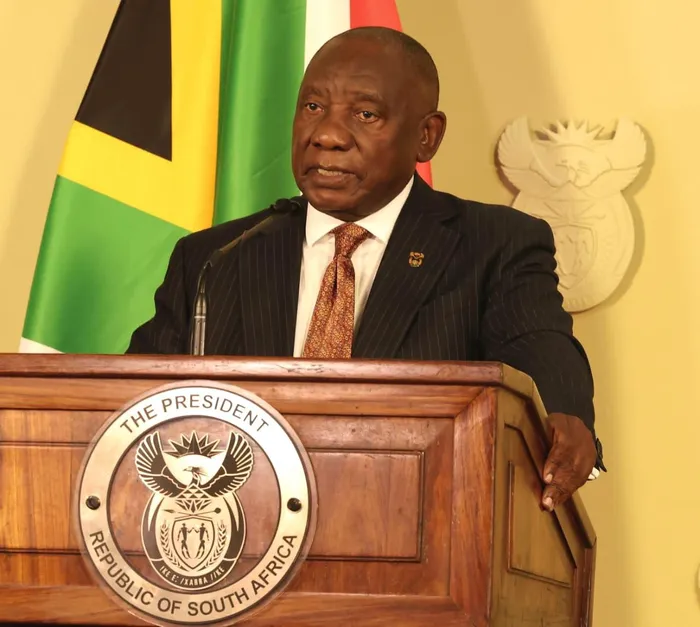
President Cyril Ramaphosa has detailed a multi-pronged approach focused on deportations, anti-corruption measures, border security and immigration law reform.
Image: Supplied
President Cyril Ramaphosa has announced that the Department of Home Affairs, the Border Management Authority (BMA), the South African Police Service (SAPS) and other law enforcement agencies will intensify efforts to identify and deport undocumented foreign nationals residing illegally in South Africa.
He was addressing the nation on Sunday night, amid growing tensions over illegal immigration and demands that undocumented migrants leave the country.
He said illegal immigration was not the cause of all the country's challenges and problems, adding that immigration was a global issue and not one faced by South Africa alone.
The president said every person in the country must be in South Africa legally, whether they are working or operating a business.
He also criticised those taking the law into their own hands and attempting to enforce immigration laws themselves.
His address on the government's response to growing tensions over illegal immigration comes amid calls for a nationwide shutdown on 30 June and demands that undocumented migrants leave the country.
There has been a surge in protests targeting foreign nationals in recent months.
Anti-immigrant tensions have persisted in several parts of the country, including the Western Cape, KwaZulu-Natal and Gauteng.
Some demonstrations have been led by the controversial anti-migrant group March and March, which has called on undocumented migrants to leave South Africa by 30 June, despite government appeals for calm.
Some foreign nationals have already left the country amid growing fears of violence linked to the planned nationwide action at the end of June.
Last month, about 295 Ghanaians returned home through Ghana's voluntary repatriation programme amid growing concerns about their safety and rising anti-immigration sentiment in South Africa.
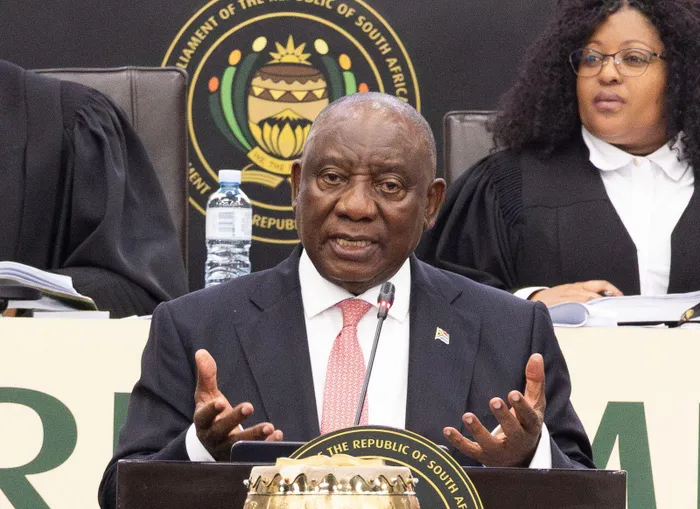
Cyril Ramaphosa addressed the nation on Sunday night.
Image: GCIS
Ramaphosa said that, following announcements made during the State of the Nation Address (SONA) in February, the government was taking further decisive action to tackle illegal immigration.
He said Cabinet last week adopted a Comprehensive Approach for Migration Management.
“This approach has been endorsed by the President's Coordinating Council, which includes Premiers and MECs, representatives of local government and representatives of the National House of Traditional and Khoi-San Leaders.”
He said the key actions the government was taking included continuing to crack down on violations of immigration, labour and other laws.
“Secondly, we will continue to prevent people from entering the country irregularly and illegally.
“Thirdly, we are and will continue to stamp out corruption in our immigration system.
“Fourthly, we will strengthen our immigration laws and policies,” he said.
Ramaphosa said South Africa would continue engaging other countries, including those on the African continent, to develop a broader response to migration challenges across the region and continent.
“The first part of our response is a concerted crackdown on violations of existing immigration, labour and other laws.
“The Department of Home Affairs, Border Management Authority, South African Police Service and other law enforcement agencies have been and will intensify the process of identifying and deporting undocumented foreign nationals residing illegally in South Africa.”
According to him, the Border Management Authority intercepted and prevented more than 450,000 people from entering South Africa illegally over the past year.
“We will set up dedicated courts to deal with immigration to speedily support the deportation of undocumented migrants.
“The South African Police Service, Home Affairs and Department of Employment and Labour are increasing inspections targeting companies employing undocumented foreign nationals.”
“As part of rebuilding the labour enforcement capacity, the Department of Employment and Labour has launched the phased recruitment of 10,000 inspectors for this financial year.”
Ramaphosa said the government would increase penalties, including imprisonment, for employers who violate the Immigration Act.
“We cannot have a situation where employers who, after being charged and found guilty of violating our laws, merely pay a fine and continue employing undocumented foreign nationals whom they exploit.”
To address violations of immigration and labour laws in the transport sector, he said government was implementing a plan developed with the logistics and freight industry and labour organisations.
He said the second part of the response was securing South Africa's borders.
“Every sovereign nation has a responsibility to know who enters its territory, why they are entering and how long they are permitted to stay.
“Secure borders are not a sign of hostility towards other countries. They are a fundamental requirement of a sovereign and well-governed state.”
He said further measures were being implemented to secure the country's borders.
“We will therefore continue to invest in modern technology, infrastructure and personnel to ensure that our borders are secure while facilitating legitimate trade, travel and economic activity.
“We will undertake a phased relocation of refugee reception centres to border posts, starting with the Tshwane centre this year.
“Many other countries have refugee reception centres close to the place where refugees enter the country seeking asylum or refuge.”
He said the relocation of refugee reception centres closer to border posts was intended to ensure asylum applications were processed more efficiently, securely and fairly.
“This will enable the government to determine protection needs at the point of entry to ensure that those who genuinely require protection receive assistance as quickly as possible.”
He said the third part of the response would focus on strengthening the immigration system by stamping out corruption and deploying advanced technology.
“We are continuing the crackdown on corruption and inefficiencies in the Department of Home Affairs. We must recognise that illegal immigration is often enabled by corruption.
“Officials who sell documents, facilitate unlawful entry or abuse public office for personal gain betray the trust of the South African people. We will pursue these cases relentlessly.
“Those who are responsible are facing dismissal, criminal prosecution and the full consequences of the law.”
“We are establishing an Intelligent Population Register that contains biometric data for every person in the country, laying the foundation for a Digital ID.
“At the same time, we will progressively discontinue the green ID books, which have enabled identity theft by undocumented immigrants and criminal syndicates.”
He said the Department of Home Affairs would set a date after which green ID books would no longer be recognised.
“We will end the abuse of the Traffic Registration Number, which foreign nationals require to register or buy vehicles, but which is being used as a form of identification.”
He said the Department of Transport would issue new regulations within the next three months to align with the country's identification laws.
The president said the fourth part of the response was to close gaps in legislation and policy.
“The laws that regulate immigration in South Africa are fragmented and often contradictory. They allow legal loopholes that are exploited by undocumented migrants.
“We are addressing these loopholes.”
“The government has finalised the National Labour Migration Policy, which proposes maximum quotas for the employment of documented foreign nationals, and deals with the prosecutions of employers hiring undocumented workers.
“The Employment Services Amendment Bill has been approved by Cabinet for introduction to Parliament. This empowers the Minister to set quotas in respect of the employment of foreign nationals in any economic sector or occupational category.”
“The Department of Small Business Development, working with the South African Local Government Association, will complete the process of ensuring small and informal businesses are properly registered. It will also provide support for South African informal businesses through the Spaza Shop Fund.”
He said the final part of the response was to work with other countries in the region and across the continent to address broader migration challenges.
“We need to address the factors that drive migration on our continent and elsewhere. South Africa cannot address migration challenges alone.
Ramaphosa said migration is a continental and global phenomenon.
“South Africa's future is inseparable from the future of the African continent. Migration pressures cannot be addressed through enforcement measures alone.
“They require peace where there is conflict, economic growth where there is stagnation and opportunity where there is poverty. As South Africa, we will continue working with our sister countries to build an Africa in which people move by choice and not by desperation.”
He said South Africa would work through SADC, the African Union and bilateral relations to find sustainable solutions.
“As part of this effort, I will be sending envoys to a number of sister African countries to outline the measures that we are announcing this evening. The Cabinet will remain seized with this matter and will regularly review progress in implementing these measures.”
Ramaphosa said the Inter-Ministerial Committee on Migration would coordinate the government's response across departments and all spheres of government.
“NATJOINTS and Provincial NATJOINTS structures have been directed to strengthen coordination among law enforcement, intelligence and security agencies to ensure effective implementation.
“As we work to tackle the problem of illegal immigration, we are determined that we will not allow anyone to exploit this problem to destabilise our country.”
“Our law enforcement agencies and security services – working with other state entities and key stakeholders – are ready to act to protect public safety, maintain law and order, and safeguard critical infrastructure,” he warned.
He said recent changes to immigration laws and regulations would allow South Africa to attract tourists, highly skilled global talent and investment through lawful channels.
“We must also remember that many of our people travel to other countries to study, to work and to gain experience. Many come home with valuable skills and expertise, with a wider view of the world, and in a better position to improve their lives and those of their families.
“Migration is the way of the world and we must be prepared to embrace it.
“South Africa is a better country for migration. And we can become better still. But that means our laws need to be strengthened and more effectively enforced.
“It means that we must end illegal immigration and deal with the social, economic and security challenges to which it contributes. We must not allow ourselves to turn against foreign nationals or each other.”
He urged South Africans to respect the Constitution, uphold the basic human rights of all people and consistently uphold the rule of law.
“We reject the notion that we must tolerate illegal immigration. We can protect our borders while protecting human dignity. We can enforce our laws while upholding our Constitution.
“We can secure our communities while preserving the values of Ubuntu that define us as a people. Like many challenges that we have faced before, we can overcome the problem of illegal immigration.”
IOL Politics