

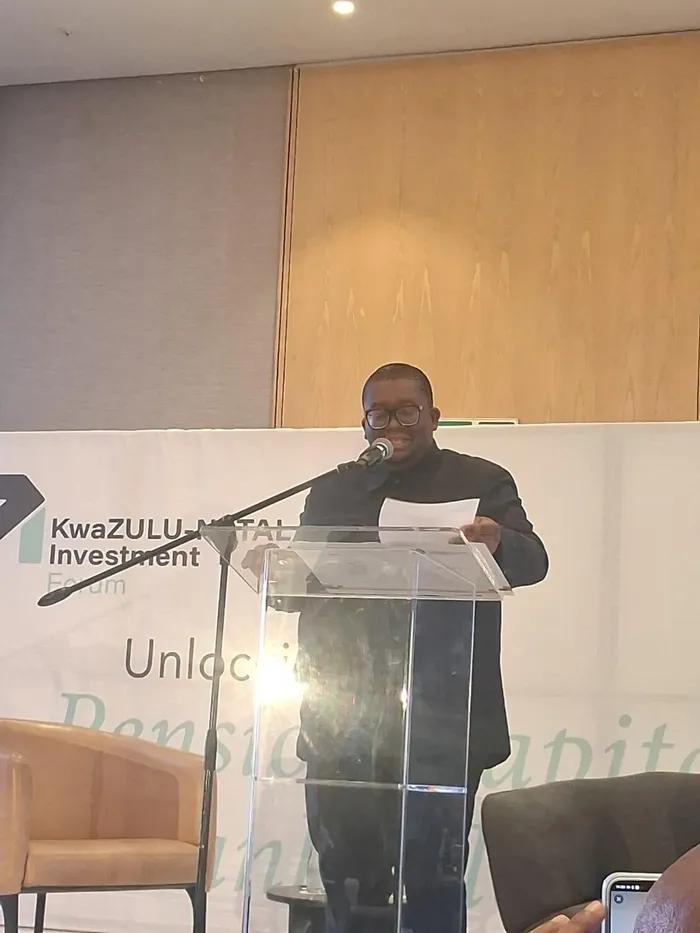
The government is working with municipalities to strengthen governance and accelerate infrastructure delivery to improve economic growth, according to MEC KZN Cooperative Governance and Traditional Affairs (COGTA) Thulasizwe Buthelezi
Image: Yogashen Pillay/Independent Newspapers
The KwaZulu-Natal government is working with municipalities to strengthen governance, improve financial management and accelerate infrastructure delivery as part of efforts to create an environment that attracts investment and supports economic growth, KwaZulu-Natal Cooperative Governance and Traditional Affairs (Cogta) MEC Thulasizwe Buthelezi said on Thursday.
Speaking at the inaugural KwaZulu-Natal Investment Forum in Umhlanga, north of Durban, Buthelezi said creating a conducive local government environment for retirement funds and other institutional investors to invest in municipalities was both timely and necessary.
“It recognises that strengthening municipalities is not only a governance priority—it is an economic imperative,” he said.
Buthelezi acknowledged that municipalities across South Africa continue to face significant challenges, particularly because they are at the frontline of service delivery and are often the first point at which residents and businesses experience government performance.
“Because municipalities are at the coalface of service delivery, they are often where citizens and businesses first experience the successes or shortcomings of government. We acknowledge these realities, but we must also recognise the progress that is being made.”
He said the provincial government was working closely with municipalities to improve governance, strengthen financial management, accelerate infrastructure delivery and build institutional capacity.
“While there is still work to be done, we are steadily laying the foundation for municipalities that are more capable, responsive, and investment-ready.”
He stressed that sustainable economic growth depends on functional municipalities capable of supporting private sector investment.
“Government cannot create every job, but it has a responsibility to create an environment where businesses can invest with confidence, expand their operations, and create employment opportunities.”
Highlighting KwaZulu-Natal's economic strengths, Buthelezi said the province offered opportunities across agriculture, manufacturing, mining, logistics, tourism, renewable energy and the ocean economy, making it an attractive destination for domestic and international investors.
He pointed to the recently announced Club Med South Africa Beach and Safari Resort in Tinley Manor as an example of successful collaboration between government and investors.
The R2.1 billion tourism development, South Africa's first Club Med resort, was made possible through cooperation between investors, the provincial government and the KwaDukuza Municipality, which facilitated the required approvals leading to the handover of the occupation certificate.
“It is tangible proof that when the government provides planning certainty, supports infrastructure development, and works collaboratively with investors, major investments become a reality.”
He added that the growth of the Durban-Umhlanga-Ballito corridor into one of South Africa's fastest-growing wealth corridors reflected increasing investor confidence in the province.
“This reflects growing investor confidence in our province and reinforces KwaZulu-Natal’s position as an increasingly attractive destination for long-term investment.”
Buthelezi said investors sought more than opportunities—they wanted confidence that projects were well planned, governance systems were sound, infrastructure could support investment and municipalities had the capacity to honour their commitments.
He called for the forum to serve as the start of a long-term partnership between government and investors rather than a once-off engagement.
“Confidence that projects are properly planned, governance systems are sound, infrastructure can support investment, and municipalities have the capacity to honour their commitments,” he said.
“As the government, we remain committed to building municipalities that are financially sustainable, institutionally capable, and investment-ready.”
Also addressing the forum, Presidential eThekwini Working Group (PeWG) co-chair Mike Mabuyakhulu said eThekwini had developed a substantial pipeline of catalytic investment projects across manufacturing, logistics, infrastructure, tourism and mixed-use urban development.
“These opportunities have not been developed in isolation. They are supported by strategic spatial planning, coordinated public infrastructure investment, and an integrated approach that seeks to improve project readiness across the entire development lifecycle.”
He said the city's catalytic investment pipeline represented about R227 billion in potential investment and could create more than 300,000 construction jobs as well as over 120,000 permanent employment opportunities.
“These figures illustrate the scale of economic activity that can be unlocked when projects are supported by effective institutions and meaningful collaboration,” he said.
“Let us use this inaugural KwaZulu-Natal Investment Forum to move from conceptual discussions to concrete, structured transactions.”
BUSINESS REPORT