

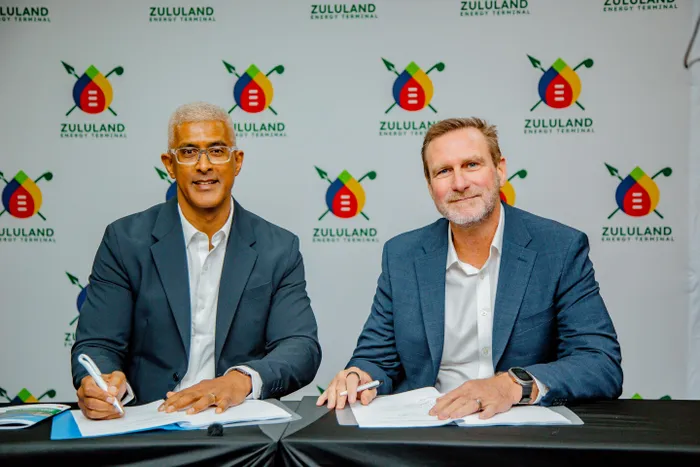
Signing the agreement are Oliver Naidu, director of Zululand Energy Terminal, and Andrew Barry, chairman of ExxonMobil LNG Market Development Inc.
Image: Supplied
The development of South Africa’s first liquefied natural gas (LNG) import terminal gained significant momentum on Wednesday after the Zululand Energy Terminal (ZET) signed a Heads of Agreement (HoA) with ExxonMobil South Africa LNG, signalling growing international confidence in the country’s emerging gas market.
The agreement marks an important step in advancing the proposed LNG import facility at the Port of Richards Bay, which is expected to play a critical role in addressing South Africa’s looming gas supply shortage and strengthening the country’s long-term energy security.
ZET said the agreement with ExxonMobil South Africa LNG, an affiliate of global energy giant ExxonMobil, demonstrates international market interest in supplying LNG to South Africa and supports the development of infrastructure required to establish a new gas import platform.
It said the new LNG terminal will position Richards Bay as a key entry point for imported LNG and support the country’s transition toward a more secure and diversified energy mix.
The project comes as South Africa faces increasing pressure to secure alternative gas supplies ahead of an anticipated decline in gas imports from Mozambique’s Pande-Temane fields, which currently underpin a significant portion of the country’s gas consumption.
If completed as planned, the Richards Bay facility is expected to become a cornerstone of South Africa’s gas infrastructure, helping to bridge future supply gaps, support industrial growth and provide a flexible energy source to complement the country’s expanding renewable energy sector.
According to ZET, South Africa is expected to face a substantial gas supply shortfall by 2030.
Oliver Naidu, director of ZET, described the agreement as a major endorsement of the project and its long-term potential.
“It is a strong vote of confidence in the Zululand Energy Terminal and the future of LNG in South Africa.”
“The participation of a global energy leader such as ExxonMobil reinforces the strategic importance of Richards Bay as an entry point for LNG and supports our vision of developing the infrastructure needed to unlock a competitive and sustainable gas market,” added Naidu.
Naidu said the project could have far-reaching economic benefits for KwaZulu-Natal, leveraging Richards Bay’s established position as one of South Africa’s key industrial and logistics centres.
“Richards Bay is already one of South Africa's most important industrial and logistics hubs, and the Zululand Energy Terminal has the potential to further strengthen the province's role as a gateway for energy, trade, and investment.”
The LNG facility is planned in two phases. During the first phase, ZET expects to deploy a floating storage unit with a capacity of at least 170,000 cubic metres, alongside an onshore regasification system capable of processing approximately three million tonnes of LNG annually, equivalent to around 400 million standard cubic feet of gas per day.
Naidu said the second phase would significantly expand the facility’s capabilities.
“Phase 2 is expected to introduce an onshore LNG tank of approximately 220,000 cubic metres and additional regasification capacity, increasing total capacity to approximately 4.5 million tons per annum, or around 600 million standard cubic feet per day,” he said.
Once operational, the terminal will be capable of receiving, storing, regasifying and distributing LNG to electricity generators and industrial users across the country.
The project is being developed as a joint venture between Vopak Terminal Durban and Transnet Pipelines, with Transnet viewing the facility as a strategic component of South Africa’s future energy infrastructure.
Michelle Phillips, Group CEO of Transnet, reaffirmed the state-owned logistics company’s support for the initiative.
“Through Transnet Pipelines’ partnership in the Zululand Energy Terminal, we continue to support the development of critical LNG import infrastructure at Richards Bay.”
ExxonMobil also highlighted the importance of LNG in supporting South Africa’s future energy needs.
Andrew Barry, chairman of ExxonMobil LNG Market Development Inc, said the agreement aligns with the company’s commitment to providing reliable energy solutions.
“With LNG markets continuing to expand globally, we see a strong opportunity to help meet growing demand for secure energy and I look forward to working with ZET to progress this opportunity,” Barry said.
Maarten Smeets, chairman of ZET, said partnering with one of the world’s largest energy companies strengthens the project’s prospects and enhances South Africa’s access to international gas markets.
“Via the terminal, South Africa ensures access to the global LNG market to further strengthen its energy mix by gaining access to affordable and reliable supply,” Smeets said.
BUSINESS REPORT