

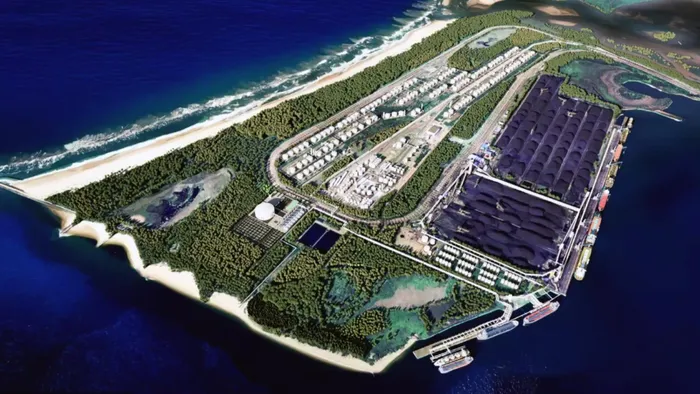
Proposed layout of the Zululand Energy Terminal.
Image: Supplied
The multibillion-rand gas projects earmarked for the Richards Bay area are set to transform the province and ensure its energy security. This is according to experts who said that KwaZulu-Natal is one of the most energy-insecure provinces in the country, as a large part of its energy sources come from other provinces. However, this is likely to change once the planned projects are implemented.
The experts made these revelations at their meeting in Durban to discuss the plans for the Zululand Energy Terminal (ZET) project and secondary work earmarked for the Richards Bay area.
The total investment of the project, encompassing all the work, including infrastructure and power stations, is estimated to be close to R 100 billion. They stated that the energy landscape in KwaZulu-Natal is evolving rapidly, creating new opportunities for businesses across multiple sectors.
Standard Bank hosted an exclusive breakfast session yesterday where key energy stakeholders unpacked the Sub-Saharan Africa gas opportunity, explored the impact of emerging developments in Richards Bay and Mozambique, and discussed how businesses can position themselves to benefit from this evolving market. Standard Bank acts as an advisor to the ZET consortium and continues to play a key role in supporting the growth of South Africa's energy sector.
The ZET recently signed Heads of Agreements with key customers such as Eskom and ExxonMobil. Paul Eardley-Taylor, head of Gas Infrastructure at Standard Bank, said the project will transform the energy sector and create opportunities in the province.
“Zululand is set to be the first LNG import terminal in South Africa, which means that uMhlathuze is the point at which the LNG lands and gets converted into natural gas. The first opportunity is the project itself, which could have a cost of about US$ 1 billion (R 16.52 billion).
“There will be a power station in Richards Bay; one has been submitted as an Independent Power Producer (IPP) scheme, and another has been submitted by Eskom. My personal guess is that there will be 2 gigawatts of CCGT (Combined Cycle Gas Turbine) in Richards Bay by around 2030.” He said these investments coupled with other projects, like the Transnet pipeline repurposing could see the total investment figure in KwaZulu-Natal from the gas value chain reach around R 98.6 billion.
“Direct investment could have a major impact in the KwaZulu-Natal region in sectors such as construction and employment,” he said. He mentioned that the projects are not just in the planning phase, but work has been underway to implement them for the past two to three years. He stated that to finally kickstart the physical work, a final investment decision is expected by late next year, when the shareholders are set to invest in the project and the banks fund them.
“My hope is that there will be an FID (Final Investment Decision) in 2027, and there will be a sequence by which the projects all come online, so there is really a rolling sequence by which all these major assets come online.” He said this is a major boost for energy security in KwaZulu-Natal.
“KwaZulu-Natal has always been one of the energy-constrained provinces in the country. If you think about it, electricity is generated in Mpumalanga, and LPG is imported. What will happen is that KwaZulu-Natal will go from being energy-constrained to being well supplied with energy. It will have its own LNG, it will have its own natural gas, and it will have its own gas-to-power.
“Small-scale LNG will be available to substitute diesel imports, so the overall energy supply will be secure, and the province will have a decent chance of economic growth in the future.”
Alfred Seema from Eskom spoke on the importance of the project, stating that it will form the bedrock of renewable energy generation. He said this will go a long way in ensuring the stability of electricity supply in the country.
Kaone Lekalake, also from Standard Bank, emphasised the importance of the project, stating that South Africa’s energy future will not be shaped by talking but through action and investment. “KwaZulu-Natal has a meaningful role to play in that future,” said Lekalake.
For more stories from The Mercury, click the link THE MERCURY