

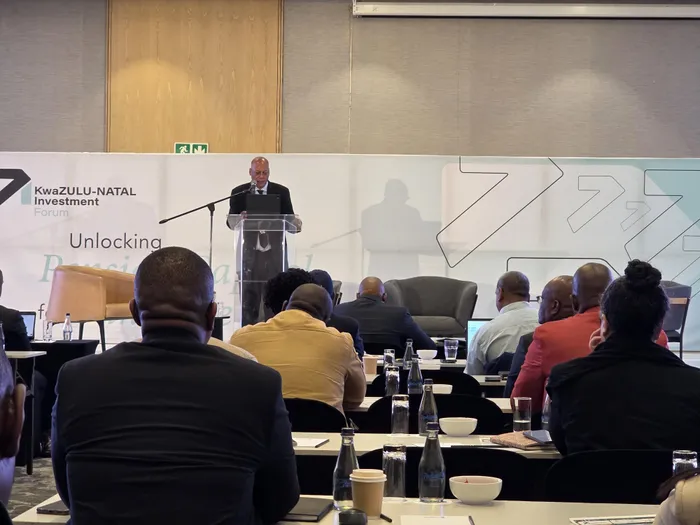
Presidential eThekwini Working Group (PeWG) co-chair Mike Mabuyakhulu speaking at the KwaZulu-Natal Investment Forum in Umhlanga, Durban, on Thursday.
Image: Twitter/@InvFundsLawyer
Progress is being made in addressing challenges that hinder growth in eThekwini according to Presidential eThekwini Working Group (PeWG) co-chair Mike Mabuyakhulu at the KZN Investment Forum on Thursday in Umhlanga, Durban.
Speaking at the KwaZulu-Natal Investment Forum in Umhlanga, Durban, on Thursday, Mabuyakhulu said the Presidential eThekwini Working Group was established by President Cyril Ramaphosa to provide a collaborative platform bringing together all spheres of government, organised labour and other stakeholders to resolve obstacles affecting economic growth, infrastructure development and service delivery in the municipality.
He said the working group has become a model for aligning public administration with institutional investors to unlock investment and accelerate project implementation.
“There is broad agreement that faster economic growth depends on infrastructure investment, stronger industrial development and the expansion of productive sectors of the economy,” he said.
Mabuyakhulu said that municipalities face a very particular set of challenges.
“They are expected to respond to rapid urbanisation, increasing demand for infrastructure, ageing municipal assets, climate resilience, technological change and growing expectations for improved service delivery,” he said.
“Collaboration and partnerships between the various funds and government in general, and particularly local government, in pursuit of mutually beneficial objectives are of paramount importance.”
Mabuyakhulu said that they must accurately evaluate the economic and institutional landscape, one that, so far, has not seen the intensity and level of collaboration the country and her economy need.
“The structural pressures we face today are a function of economic expansion, rapid urbanisation, and industrial growth. The demand for increased infrastructure capacity requires a clear funding mechanism that moves beyond the constrained balance sheets of the public fiscus.”
Mabuyakhulu added that South Africa possesses a massive domestic asset in the institutional funds.
“It is estimated that, excluding structural overlaps between the asset manager and its clients, this represents a unique, non-overlapping domestic capital pool of approximately R2.96 trillion, which extends to R5.96 trillion in total assets under management across the combined ecosystem.”
Mabuyakhulu noted that a traditional framework has treated retirement capital as an entity that should operate exclusively in secondary markets, detached from the physical economy.
“This passive approach is no longer sustainable. The long-term performance and solvency of pension funds are directly dependent on the growth and structural stability of the domestic economy. If the real economy underperforms, if utility networks lack capacity, and if the labour market contracts, the financial assets backing your liabilities will face long-term systemic risks.”
Mabuyakhulu concluded that deliberate, structured investment in the domestic physical economy is a core fiduciary requirement.
“Capital allocation must appreciate that the sustainability of long-term returns requires a functional, productive, and stable economic environment,” he said.
BUSINESS REPORT