

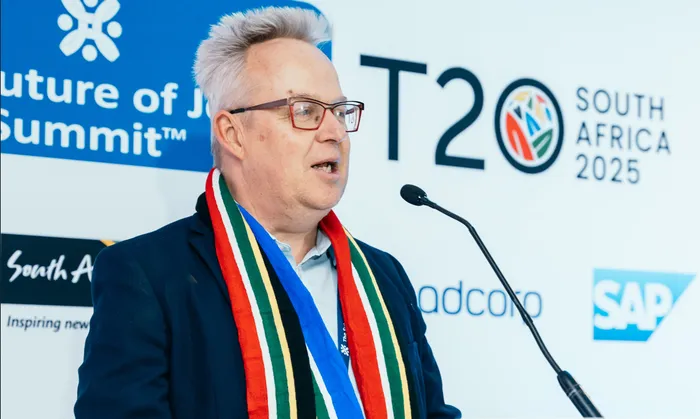
Dr Nik Eberl is the founder and executive chair: The Future of Jobs Summit™ (Official T20 Side Event). He is also the author of Nation of Champions: How South Africa won the World Cup of Destination Branding).
Image: Supplied
Two weeks before the opening match of the 2010 FIFA World Cup, something extraordinary happened in Soweto. Orlando Stadium hosted a Super Rugby match between the Lions and the Sharks - the first major professional rugby match ever played in a South African township.
Thousands of rugby supporters, many of them visiting Soweto for the first time, streamed into the township wearing their team colours.
For many, it was a journey into a community they had previously known only through newspaper headlines and television reports.
What they discovered surprised them. Instead of fear, they found hospitality. Instead of division, they found celebration. Instead of the South Africa they had imagined, they encountered the South Africa they had never experienced.
Just days later, the same stadium hosted the official World Cup Kick-Off Celebration Concert.
Broadcast to hundreds of millions of viewers around the world, Orlando Stadium became the stage on which South Africa introduced itself - not simply through football, but through music, culture, warmth and the unmistakable spirit of Soweto.
Those two events captured something profound. They proved that when people experience South Africa rather than merely read about it, perceptions change.
Nelson Mandela understood this better than anyone. His greatest achievement was not simply leading South Africa into democracy.
It was inspiring South Africans to believe in one another again. He recognised that nation-building is not achieved through legislation alone. It is built through shared experiences that replace fear with trust, stereotypes with understanding, and division with belonging.
Sport became one of his most powerful instruments of nation-building. The 1995 Rugby World Cup gave South Africans a glimpse of what unity could look like.
The 2010 FIFA World Cup showed the world what South Africa could become when it believed in itself. Today, as we celebrate Mandela Month, another opportunity stands before us. The 2027 Cricket World Cup should not simply be viewed as another international sporting event. It should become South Africa's next nation-building project.
Having been privileged to lead the Brand Ambassador Programme during the 2010 FIFA World Cup, I witnessed how ordinary South Africans became extraordinary ambassadors for our country. Visitors arrived carrying concerns shaped by international media. They departed with stories of kindness, generosity, resilience and joy.
Many of their most memorable experiences happened outside the stadiums. They happened while walking through Vilakazi Street.
They happened around braais and township restaurants.
They happened while listening to local musicians, meeting entrepreneurs and discovering communities bursting with creativity and optimism. Those moments did more for South Africa's reputation than any advertising campaign could have achieved. They transformed visitors into ambassadors.
Fifteen years later, another story has quietly unfolded in those same communities. As GG Alcock argued so compellingly in Kasinomics, South Africa's townships are home to one of the country's most dynamic entrepreneurial ecosystems.
Despite years of slow national economic growth, township entrepreneurs have continued to innovate, create employment and build thriving businesses by understanding their customers better than almost anyone else.
The township economy is no longer simply an informal economy. It is an innovation economy. It is a relationship economy.
It is increasingly an investment economy. Corporate South Africa is beginning to recognise this reality.
Recent investments into township commerce, including Pepkor's R21.3 billion merger of Flash and Shop2Shop, reflect growing confidence in entrepreneurs who have spent years building resilient businesses under extraordinarily challenging conditions.
But the greatest opportunity lies beyond economics. Imagine if every visitor attending the 2027 Cricket World Cup experienced not only world-class cricket, but also the entrepreneurial energy of Soweto, the creativity of Alexandra, the history of Vilakazi Street, the music, food, art and innovation that define modern township life.
Imagine if township entrepreneurs became part of South Africa's official visitor experience. Imagine if every international visitor left South Africa not simply having attended a sporting event, but having formed genuine relationships with local communities. That would create something no competing destination could replicate.
Every nation can build stadiums. Few can offer authentic human experiences. South Africa can. In a fiercely competitive global tourism market, our greatest differentiator is not our infrastructure. It is our people.
That is why the legacy of 2027 should not be measured only in visitor numbers, hotel occupancy or broadcast audiences. Its true legacy should be measured by stronger township businesses, new investment into local entrepreneurs, richer visitor experiences, lasting international goodwill and renewed national confidence.
Cricket South Africa, Brand South Africa, South African Tourism, the host cities, business leaders and local communities have an opportunity to work together on something much bigger than a tournament. They have an opportunity to build a legacy.
Mandela showed us that sport can unite a nation. The 2010 FIFA World Cup showed us that South Africa can inspire the world.
The 2027 Cricket World Cup now gives us the opportunity to connect those two legacies—to showcase not only our sporting excellence, but our entrepreneurial excellence; not only our destinations, but our people; not only our economy, but our capacity for nation-building.
If we seize that opportunity, the world will remember far more than the cricket. It will remember how South Africa made them feel. And in doing so, we may rediscover something equally important. Our own belief in ourselves.
Dr Nik Eberl is the founder and executive chair: The Future of Jobs Summit™ (Official T20 Side Event). He is also the author of Nation of Champions: How South Africa won the World Cup of Destination Branding).
Follow Business Report on Facebook, X and on LinkedIn for the latest Business and tech news.