

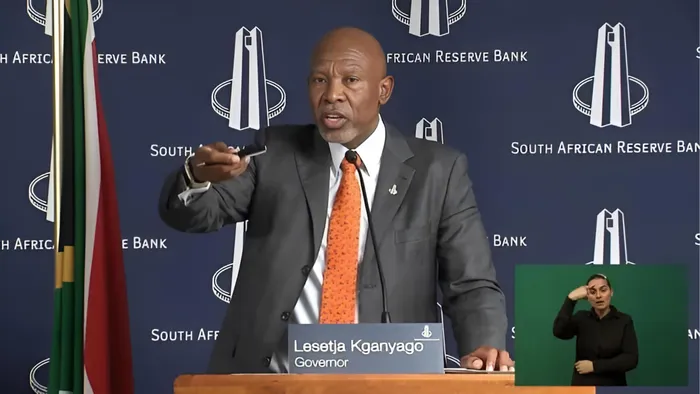
The South African Reserve Bank kept interest rates unchanged, with economists and property experts saying the decision provides certainty while warning that volatile oil prices remain the biggest risk to inflation and future rate decisions.
Image: IOL | File
The South African Reserve Bank's (Sarb) decision to leave the repo rate unchanged at 7% has provided welcome certainty for consumers, homeowners and the commercial property sector, although economists cautioned that volatile oil prices remain the single biggest threat to South Africa's inflation outlook.
The Monetary Policy Committee (MPC) kept the prime lending rate at 10.5%, with four members voting to hold rates and two preferring a 25 basis point increase, highlighting the delicate balancing act facing policymakers.
The decision came despite inflation accelerating to 5% in June, largely driven by higher fuel prices linked to renewed conflict in the Middle East.
Arthur Kamp, chief economist at Sanlam Investments, said the Reserve Bank's updated inflation forecasts reflected a more favourable oil price outlook.
"The bank's headline CPI forecast was revised lower for 2026 to an average of 4.0%, from 4.4% previously, while the peak for inflation is now expected at 4.7% in the first quarter of 2027, from 4.9% previously. In part, this reflects a lower oil price assumption," Kamp said.
He noted that despite debate around another interest rate increase, the Bank's own projections still pointed towards lower interest rates over the medium term.
"It is interesting to note that whereas the debate was whether to leave the repo rate unchanged or whether to hike it, the bank's quarterly projection model continues to show a lower repo rate going forward, at 6.79% in the fourth quarter of 2026, and 6.24% in the fourth quarter of 2027."
Kamp warned, however, that inflation expectations remain a key concern.
"The bank nonetheless does warn that there are potential upside risks to inflation. One of the key factors to watch would be inflation expectations, which have been drifting higher and hold the risk of second round effects. If inflation expectations remain high or continue to drift upwards, the risk is that the Reserve Bank would need to hike again in the future."
The property sector broadly welcomed the decision, saying certainty around borrowing costs would support investment decisions after months of speculation over additional rate increases.
Norman Raad, chief executive of Broll Auctions and Sales, said stable interest rates improve confidence across the commercial property market.
"A hold means the numbers buyers ran three months ago still hold up today. That kind of certainty is what gets deals over the line," Raad said.
"We have seen it before. When the cost of capital stops moving, decision making speeds up."
He said the unchanged rate would benefit both buyers and sellers.
"A hold does not mean things are getting easy again. Rates are still restrictive by historical standards. What a hold does is stop the goalposts moving, and that is enough to keep transaction volumes healthy."
Stephen Whitcombe, managing director of the FIRZT Property Group, said the Reserve Bank had correctly recognised that today's inflation pressures were largely imported through higher fuel costs rather than excessive consumer demand.
"The biggest contributors have been sharply higher fuel prices following renewed conflict in the Middle East and the resulting disruption to global oil markets, together with steep increases in administered prices such as municipal electricity and water tariffs," Whitcombe said.
"These are costs that households simply cannot avoid. Whether interest rates are higher or lower, people still need to fill their cars with fuel to get to work, keep the lights on and pay their municipal accounts."
He added that keeping rates unchanged also supports the currency.
"Keeping interest rates at their current level will help to maintain confidence in the South African economy and support the value of the rand."
Whitcombe said this was particularly important as crude oil imports are priced in US dollars.
"If the rand weakens significantly, those imports become even more expensive, adding another layer of inflationary pressure. Relatively attractive South African interest rates help to encourage foreign investment into local financial markets, supporting the currency and limiting the extent to which imported inflation feeds through into the economy."
Looking ahead, Whitcombe believes lower oil prices could eventually provide room for interest rate relief.
"As the Reserve Bank Governor noted today, there are reasons to believe that some of the inflationary pressures currently affecting South Africa may begin easing over the coming year. Many international energy analysts expect oil prices to moderate as supply conditions improve and geopolitical tensions stabilise."
He added that the residential market remained resilient despite elevated borrowing costs.
"Demand for well priced homes remains healthy, supported by ongoing demographic changes, semigration trends, lifestyle shifts and the growing appeal of residential property as an investment among younger people."
The labour union UASA also welcomed the decision, saying households desperately needed stability after months of rising living costs.
Abigail Moyo, spokesperson for UASA, said holding rates steady would provide much needed relief.
"Although many market observers anticipated a further interest rate increase, UASA believes the MPC's decision to hold rates steady will provide much needed short term relief to consumers who are already grappling with elevated living costs."
Moyo said the organisation remained optimistic that easing inflationary pressures could allow the Reserve Bank to reduce borrowing costs later this year.
"UASA remains hopeful that improving economic conditions could create space for interest rate cuts later in the year, helping to ease financial strain on households and providing welcome relief ahead of the festive season."
She also urged government to address the underlying drivers of inflation.
"Sustaining consumer spending power is essential to stimulating economic activity and supporting long term growth."
While the latest decision provides certainty for now, economists agree that future monetary policy will continue to hinge largely on developments in global oil markets and whether geopolitical tensions continue to place upward pressure on fuel prices and inflation.
Follow Business Report on Facebook, X and on LinkedIn for the latest Business and tech news.