

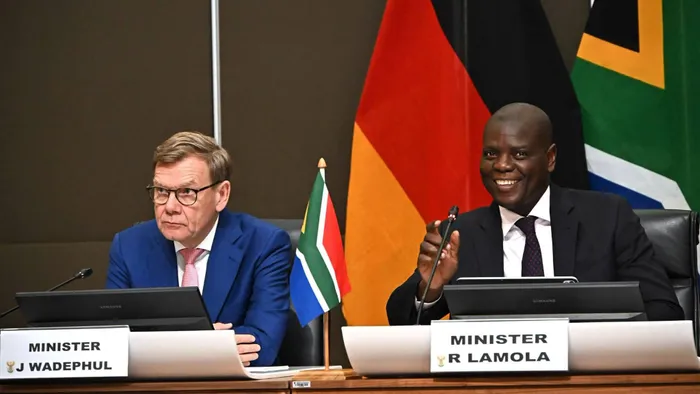
South Africa and Germany are making progress in implementing their strategic partnership joint action plan according to Minister of International Relations and Cooperation, Ronald Lamola.
Image: Supplied
South Africa and Germany are making progress in implementing their strategic partnership joint action plan, according to Minister of International Relations and Cooperation, Ronald Lamola.
Lamola was speaking on Thursday while hosting Germany's Federal Minister for Foreign Affairs, Dr Johann Wadephul, for a bilateral meeting in Pretoria.
Lamola said that Wadephul’s visit follows the 12th Meeting of their Bi-National Commission, held in Berlin in April this year.
“That meeting marked thirty years of the Commission. It was also the occasion on which our two countries decided to elevate our relationship to a Strategic Partnership and adopted a Joint Action Plan to give practical effect to that decision,” he said.
Lamola added that they reviewed implementation across the Action Plan, took stock of the progress made, and agreed on the areas in which they must move faster.
“Germany is South Africa’s most important trading partner in Europe. Some 600 German companies operate in our country and employ approximately 100,000 people. Our discussions therefore gave close attention to the economic dimension of our partnership.”
Lamola said that they discussed the expansion of trade and investment, cooperation on critical raw materials, and the development of a battery value chain that creates value and jobs here in South Africa.
“We also discussed the Just Energy Transition Partnership, which supports our shift towards cleaner energy in a manner that is socially just, as well as our long-standing cooperation on vocational education and training. This cooperation speaks directly to the urgent challenge of youth employment.”
Lamola added that they agreed to institutionalise regular high-level political dialogue between the two countries' foreign ministries.
“Our intention is to ensure that engagement of this kind becomes a standing feature of our partnership, rather than an occasional event,” he said.
“We further agreed to advance practical cooperation on strengthening democratic resilience, including through efforts to counter disinformation, an area in which both our societies face similar pressures.”
Lamola said that beyond their bilateral agenda, they exchanged views on the major international questions of the moment.
“These included the pursuit of peace and stability on our own continent, particularly in the eastern Democratic Republic of the Congo, the war in Ukraine, and the situation in the Middle East.”
Lamola added that in the Middle East, he reaffirmed South Africa’s consistent and principled position.
“We remain gravely concerned about the humanitarian situation in Gaza. We call for the full implementation of the ceasefire, unimpeded humanitarian access, and a credible political process leading to a two-state solution, with a viable Palestinian state existing alongside a secure Israel. Our approach is grounded in international law and the United Nations Charter.”
Lamola said that South Africa and Germany do not view every aspect of this question in the same way.
“It is precisely because of the strength of our partnership that we are able to discuss our differences openly and in good faith. I welcomed the candour of our exchange.”
Lamola added that as Chair of the Southern African Development Community, and ahead of the Summit that the country will host next month, he briefed Wadephul on their regional priorities.
“These include industrialisation, agricultural transformation, and the energy transition, alongside our support for African-led efforts to secure peace and stability in our region,” he said.
“I also expressed South Africa’s appreciation for Germany’s principled support for an inclusive G20, and for its view that the forum should not be diminished.”
Lamola concluded that he was proud to host the first G20 Summit on African soil last year. “We will continue to defend the inclusivity and integrity of that forum.”
BUSINESS REPORT