

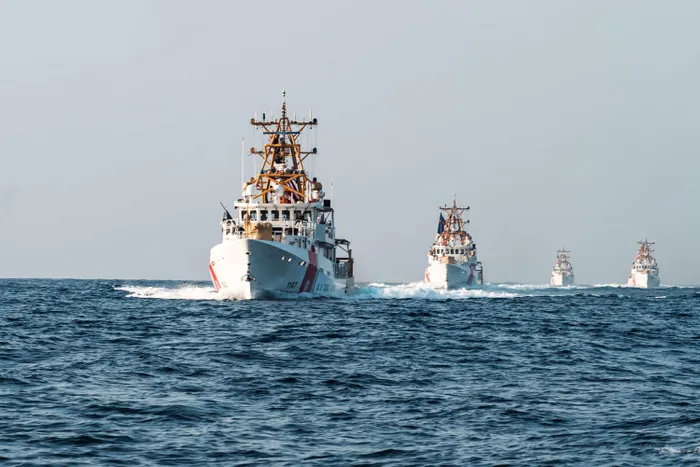
With Middle East tensions starting to flare up again, experts have warned that tolls in the Strait of Hormuz look more of a certainty.
Image: Noah Martin / Various Sources / AFP
With Middle East tensions starting to flare up again, experts have warned that tolls in the Strait of Hormuz look more of a certainty. Some concern has been raised about the impact this could have on international oil prices.
Financial advisory giant deVere Group’s CEO Nigel Green said that this follows Monday’s biggest one-day surge since the pandemic era, with Brent crude climbing further past $85 (R1389) a barrel on Tuesday after President Trump announced a 20% fee on cargo transiting the strait, alongside a renewed naval blockade of Iranian ports.
“Whoever wins this fight over the toll, the bill lands on everyone else. About a fifth of the world’s oil and gas moves through Hormuz. Add a 20% charge on that and you’ve taxed global energy, full stop, no matter whose flag is on the toll booth,” added Green.
Green stated that two governments are fighting over who gets to run the toll booth. “The rest of the world just pays whoever wins.”
Professor Andre Thomashausen, professor emeritus of international law at Unisa, said that global oil production averages around 84.5 million barrels per day, and only about 10% of that passes through the Hormuz international waterway.
“Current global production capacities can easily make up for any interruption of the Hormuz-dependent supply, and global price levels will not be affected by increased costs resulting from the obstructions in Hormuz. Iran cannot win. Production increases from elsewhere and pipelines under construction are going to render passage through Hormuz irrelevant.”
Professor Simphiwe Madikizela, an economist at the University of South Africa (Unisa), said that it is a big concern as it’s introducing another dynamic which will slow things down even more due to the tolls that are introduced.
“Not only will it increase the costs, it will impact on the time it takes, which talks to efficiency and the other related logistics. The longer the ships take to move through due to the backlog, the impact is negative in the world's oil supply, and South Africa will be impacted negatively like other countries that are importing the crude oil.”
Madikizela added that the possibility of tolls will add more costs, create more delays and inefficiencies with the logistics, and will further slow down economic growth, as well as costs of doing business.
“However, we are fortunate that we are not only importing our oil from the Middle East; we are getting supply from other countries on the continent, so availability of oil will continue; only the price will increase as we have seen the increase in the crude oil price hovering around $83 (R1357) to $85 (R1390) per barrel, which will increase the prices of diesel and petrol.”
Dr Sakhile Hadebe, a lecturer in Political Science and International Relations at the University of KwaZulu-Natal (UKZN), said that the prospect of tolls being imposed on shipping through the Strait of Hormuz represents a significant shift in geopolitical risk because it transforms a temporary security disruption into a potentially institutionalised cost on global energy trade.
“Whether such tolls are ultimately enforced by the US, or claimed by Iran, the implications extend far beyond the Gulf region.”
Hadebe added that the Strait of Hormuz is arguably the world's most strategically important maritime chokepoint, carrying approximately 20% of globally traded crude oil and a substantial share of liquefied natural gas exports, particularly from Saudi Arabia, Iraq, Kuwait, Qatar and the United Arab Emirates.
“Any additional cost imposed on transit immediately feeds into global energy markets because oil is priced internationally rather than regionally. Consequently, even countries that do not import oil directly from the Gulf experience higher prices through international benchmark pricing.”
Visit:www.businessreport.co.za
Hadebe concluded that the more concerning issue is that markets are reacting not simply to the proposed toll itself but to the uncertainty surrounding the governance of one of the world's critical maritime routes. “For South Africa, the implications are significant despite the country's geographic distance from the Gulf. South Africa imports a substantial proportion of its crude oil and refined petroleum products from international markets whose prices are determined by Brent crude. A sustained increase in oil prices would therefore translate directly into higher domestic fuel prices.”
Waldo Krugell, an economist at North West University, said that the concern about the Strait of Hormuz is justified, but the argument that a permanent global energy toll is now almost unavoidable has already been overtaken by events. “President Trump withdrew the proposed 20% fee only a day after announcing it. The real risk is therefore not currently a formal toll. It is the geopolitical risk premium created by attacks on vessels, the blockade of Iranian shipping, longer waiting times and increasingly expensive or unavailable marine insurance. These factors can restrict the effective supply of oil even without the strait being formally closed.”
BUSINESS REPORT
https://businessreport.co.za/