

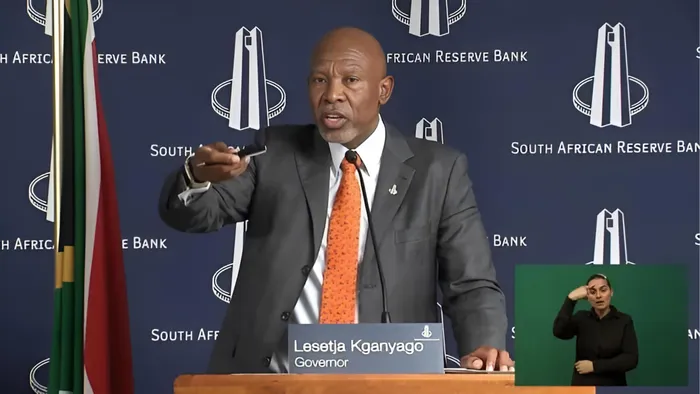
SA Reserve Bank (Sarb) Governor, Lesetja Kganyago. Escalating conflict in the Persian Gulf and rising oil prices have prompted economists to warn that the South African Reserve Bank may raise interest rates again later this week to contain inflationary risks.
Image: IOL | File
Escalating conflict in the Persian Gulf and a renewed surge in global oil prices have increased the likelihood that the South African Reserve Bank (Sarb) could raise interest rates again later this week as policymakers seek to contain inflationary pressures.
The Monetary Policy Committee (MPC) is scheduled to announce its next interest rate decision this Thursday on July 23, just one day after Statistics South Africa (StatsSA) releases the June consumer inflation data.
Economists say the renewed conflict around the Strait of Hormuz has significantly altered the inflation outlook after markets had previously anticipated lower oil prices and a stronger rand following the ceasefire announced earlier this year.
The Reserve Bank raised the repo rate by 25 basis points in May, lifting the prime lending rate to 10.5%.
Frank Blackmore, lead economist at KPMG, said expectations before the renewed hostilities had favoured an unchanged interest rate.
"The MPC will bring out their policy rate decision later this week, just one day after the June CPI value has been released. Prior to hostilities commencing once more in the Persian Gulf after the ceasefire apparently seems to be broken, the assumption would have been perhaps to keep rates steady given the fact that under the ceasefire condition, we would have expected and saw oil prices falling as well as recovery in the rand strength that would have promoted lower inflation," Blackmore said.
He said the renewed conflict had changed the outlook for monetary policy.
"With the commencement of the war however, the bank will have to look at if the impact over a prolonged period of time requires an additional increase in the policy rate of the Reserve Bank. It is the feeling of this organisation that there may be an additional 25 basis points increase in the repo rate at the next Monetary Policy announcement."
Andreas Tindlund, fixed income specialist at Abax Investments, said rising oil prices were already affecting global financial markets and increasing inflation risks for South Africa.
"Higher oil prices are pushing up global bond yields and strengthening the US dollar, which tends to weaken the rand and raise imported inflation. This places pressure on South African bonds and interest rate sensitive sectors such as property and retail, while commodity linked sectors like energy and gold may offer some support," he said.
Tindlund said inflation expectations remained the central concern for policymakers.
"The key issue for the Reserve Bank is inflation expectations. These are now drifting above the Sarb's 3% target, with recent surveys showing expectations moving closer to 4%, and renewed uncertainty around oil prices limits the Bank's ability to wait."
He said Abax Investments expected another 25 basis point increase at the upcoming MPC meeting, while warning that additional tightening later this year remained a possibility.
"We expect another 25 basis point rate hike at the upcoming MPC meeting in two weeks' time, with further tightening later in the year a clear risk."
According to Tindlund, higher interest rates combined with rising living costs would place additional financial pressure on households.
"The result is a double hit for South Africans: higher living costs and higher bond repayments."
He advised investors to closely monitor three key indicators over the coming days.
"Local investors should focus on three things in the coming days. The first is the oil price, which remains the clearest real time barometer of geopolitical risk. The second is the rand. A weaker currency would amplify imported inflation and increase pressure on the Sarb."
He added that the Reserve Bank's communication following its policy meeting would also be closely scrutinised.
"The third, and most important locally, is central bank communication. With inflation expectations rising and oil prices back in focus, the Sarb is unlikely to ignore the risk. Markets are already pricing in further rate hikes at upcoming MPC meetings, and any signal from the Bank will be critical for bonds and other interest rate sensitive sectors."
Tindlund said developments in the Strait of Hormuz would remain the key driver of market expectations.
"Ultimately, the key trigger remains the situation in the Strait of Hormuz. Developments there can shift oil prices, the rand and rate expectations very quickly."
Follow Business Report on Facebook, X and on LinkedIn for the latest Business and tech news.