

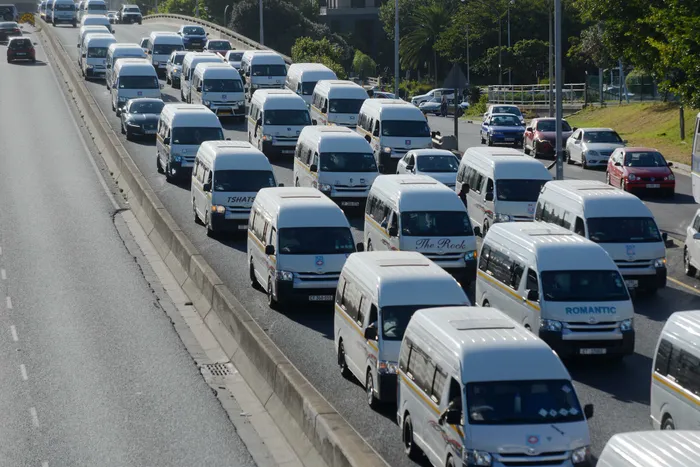
A new emissions study found diesel minibuses are contributing disproportionately to air pollution in Johannesburg, with experts calling for urgent policy interventions to protect public health.
Image: Armand Hough/Independent Newspapers
Diesel powered minibus taxis are emerging as one of Johannesburg's biggest contributors to harmful vehicle emissions, with a new study warning that residents in central and southern parts of the city are bearing the greatest health burden from poor air quality.
The findings, released by The Real Urban Emissions Initiative, mark Africa's first real world roadside vehicle emissions study and provide one of the clearest pictures yet of how different vehicle types contribute to air pollution in Johannesburg.
The study, supported by Breathe Cities, analysed more than 250 000 vehicle exhaust measurements collected at 11 sites across Johannesburg between July and September 2025.
It found that while minibus taxis accounted for only 10% of the measured vehicle fleet in central and southern Johannesburg, they contributed between 21% and 40% of total measured vehicle emissions in those areas, particularly carbon monoxide and hydrocarbon emissions.
Researchers also found diesel powered minibuses emitted particulate matter levels up to 18 times higher and nitrogen oxide emissions up to 44 times higher than their petrol powered counterparts.
The report warned that the rapid shift towards diesel minibuses could worsen air quality if no action is taken. Diesel vehicles accounted for 98% of all new minibus taxi registrations in 2025, compared with just 7% in 2001.
The research also highlighted the significant impact of ageing vehicles on emissions.
Petrol passenger cars registered before 2006 represented only 4% of Johannesburg's fleet but contributed between 12% and 24% of nitrogen oxide emissions, 21% of hydrocarbon emissions, 22% of carbon monoxide emissions and 24% of particulate matter emissions.
Older petrol minibuses registered before 2006, representing 8% of the fleet, also contributed between 22% and 25% of the city's hydrocarbon and carbon monoxide emissions.
The study estimated that transport related emissions contributed to about 500 premature deaths and 200 new cases of childhood asthma in Johannesburg during 2024. Across Gauteng, vehicle emissions were linked to more than 1 200 premature deaths and nearly 500 new paediatric asthma cases.
Residents living in central and southern Johannesburg, where reliance on public transport is greatest, were identified as facing the highest exposure to harmful vehicle emissions.
Nokuthula Dubazane, Portfolio Manager for South Africa at Breathe Cities, said the findings provide policymakers with the evidence needed to tackle air pollution more effectively.
"This report gives Johannesburg the evidence it needs to act. The city has already proposed clean air zones as a key policy solution, and findings like these, showing exactly where emissions are highest and who bears the greatest burden, are what turn recommendations into targeted, effective policy."
Dubazane said cleaner air was achievable when cities had reliable data to guide decision making.
"At Breathe Cities, we believe that cleaner air is achievable when cities have robust data to make informed decisions, and we hope this study accelerates that process in Johannesburg and across the continent."
The report supports the City of Johannesburg's proposal to introduce clean air zones, particularly in central and southern parts of the city, to encourage a gradual transition towards cleaner transport.
Additional recommendations include adopting Euro 6d and VI D vehicle emission standards for new vehicles, expanding and enforcing vehicle inspection and maintenance programmes, and accelerating the adoption of electric minibus taxis through financing initiatives that lower upfront costs.
Lebo Molefe, Director of Air Quality and Climate Change at the City of Johannesburg, said the research fills an important knowledge gap.
"The completion of the TRUE Initiative real world vehicle emissions study marks a significant milestone for Johannesburg. By providing detailed insights into actual on road vehicle emissions under local operating conditions, the study helps address a critical evidence gap that has historically constrained the development of targeted and effective interventions."
She said the findings would help shape future policies.
"These findings will strengthen the city's ability to work collaboratively with provincial and national government partners to develop evidence based policies, strategies and programmes that reduce vehicle emissions, improve air quality and deliver healthier outcomes for our residents."
Mallery Crowe, lead author and researcher at the International Council on Clean Transportation, said the findings showed that relatively few vehicles were responsible for a large share of emissions.
"This latest testing campaign has expanded our picture of vehicle emissions in Johannesburg and can help broaden our understanding of vehicle emissions across the larger region in Africa. We see that a small number of older vehicles emit a disproportionate amount, so targeted policies to quicken fleet turnover will be crucial to improve air quality."
Boitemogelo Kwakwa, project leader at UJ PEETS, said the study represented an important milestone for South Africa.
"Delivering Africa's first real world roadside vehicle emissions remote sensing campaign is a significant milestone for both South Africa and the continent."
She said the technology could now be expanded to other cities.
"Our vision is to build on this success by replicating similar campaigns across South Africa, enabling cities and government to access robust, locally generated evidence that can accelerate cleaner transport policies, improve air quality and protect public health."
Sheila Watson, deputy director of the FIA Foundation, said the findings underscored the urgency of tackling transport related pollution.
"The TRUE Initiative has shown the shockingly high emissions of vehicles on Johannesburg's streets. Hundreds of the city's residents are sicker or dying each year because of dirty air, to which road vehicles are a major contributing factor."
"Real world data such as this in Johannesburg is vital to understand and then to address a public health crisis. These findings point to the need for urgent action, not only to clean up the city's air but to protect the health and lives of its residents."
Follow Business Report on Facebook, X and on LinkedIn for the latest Business and tech news.