

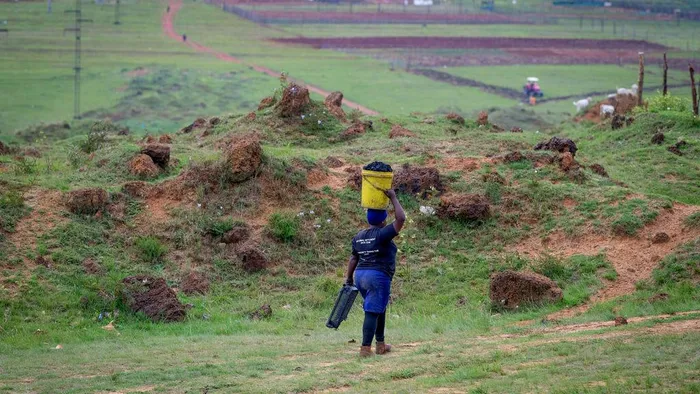
A resident near the abandoned Imbabala Coal Mine near Ermelo.
Image: Centre for Environmental Rights
Communities living near an abandoned coal mine outside Ermelo have asked the Mpumalanga High Court to declare part of South Africa's mining legislation unconstitutional.
They argue it leaves authorities without clear powers to intervene when mines are abandoned, and their owners cannot be traced.
The Khuthala Environmental Care Group, together with residents of Nomzamo Agri Village, Steve Biko Settlement and Thusi Ville, have filed an application challenging section 46(1) of the Mineral and Petroleum Resources Development Act (MPRDA) as unconstitutional.
This section of the Act empowers the Minister to intervene when prospecting or mining operations cause pollution, environmental damage or ecological degradation and the responsible holder fails to address it.
According to the applicants, this section is inconsistent with the section in the Constitution that guarantees the right to an environment that is not harmful to health or well-being.
A statement from the Centre for Environmental Rights (CER) said the group contends that the provision doesn’t grant the Minister clear and enforceable powers to act when mines are abandoned, and owners cannot be traced, “creating a legal gap that undermines environmental protection and accountability”.
The application, filed in the High Court in Middelburg, cites the Minister of Mineral and Petroleum Resources, the department's director-general and Mpumalanga regional manager, the Minister of Public Works and Infrastructure, and the Msukaligwa Local Municipality as respondents.
The challenge centres on the abandoned Imbabala Coal Mine near Ermelo, which the applicants say illustrates the consequences of the alleged legislative gap.
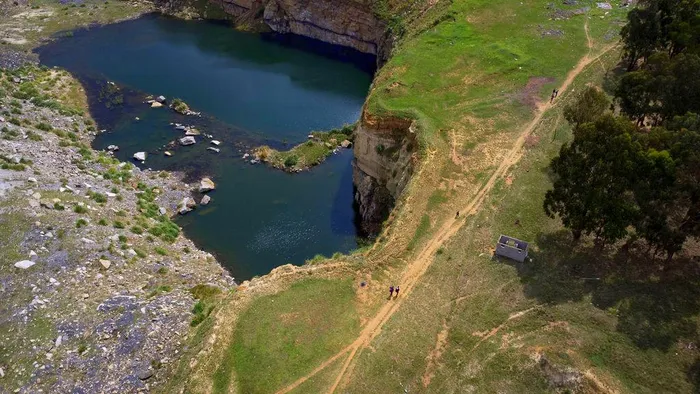
According to a recent report by the CER, the country has about 6,100 abandoned and derelict mines, including at least 400 abandoned coal mines.
Image: Centre for Environmental Rights
According to the court application, Imbabala Coal ceased operations in 2011 after being ordered to stop mining without a valid water-use licence. The company was later deregistered in 2018, and its owners can no longer be traced.
The applicants allege the site was left with open pits, contaminated land and polluted water sources, while rehabilitation never took place.
They further state that several children have drowned in the open mine pit over the years and that community members have been injured or killed after falling into excavations at the site.
The application also cites water quality tests that allegedly found contamination in nearby water sources used for crops and livestock.
According to the applicants, the Department of Mineral and Petroleum Resources holds about R600,000 in financial provision linked to the mine, despite estimates suggesting that around R450 million would be required to rehabilitate the site fully.
The communities argue that the Imbabala case is not an isolated incident but highlights broader challenges associated with abandoned mines across South Africa.
According to a recent report by the CER, the country has about 6,100 abandoned and derelict mines, including at least 400 abandoned coal mines, many of which continue to pose environmental and safety risks years after operations ceased.
An Auditor-General South Africa (AG-SA) audit in 2021/22 referenced in the report found that, of these 6,100 derelict and ownerless mines, 2,568 were high-risk and there were 1,170 dangerous openings, while only 555 mines had been rehabilitated.
Minister of Mineral and Petroleum Resources Gwede Mantashe's 2026/27 Budget Vote stated that R23.48 million was allocated for the Mine Rehabilitation Research Project and R140.87 million for the rehabilitation of derelict and ownerless mines.
The DMPR's 2025 annual report said the department closed 280 hazardous mine openings and rehabilitated derelict sites, while intensifying action against illegal mining.
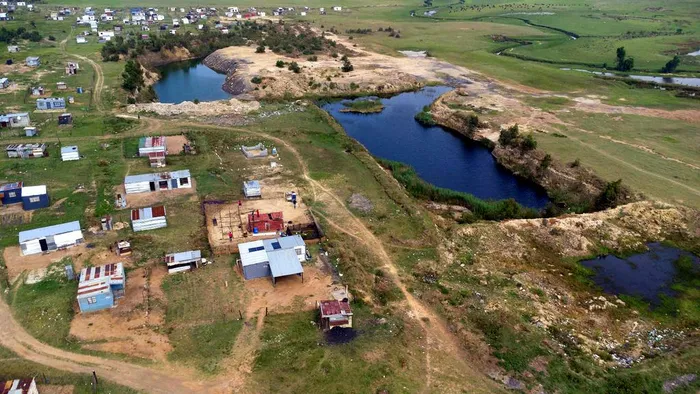
Inhabitants live near a former open-pit coal mine in Mpumalanga.
Image: Centre for Environmental Rights
Mpumalanga, South Africa's coal-mining heartland, features prominently in the report. The province accounted for R14 billion in financial provision held by mining companies between 2000 and 2023, yet communities continue to live alongside abandoned sites that have not been rehabilitated.
The CER has previously highlighted the Imbabala mine as an example of the long-term consequences of failed mine closure, citing drowning incidents, unsafe excavations and environmental contamination years after mining activities ended.
In a statement accompanying the court action, attorney Thobeka Gumede of the Centre for Environmental Rights said the matter exposed what the applicants regard as a critical gap in the law.
“Mining-affected communities are left to bear the devastating social, environmental, and economic costs of extraction. This is not only a legal battle — it is a fight for justice led by communities living daily with polluted water, unsafe land, and abandoned mines,” said Gumede.
CER said the applicants turned to the courts after years of engagement failed to secure meaningful rehabilitation or safety measures at the site.
IOL BUSINESS