

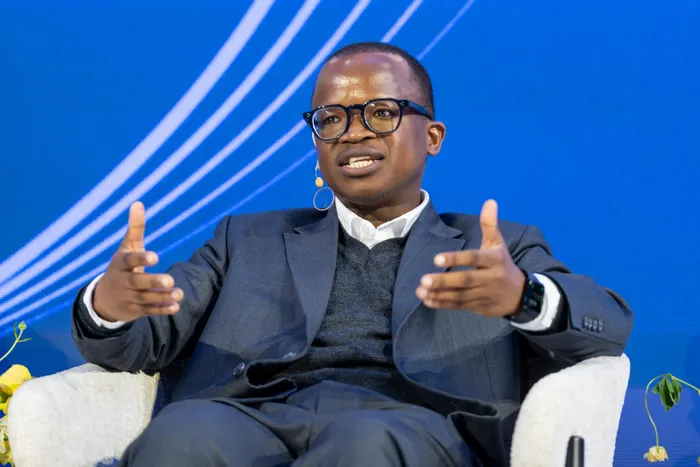
A panel discussion at the Standard Bank Africa Unlocked Conference took place in Cape Town on Friday, focusing on how to unlock Africa’s agricultural production to deepen intra-trade and exports.
Image: Supplied
A panel discussion at the Standard Bank Africa Unlocked Conference 2026 in Cape Town focused on how to unlock Africa’s agricultural production to deepen intra-trade and exports to other regions, with key interventions required including government support of the commercial farming sector and granting farmers title deeds to their land.
Wandile Sihlobo, Chief Economist at the Agricultural Business Chamber of South Africa, said that to unlock Africa’s agricultural production, "we must have a product before we can export. Various African countries can learn from the South African agricultural story of private sector-led growth,"
He said extending title deeds or tradable leases to farmers and agribusinesses is vital for attracting investment. Investments in infrastructure are critical for improving value chains.
Sihlobo said embracing technological advancements in seeds, genetics, and agrochemicals is important for boosting productivity. “Limited trade and commodity price interventions are essential for ensuring policy certainty and ultimately attracting investment.”
Sihlobo said that supporting commercial farming, which will be essential for the growth of the agro-processing part of the various countries’ food systems and a source of employment, is a critical step for agricultural progress in Africa.
“South Africa is not a perfect country; we face unique challenges, including rising crime, failing municipalities, deteriorating roads, port issues, and a slow inclusivity journey. Still, judging from a broad national performance, South Africa offers many lessons for Africa,” he said.
Sihlobo said South Africa is doing a lot of exports on the continent. “We need to look at what learnings we are taking from South Africa that we can see in Zambia, as well as Malawi and Kenya; this will allow you to improve agricultural production and agro-processing.”
Sihlobo said that you must have a product that you can trade. “If we do not improve agricultural productivity across the African continent, we are going to sit with the same problem that we have in the South African Customs Union (SACU), where one country is more dominant than the other.”
Sihlobo said it is important that South Africa can produce food products quite cheaply at a farm level. “We encounter all sorts of problems in logistics and ports; however, we are still able to deliver it to any particular market at a competitive price.
We are expecting El Niño later on this year in South Africa; had we had the East Africa region be as robust in agricultural production as when we experience drought here, they have better rainfall there, so we actually would be importing from East Africa instead of other parts of the world.”
Mohammed Dewji, CEO of MeTL Group in Tanzania, said that for decades, Africa'spotetial had been spoken about.
"We have debated what Africa could become, what Africa should do, and what Africa might achieve. Today, Africa is no longer defined by its potential. It is increasingly defined by what it IS already building. Across our continent, entrepreneurs are building globally competitive businesses, manufacturers are adding value, farmers are feeding nations, and innovators are solving African problems with African solutions.”
Dewji added that MeTL Group began as a trading business, moving essential goods to the people who needed them. “But as Tanzania—and Africa—continued to evolve, we realised that trading alone would never be enough. We believed Africa could not build lasting prosperity by exporting raw materials and importing finished products.”
Dewji concluded that the company expanded into food processing, edible oils, beverage production, textile manufacturing, soaps, detergents, and consumer goods used by millions of African families every day.
Today, MeTL manufactures more than 50 product categories, operates in 11 African countries, employs over 40,000 people, and is on track to generate more than $3 billion (R49bn) in annual revenue in 2026. That ability to adapt has been one of MeTL’s greatest strengths. Over the years, we have navigated commodity cycles, currency fluctuations, changing regulations, and shifting consumer demand.
Visit:www.businessreport.co.za