

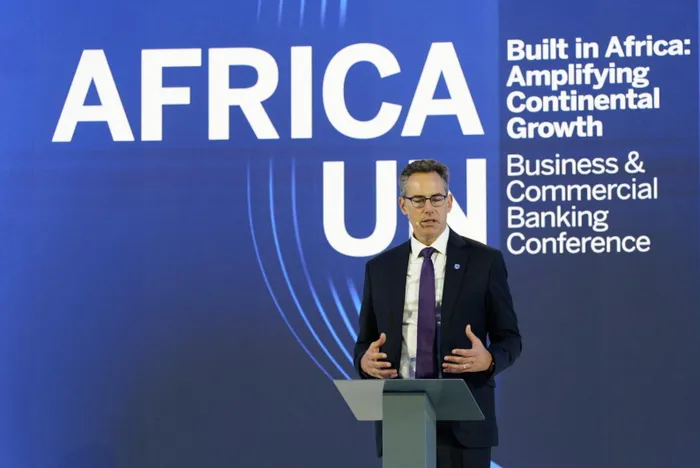
Standard Bank Africa unlocked conference that took place recently looked at Africa’s potential for growth
Image: Supplied By Standard Bank
Standard Bank's Africa unlocked conference delved into the continent's substantial potential for growth, withl GDP expected to be 4% this year, despite many challenges including high US tariffs and disrupted energy and shipping flows.
Bill Blackie, CEO of business and commercial Banking at Standard Bank said this is the third edition of Africa Unlocked. “Our theme this year is Built in Africa: Amplifying Continental Growth. It speaks to growth shaped by African enterprise, African capital, and African conviction—built steadily over time, often despite prevailing sentiment. That effort compounds; Across sectors; Across borders; Across generations.”
Blackie added that when he closed this conference last year, he spoke about his optimism for Africa’s growth prospects. “Earlier this year, I visited East Africa and met one of our clients, Coast Cables. Founded in 1978 as a manufacturer of super-enameled copper cables, it has since developed into a large-scale producer of domestic and industrial power cables, supplying across the region and now expanding into solar energy."
Blackie said that what stayed with him was not only the business itself. “It was the conviction behind it. Through economic cycles, currency volatility and infrastructure constraints, they kept building. As I was leaving, the owner reflected on his journey. For years, he had done what prudent operators are taught to do—diversify, hedge and spread risk. Then he said: "If I knew then what I know now, I would have invested all my capital here in East Africa.”
Blackie added that the global context remains complex. “US tariffs are at their highest levels in over a century. Conflict in the Middle East continues to disrupt energy flows and shipping routes. The multilateral trading system is under strain in ways we have not seen in a generation.”
Blackie said Africa is expected to grow at approximately four percent this year. “Intra-African trade increased by more than twelve percent last year. Pension assets now exceed one trillion dollars. But the data point I return to most often is this: today, Business Banking clients trade more with each other across this continent than with any single external partner—more than with China, the United States or the European Union.”
Blackie added that the shift matters. “It reflects something structural rather than cyclical. Forty-seven countries are now part of the AfCFTA, the largest free trade area by number of participants anywhere in the world. Added to that, the continent’s infrastructure pipeline has never been deeper, and its energy transition ambitions have never been more commercially grounded.”
David Hodnett, CEO at Standard Bank of South Africa said that South Africa is going through a period of real and legitimate debate about its direction. “There are voices in this country — on the streets and in the headlines — that create a picture of a nation in difficulty. And I want to be honest: some of that difficulty is real. Growth is modest. Investment is below where it needs to be and the structural reforms we need are moving, but not as fast as many of us would like.”
Hodnett added that desppite this, South Africa has had its credit rating upgraded by S&P Global. “Load shedding has ended. We have been removed from the FATF Grey List. The Government of National Unity is intact and functioning. The financial sector is deep, sophisticated and internationally connected. The legal system is independent and many of our key institutions work very well and are world class.”
Hodnett said that in the South African market where while they do a lot right at an incredible scale, the sector recognises there are areas that need improvement.
“We are very focused on those. The reality is many of our customers do not simply operate in South Africa – they grow into the rest of the African continent or elsewhere into other areas of our international presence like the Gulf region or run treasury operations from our offshore jurisdictions.”
Hodnett added that these are markets that operate under entirely different regulatory environments, with different currencies, different compliance requirements, and different banking infrastructure. “We also know that clients from across Africa are investing in South Africa. And what I want you to know — is that we are working hard every day to make sure that when you cross a border, Standard Bank crosses with you.”
Visit:www.businessreport.co.za