

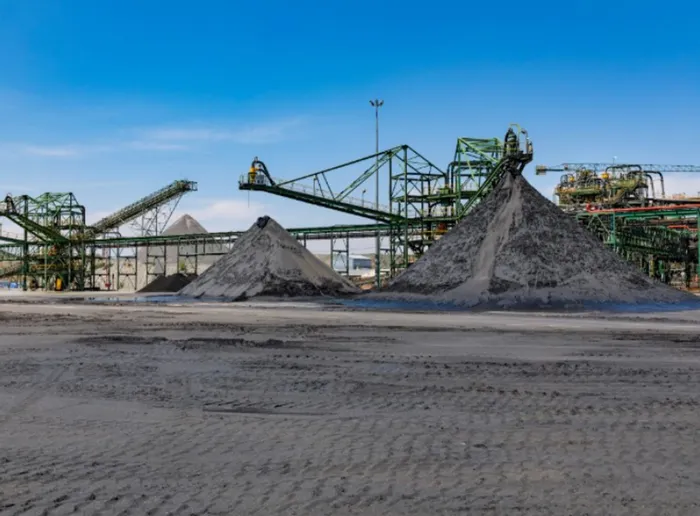
Explore the intricate socio-economic dynamics of Masebudule village, where decades of statistical analysis reveal the harsh realities of resource extraction and grant dependency in post-apartheid South Africa.
Image: Supplied
I write this with the forensic clarity that only four decades of statistical enumeration can yield.
Over forty years, I have monitored the demographic and macroeconomic heartbeat of South Africa. To truly understand the structural extraction embedded in our post apartheid landscape, one must look closely at a single geographic coordinate in the North West province: Masebudule village, situated within Ward 17 of the Lehurutse district, now the Ramotshere Moiloa Local Municipality.
My relationship with Masebudule began during the fragmentation of the homeland system.
I ran the 1985 and 1991 censuses under the Bophuthatswana administration, subsequently directing the first three post apartheid censuses in 1996, 2001 and 2011, before my successor oversaw the 2022 enumeration.
Looking through this forty year census lens reveals that Masebudule is a stark example of how national statistical frameworks systematically obscure local reality.
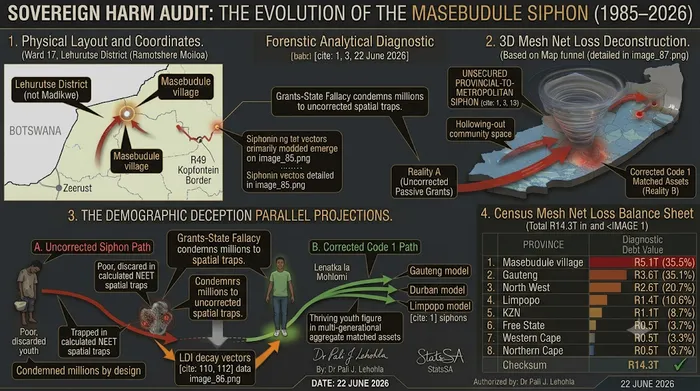
Explore the intricate socio-economic dynamics of Masebudule village, where decades of statistical analysis reveal the harsh realities of resource extraction and grant dependency in post-apartheid South Africa.
Image: Supplied.
The physical layout of Masebudule spans a compact 3.42 square kilometres near the Nietverdiend mining belt and the Riekertsdam road axis.
The shifts in its raw data tell a multi spatial story of systemic economic displacement over four distinct intervals.
1985 to 1991 (The Bophuthatswana Enclave): The village population hovered around 850 residents. Its layout was characterised by traditional residential plots, small scale livestock grazing and a high reliance on migrant remittances. More than 85% of household income was derived from male labour siphoned away to the gold mines of the Witwatersrand. The village bore the social reproduction costs while the centre reaped the capital.
2011 Census: The population grew to 1,232 individuals across 324 households, with 99.8% identifying as Black African and 92.6% as Setswana speaking. The youth demographic swelled significantly, with children aged 0 to 4 making up 13.6% of the population, signalling an expanding dependent base without a corresponding asset base.
2022 to 2026 Tracking: The population has plateaued at around 1,500 residents. However, the source of livelihoods has shifted drastically. The historical migrant labour model and subsistence farming have collapsed, replaced by a dual reliance on passive social grants of R350 to R370 and highly volatile, often informal, chrome mining extraction.
In 1985, Masebudule operated as a classic labour reservoir. Its human vitality was extracted to build the wealth of Gauteng, leaving the village to bear the structural burden.
When democracy arrived, we expected our macroeconomic accounting to correct this imbalance. Instead, successive censuses have documented a more sophisticated form of resource externalisation.
The expansion of chrome production in the Marico region did not translate into local asset accumulation. The head office aggregation effect ensured that while the earth was physically torn up in Lehurutse, the financial value added was booked at the corporate headquarters in Sandton.
Today, Masebudule is caught in a severe Vulture Vortex.
The recent boom in chrome extraction has brought conflict over mining rights rather than sustainable development.
The village has become an uncredited engine for global mineral supply chains, while its local economy remains structurally hollowed out.
The social grants intended to alleviate this poverty offer no permanent solution. Without a localised asset anchor, these cash injections function merely as liquidity lubricants.
They pass through the hands of residents and immediately exit the community through external retail monopolies.
This process leaves the younger generation trapped in a cycle of unemployment and limited local opportunities, a calculated NEET spatial trap designed through bookkeeping omission.
This brings us to a fundamental question as the nation approaches the local government elections. For forty years, the residents of Masebudule have cast their ballots under various administrative structures, yet the underlying economic pipeline has remained unchanged.
Politicians will return to Lehurutse promising basic services, minor road gravelling or temporary short term employment programmes. But the census numbers show that these superficial fixes cannot close a structural deficit. They are drops of water on a parched, hollowed out floor.
The question for Masebudule, and for rural communities across the North West, is straightforward: Will you continue to accept an uncorrected path of grant dependency and resource extraction, or will you demand a structural shift towards localised asset retention?
True local sovereignty requires moving beyond the standard budgeting approach.
It demands a hard coded framework where the state matches community assets directly at the source of production, a one to one state asset match pooled with communal self management.
This would ensure that the wealth generated from Lehurutse's mineral resources remains anchored to build a sustainable, multi generational local economy, Lenaka la Mohlomi.
The data collected over forty years tells a clear story. I have recorded the figures, and the diagnosis is clear.
The future of Masebudule depends on having the structural courage to re anchor its economic foundation. It could very well become a component and subset of the Mpumalangas of our country, from whence R5.3 trillion has been siphoned to the metros.
Dr Pali Lehohla is the former Statistician General of South Africa, Director of the Pan African Institute for Evidence (PIE), and the founder of the Lehohla Ledger. He is a Professor of Practice at the University of Johannesburg and a Research Associate at Oxford University.
Dr. Pali Lehohla is the former Statistician-General of South Africa, Director of the Pan African Institute for Evidence (PIE), and the founder of the Lehohla Ledger. He is a Professor of Practice at the University of Johannesburg and a Research Associate at Oxford University.
Image: Supplied
Follow Business Report on Facebook, X and on LinkedIn for the latest Business and tech news.