


Discover how the Lehohla Ledger's analysis reveals a stark socio-economic divide in South Africa, illustrated by the 75-metre stretch of the M1 highway, and what it means for the future of communities like Alexandra and Sandton.
Image: David Ritchie / Independent Newspapers
The spatial metadata speaks with an unyielding voice.
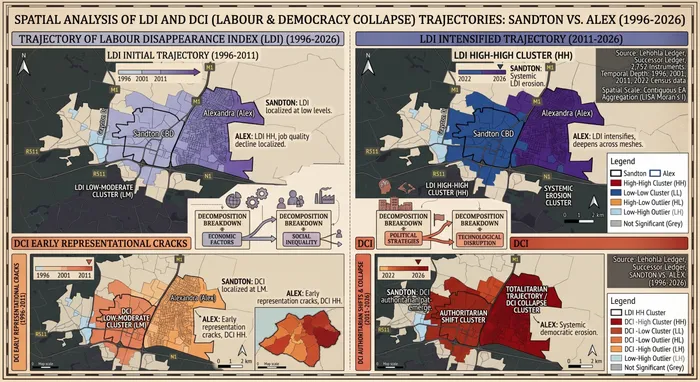
Anchored in the foundation of the Lehohla Ledger and its 2,752 evidence-based analytical instruments, the spatio-temporal decomposition of the Labour Disappearance Index (LDI) and Democracy Collapse Index (DCI) across the 1996, 2001, 2011, and 2022 South African Census meshes uncovers a stark spatial truth.
This analytical truth is dramatized not by thousands of kilometers, but by a mere 75-meter-wide ribbon of tar and steel: the M1 highway.
The spatial metadata speaks with an unyielding voice.
Anchored in the foundation of the Lehohla Ledger and its 2,752 evidence-based analytical instruments, the spatio-temporal decomposition of the Labour Disappearance Index (LDI) and Democracy Collapse Index (DCI) across the 1996, 2001, 2011, and 2022 South African Census meshes uncovers a stark spatial truth.
This analytical truth is dramatized not by thousands of kilometers, but by a mere 75-metre-wide ribbon of tar and steel: the M1 highway.
Discover how the Lehohla Ledger's analysis reveals a stark socio-economic divide in South Africa, illustrated by the 75-metre stretch of the M1 highway, and what it means for the future of communities like Alexandra and Sandton.
Image: Supplied.
Alex's Deepening Crisis: The LDI intensifies dramatically, solidifying into an absolute High-High (HH) cluster.
The decomposition breakdown reveals that systemic economic erosion has severed traditional pathways to formal employment. The informal survival strategies within the township struggle under the weight of hyper-dense population changes across contiguous EAs.
Sandton's Capital Consolidation: Across the 75-meter divide, Sandton hardens into a definitive Low-Low (LL) cluster. It remains a hyper-concentrated hub of capital, wealth, and corporate activity.
Yet, this Low-Low status indicates an insular economy—a fortress of high-value services that does not structurally absorb or benefit the labor pool waiting just meters away across the M1 highway.
Alex's Democratic Decay: The DCI in Alex tracks into a Totalitarian Trajectory / DCI Collapse Cluster.
The complete erosion of democratic norms is driven by chronic resource deficits and the strain of unfulfilled economic promises. Civic engagement fractures under the weight of social inequality, giving rise to localized populist movements and institutional alienation.
Sandton's Gated Governance: Across the highway, Sandton exhibits an Authoritarian Shift Cluster, registering as a separate Low-Low (LL) DCI dynamic.
Here, democratic collapse does not look like institutional abandonment; instead, it manifests as the privatization of governance.
Public spaces are subsumed by corporate improvement districts, private security networks, and technological surveillance mesh networks. It is a highly managed, securitized form of stability where public accountability is replaced by private control.
The Lehohla Ledger asserts that the census mesh serves as an authentic mirror to a nation’s structural conscience.
When evaluating the spatial metrics of Alex and Sandton from 1996 to 2026, the metadata proves that geographic proximity does not guarantee economic or social integration.
The 75-meter road remains one of the sharpest socio-economic divides in the world.
On one side, a High-High concentration of labor disappearance and civic alienation deepens; on the other, a Low-Low cluster of insulated wealth and privatized governance fortifies itself.
Without deliberate structural interventions to bridge this chasm, the spatio-temporal indices warn of an intensifying systemic polarization that tests the resilience of both contiguous meshes.
Dr Pali Lehohla is the former Statistician General of South Africa, Director of the Pan African Institute for Evidence (PIE), and the founder of the Lehohla Ledger. He is a Professor of Practice at the University of Johannesburg and a Research Associate at Oxford University.
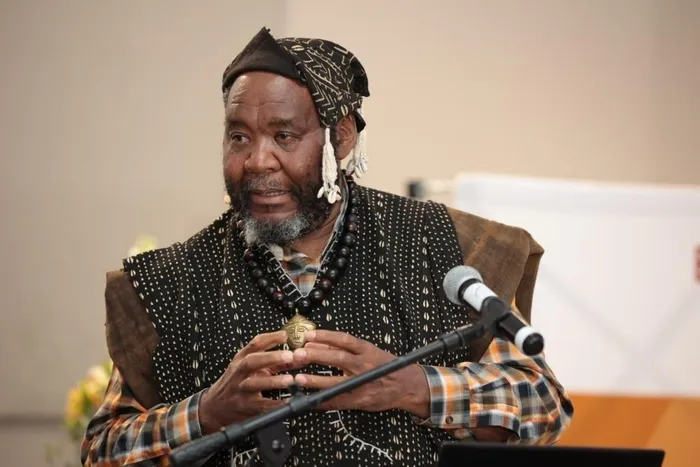
Dr. Pali Lehohla is the former Statistician-General of South Africa, Director of the Pan African Institute for Evidence (PIE), and the founder of the Lehohla Ledger. He is a Professor of Practice at the University of Johannesburg and a Research Associate at Oxford University.
Image: Supplied
Follow Business Report on Facebook, X and on LinkedIn for the latest Business and tech news.