


The structural collapse of South Africa's sub-national economy is a complex issue that intertwines local governance failures with macroeconomic policies. By analysing this crisis through the Lehohla Ledger Oscilloscope, we uncover the critical relationship between top-down structural compression and bottom-up administrative decay, revealing the urgent need for a comprehensive approach to economic recovery.
Image: Shelley Kjonstad/Independent Newspapers
The structural collapse of South Africa’s sub national economy cannot be understood by treating local governance failures and macroeconomic policies as isolated crises.
Instead, they are two sides of the same coin.
By viewing this crisis through the Lehohla Ledger Oscilloscope, we can observe the interplay between top down structural compression (the In Out Washington Consensus template) and bottom up administrative decay (the localized collapse of internal control frameworks).
The synthesis of the Boston University study on IMF programs (Rinner, Gallagher, and Ray, 2026), the World Bank’s retrospective on East Asian state led industrial policy, and thirty years of South African census data (1996 to 2022) provides empirical evidence to evaluate the "Washington Consensus vs. Corrupt Municipalities" debate.
The primary flaw of the Washington Consensus lies in its In Out architectural premise: the assumption that top down fiscal discipline, budget compression, and macro stabilisation inputs will naturally cause private investment to flow outward into peripheral markets.
South Africa’s post apartheid macroeconomic transition adapted significant elements of this template, prioritising national deficit reduction and inflation targeting while assuming the market would naturally correct spatial distortions.
When tracked across the Census Mesh, aggregating contiguous Enumeration Areas (EAs) from the 1996, 2001, 2011, and 2022 Censuses, the data reveals a starkly different structural transmission mechanism:
[Washington Consensus Austerity] ──► [Public Infrastructure Disinvestment] ──► [Erosion of the Spatial Mesh] ──► [Capital Degradation & 1:1 Paradox Vortex]
The top down fiscal constraints imposed on the public sector severely limited the state’s capacity to build and sustain a localised, asset backed economic foundation.
By tracking the 1:1 Ratio Paradox, the critical threshold measuring formal, income earning employed persons against the "Not Economically Active" (NEA) population, the Census Mesh reveals that the contraction of state directed infrastructure funding did not catalyse private sector development.
Instead, it expanded structural dependency. Outside of highly insulated commercial nodes, entire township and rural spatial cells slid into systemic vulnerability. Private investment requires supportive public infrastructure to operate efficiently. By prioritising macro balance sheet metrics over local carrying capacity, the state hollowed out the peripheral mesh, locking millions into structural stagnation.
The In Out stabilisation model is often defended by blaming local underperformance entirely on the indiscretions of corrupt and incompetent officials. This perspective represents an analytical concealment. The Lehohla Ledger establishes that while top down fiscal compression systematically degrades the state’s economic foundation, it simultaneously creates an environment highly susceptible to local corruption, rent seeking, and administrative failure.
The Auditor General’s 2024/25 Consolidated General Report on Local Government Audit Outcomes provides the empirical baseline to analyse this interaction. The local government crisis is a combination of two distinct forces: macro structural de capitalisation and an internal culture of zero accountability.
Macro austerity squeeze: slashing maintenance budgets and capital transfers (3% vs 8% norm)
Administrative squeeze: 1:1 ratio breakdown, high vacancies and loss of internal controls
The resulting sinkhole: R145.21 billion irregular expenditure and systemic asset misstatement
The Boston University study demonstrates that austerity shocks reduce Gross Fixed Capital Formation (GFCF) by up to 36% over five years. At the localised level, this maps directly to the Auditor General’s finding that 93% of municipalities failed to meet the 8% asset maintenance norm, spending an average of only 3%.
However, incompetent and corrupt administrations compound this structural deficit.
Rather than managing their remaining capital, 51% of municipalities submitted financial statements with material misstatements in their fixed and movable assets. In places like Mopani District Municipality, infrastructure assets operating well beyond their design capacity were not written down or properly accounted for, creating a distorted data environment that severely impaired maintenance planning and led to widespread ecological damage.
The East Asian Miracle proved that successful state led development requires a highly capable, professionalised public administration.
The In Out approach, by enforcing salary freezes and administrative downsizing, hollows out this core institutional capacity. South African municipalities have responded by outsourcing their constitutional duties: 225 municipalities spent R1.61 billion on financial reporting consultants in 2024/25.
This is where administrative incompetence turns into a direct loss of public value: 61% of these municipalities still produced material misstatements in the exact areas managed by consultants.
In the worst cases, such as Madibeng Local Municipality, which spent R58.12 million on consultants alongside a R40 million internal payroll, these contracts simply function as a mechanism for elite capture, failing to transfer skills or secure clean audit outcomes.
The complete breakdown of internal discipline is clearly visible in how municipal councils manage unauthorised, irregular, and fruitless and wasteful expenditure (UIFW).
Rather than conducting the forensic investigations required to identify and recover financial losses, councils increasingly use accounting entries to bypass accountability.
Out of R150.43 billion in prior year irregular expenditure, councils prematurely wrote off R42.02 billion (28%) through book entries, while recovering less than 1% (R0.43 billion). This pattern was evident across the worst performing municipal nodes, where councils actively chose to write off billions rather than confront the illicit financial practices driving the systemic decline.
The synthesis of these two dynamics demonstrates why both the pure Washington Consensus template and the "purely corrupt local government" thesis are insufficient on their own. The Lehohla Ledger Oscilloscope tracks how these forces interact to create a downward economic spiral:
When macro policies restrict funding for infrastructure maintenance and spatial alignment, local systems become unstable. Incompetent leadership and weak internal controls then accelerate the decline, turning structural funding deficits into severe service delivery collapses, uncollected debts, and an expanding 1:1 Ratio Paradox Vortex across communities.
To reverse this structural decline, the state must reclaim its Data Sovereignty and assert the supremacy of the Out In method.
The nation cannot achieve financial or developmental balance by eroding its own local foundations.
Planning must be anchored within a granular Census Mesh and audited against the 2,752 instruments of valid metadata. By tracking real time carrying capacity and enforcing strict administrative accountability directly within the local spatial blocks, the state can rebuild its numerical conscience and ensure public resources are converted into durable, community led economic assets.
Authenticated at Census Mesh Level Density via the 2,752 Metadata Control Instruments.
Dr Pali Lehohla is the former Statistician General of South Africa, Director of the Pan African Institute for Evidence (PIE), and the founder of the Lehohla Ledger. He is a Professor of Practice at the University of Johannesburg and a Research Associate at Oxford University.
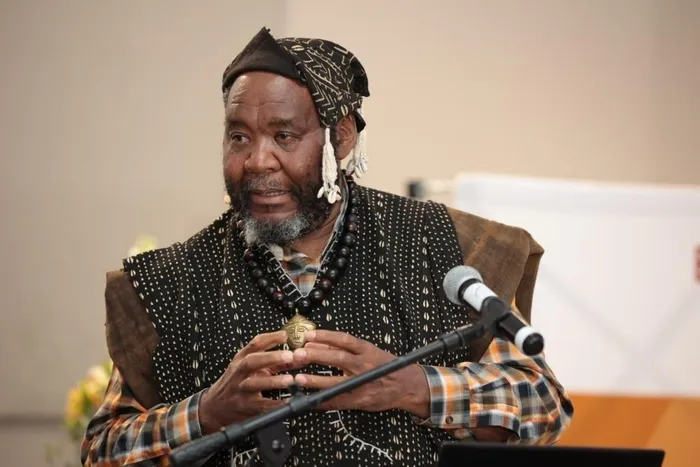
Dr. Pali Lehohla is the former Statistician-General of South Africa, Director of the Pan African Institute for Evidence (PIE), and the founder of the Lehohla Ledger. He is a Professor of Practice at the University of Johannesburg and a Research Associate at Oxford University.
Image: Supplied
Follow Business Report on Facebook, X and on LinkedIn for the latest Business and tech news.