

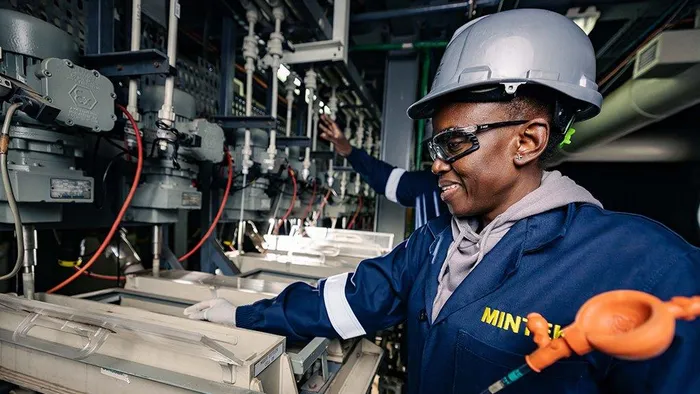
Rare earth elements are critical components in a wide range of technologies, including electric vehicles, wind turbines, smartphones, advanced electronics, defence systems and medical equipment.
Image: Supplied
South Africa has taken a significant step towards establishing a domestic rare earth processing industry after Steenkampskraal Monazite Mine (SMM) and Mintek successfully produced high-purity mixed rare earth products at laboratory scale.
This is a breakthrough that could position the country as a strategic supplier to rapidly growing global clean energy, technology and medical sectors currently dominated by China.
The achievement, announced on Wednesday, marks a key milestone in South Africa’s efforts to move beyond the export of raw minerals and develop local beneficiation capabilities in one of the world’s most sought-after critical mineral markets.
According to the partners, the successful production of high-purity mixed rare earth products was achieved through a long-standing collaboration between SMM and Mintek, with support from the South African Nuclear Energy Corporation (Necsa).
The development lays the foundation for commercial production of rare earth products in South Africa before the end of 2026 and could eventually support the beneficiation of rare earth elements and thorium as well as the production of medical isotopes.
The project centres on the Steenkampskraal mine in the Western Cape, which is regarded as the world's highest-grade rare earth element and thorium deposit.
SMM executive chairman and shareholder, Dr Enock Mathebula, described the breakthrough as a milestone not only for the project partners but for the country as a whole.
“This is not only a victory for Steenkampskraal and Mintek, but a victory for South Africa. It demonstrates the country’s ability to develop world-class technologies, create local beneficial opportunities and participate meaningfully in global critical mineral supply chains,” he said.
Mathebula said that this achievement represents a significant technological breakthrough and demonstrates what can be accomplished when South African institutions and industry work together toward a common vision.
Necsa is also expected to play a significant role in unlocking further value from the project through its expertise in nuclear technologies and the development of high-value rare earth and thorium applications.
“This will further unlock the value chain potential as South Africa advances its beneficiation capabilities,” Mathebula said.
“We are currently advancing discussions and development work aimed at establishing separation capabilities in South Africa. Together with Mintek, we are continuing to explore and develop local solutions that will support the future establishment of a world-class separation system.”
Rare earth elements are critical components in a wide range of technologies, including electric vehicles, wind turbines, smartphones, advanced electronics, defence systems and medical equipment.
As countries accelerate efforts to decarbonise their economies and secure supply chains for strategic minerals, demand for rare earth products is expected to rise significantly over the coming decades.
The successful production of mixed rare earth products also positions South Africa as the first African country to produce rare earth products through a partnership between a mining company and a national research institution.
Mintek CEO Dr Molefi Motuku said the achievement demonstrated the value of collaboration between research institutions and industry
“Mintek’s expertise, combined with Steenkampskraal’s world-class resource, has proven that South Africa possesses not only the minerals but also the scientific capability to compete globally in critical minerals processing,” he said.
The project has received support from the Industrial Development Corporation (IDC), which has provided full funding for the mine’s phase one metallurgical processing plant. Construction of the facility is currently under way, with commissioning scheduled for August 2026.
Steenkampskraal mine was formally brought out of care and maintenance in 2023, with approvals secured from both the National Nuclear Regulator (NNR) and the Department of Mineral and Petroleum Resources (DMPR).
Full funding for the phase 1 metallurgical processing plant has been secured through the IDC, and construction of the plant is currently underway, with commissioning scheduled for August 2026.
Mathebula said the long-term vision extends beyond mining and concentrate production.
“Construction of the processing plant is progressing well, with concentrate production expected to commence later this year and first shipments anticipated before the end of 2026,” he said.
“The mine continues to engage with several strategic investors currently conducting due diligence regarding potential participation in the project.”
BUSINESS REPORT