

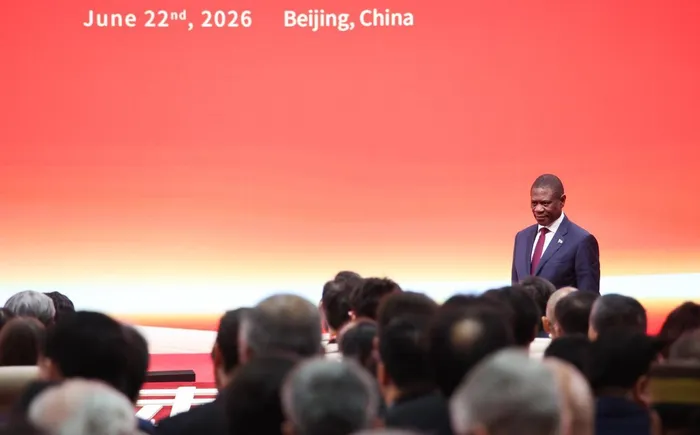
Deputy President Paul Mashatile delivered a keynote address at the 4th China International Supply Chain Expo Opening Ceremony taking place in Beijing, in the People’s Republic of China, on Monday.
Image: GCIS
Deputy President Paul Mashatile has positioned South Africa as a reliable supply base for critical inputs, industrial beneficiation and co-production opportunities, as the country seeks to strengthen its role in global supply chains and deepen economic cooperation with China.
Addressing delegates at the China International Supply Chain Expo (CISCE) in Beijing on Monday, Mashatile said South Africa was determined to leverage its mineral wealth, industrial capacity and strategic location to become a key player in evolving global supply networks.
Mashatile said the world was experiencing significant changes in trade and production patterns driven by geopolitical developments, technological advances and climate-related imperatives.
“We meet at a defining moment in the global economy. Geopolitical shifts, technological advancements, climate imperatives, and changing patterns of production are reshaping the architecture of global commerce,” Mashatile said.
He noted that businesses and countries were increasingly seeking “greater resilience, diversification, decarbonisation and sustainability within global supply chains,” creating new opportunities for countries such as South Africa.
Mashatile said South Africa offered a compelling value proposition to investors and manufacturers looking to diversify supply chains.
“South Africa is an attractive investment destination, supported by sophisticated industrial capabilities, a world-class financial sector, and well-established logistics infrastructure,” he said.
He added that government reforms aimed at improving the ease of doing business, accelerating infrastructure development and strengthening industrial competitiveness would further enhance the country’s attractiveness as a production and sourcing destination.
Central to South Africa’s pitch was its ability to supply critical raw materials and products needed by modern industries and the global energy transition.
“South Africa is a reliable source of high-value products and critical inputs required for modern industries and the global energy transition,” Mashatile said.
He highlighted the country’s extensive reserves of platinum group metals, manganese and chromium, as well as its agricultural production capabilities, advanced manufacturing sector and growing services and digital trade industries.
“A key objective of our engagement in Beijing is to expand the range and value of South African exports entering the Chinese market and to shift our trade relationship increasingly towards value-added manufactured goods,” he said.
Mashatile also emphasised South Africa’s strategic role as a gateway to Africa through the African Continental Free Trade Area (AfCFTA), which provides access to a market of more than 1.3 billion people.
“Through the African Continental Free Trade Area, investors located in South Africa gain access to a market of more than 1.3 billion people. This presents significant opportunities for regional value chain development and industrial expansion across Africa,” he said.
He encouraged Chinese and international businesses to view Africa as more than just a consumer market.
“We invite Chinese and international partners to work with us in positioning Africa not merely as a consumer market, but as a competitive production base, a sourcing destination, and an important node within global supply chains,” Mashatile said.
This comes as South Africa's the trade deficit with China has escalated dramatically from less than $1 billion in the period between 1988 and 2000 to an alarming $9.71bn by 2023.
Mashatile said the recently signed Framework Agreement on Economic Partnership for Shared Prosperity, known as CADEPA, together with China’s new zero-tariff preference scheme for qualifying South African exports, would further strengthen trade ties between the two countries.
“South Africa is therefore positioning itself as a reliable supply base for critical inputs, a destination for industrial beneficiation and an ideal partner for co-production,” he said.
Mashatile identified agriculture, critical minerals and advanced manufacturing as key sectors for future cooperation.
In agriculture, he said South African citrus, avocados, stone fruits, wines and macadamia nuts now benefited from duty-free access to the Chinese market under the new arrangements.
In the mining and green economy sectors, he highlighted opportunities for joint ventures and downstream processing of strategic minerals used in renewable energy technologies, fuel cells and energy storage systems.
“South Africa possesses substantial reserves of platinum group metals and other strategic minerals required for fuel cells, renewable energy technologies, and energy storage solutions,” Mashatile said.
He also pointed to opportunities in advanced manufacturing, logistics and automotive value chains, saying South Africa’s industrial base was well-positioned to support export-oriented production serving both local and broader African markets.
Concluding his address, Mashatile reaffirmed South Africa’s commitment to deeper economic cooperation with China and to building resilient and inclusive supply chains.
“We are determined to position our country as both a preferred destination for investment and a reliable source of value within global supply chains,” he said.
Mashatile expressed confidence that the expo would help usher in “a new phase of practical cooperation, deeper industrial integration, and shared prosperity for all people.”
BUSINESS REPORT