

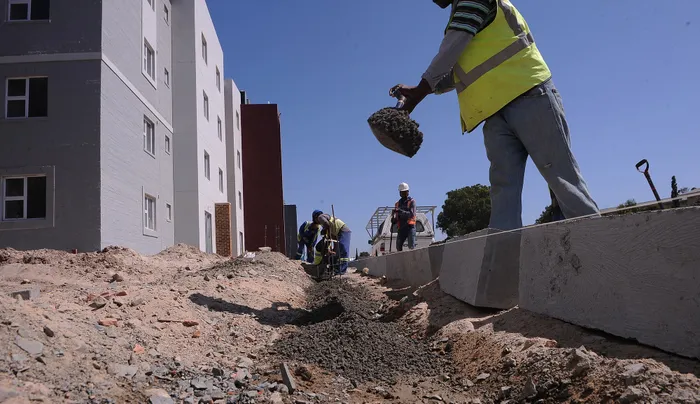
The ACI’s seasonally adjusted reading has increased for the third consecutive quarter, the first time this has occurred since the brief recession of 2020.
Image: Courtney Africa/Independent Newspapers
South Africa’s construction sector is showing tentative signs of recovery, with the latest Afrimat Construction Index (ACI) recording a third consecutive quarter of positive growth despite continued challenges facing the industry.
The ACI, released on Tuesday, increased by 0.3% year-on-year during the first quarter of 2026, supported by stronger construction activity, higher building completions, rising employment and improved sales of building materials.
Compiled quarterly by economist Dr Roelof Botha on behalf of Afrimat, the index serves as a composite measure of activity levels across the building and construction sectors.
Although growth remains modest, Botha said the latest results point to increasing stability in a sector that has endured years of subdued activity. The ACI’s seasonally adjusted reading has increased for the third consecutive quarter, the first time this has occurred since the brief recession of 2020.
“The most impressive aspect of the latest ACI reading is the stability that has crept in for two key indicators – the value of non-residential buildings completed, and the value of construction works,” Botha said.
The index was boosted by year-on-year increases of more than 5% in both the value of construction works completed and the value of completed buildings. Employment levels and building material sales also recorded improvements during the quarter.
Five of the index’s ten indicators recorded positive year-on-year growth, while one remained unchanged. Of the four indicators that declined, three registered decreases of less than 2%, highlighting the relatively broad-based nature of the sector’s recovery.
One of the most encouraging developments was continued job creation in the industry.
According to Botha, employment in the construction sector increased by 74,000 jobs compared with the first quarter of 2025.
“Despite the combined value of construction works and buildings accounting for only 5.5% of the total value added in the economy, the construction sector was responsible for 11% of the new jobs created in the first quarter of 2026 year-on-year,” he said.
The sector has also benefited from lower borrowing costs over the past year, which have helped reduce the cost of capital for construction projects and property development.
Botha believes recent geopolitical developments could create room for further monetary policy easing later this year. He said lower interest rates have played an important role in lowering the cost of capital formation, and the peace accord between the US and Iran might lead to a resumption of the rate-cutting cycle during the second half of the year.
Botha added that it is encouraging that the total construction tender activity during February and March experienced two consecutive months of double-digit increases.
According to a report published by Industry Insights, overall construction tender activity in South Africa increased by 11.4% year-on-year in the first four months of 2026. KwaZulu-Natal, the Eastern Cape, and the North-West have shown notable increases thus far in 2026.
Botha said a reopening of the Strait of Hormuz and lower global oil prices could contribute to lower inflation and encourage the South African Reserve Bank to resume reducing interest rates.
“A lowering of the prime rate will go a long way to restoring profitability in the construction sector, which is sensitive to the cost of capital – especially in residential construction,” he said.
Meanwhile, Afrimat continues to strengthen its position in the construction materials market. The company recently completed the disposal of certain aggregate quarries and readymix concrete plants as part of its acquisition of Lafarge South Africa Holdings.
The transaction is valued at R215 million, comprising R160m in cash payable on 1 July 2026 and R55m deferred over three years, subject to certain conditions.
Afrimat CEO Andries van Heerden said the group remains focused on building a sustainable South African business anchored in construction materials and bulk commodities.
“Both of these involve open-pit mining, the core of Afrimat’s operations,” he said.
Van Heerden also welcomed the recent decision by the National Energy Regulator of South Africa to approve a reduced electricity tariff for the ferrochrome industry, saying it would support industrial activity and job preservation.
“It also means that our Nkomati Anthracite Mine is ramping up to full production over the next six months.”
BUSINESS REPORT