


South Africa’s young consumer class is facing a difficult economic journey, but new research reveals resilience, ambition and a strong desire to create better futures.
Image: Supplied.
The story of South Africa’s youth is often dominated by unemployment, financial hardship and uncertainty, but new research paints a more complex picture of a generation that is working, saving, investing in themselves and building towards a better future despite economic pressures.
The newly released 2026 BrandMapp Youth Report reveals that nearly six million economically active consumers under the age of 35 are contributing to the economy, shaping consumer trends and creating their own pathways to independence.
Based on one of South Africa’s largest surveys of consumer class adults, the report challenges the idea that young South Africans are simply struggling to survive, highlighting a generation that is ambitious, digitally fluent and financially intentional.
Brandon De Kock, BrandMapp’s Director of Storytelling, said the research provides a different perspective on young South Africans who are often overlooked in broader economic discussions.
“High rates of youth unemployment, poverty, educational frustrations and inequalities naturally dominate our national conversations about young people,” De Kock said.
“But at BrandMapp, we focus the lens on the segment of our youth who are lucky to be well educated, forging career paths. This is highly relevant because they are contributing significantly to building our economy and tax paying base.”
The report found that consumer class youth make up 40% of the 14 million adults living in households earning more than R10 000 per month, representing almost six million economically empowered young consumers.
“This segment makes up 40% of the 14 million adults living in households earning more than R10K per month, so that’s almost six million economically empowered young consumers who are leading us into the future,” De Kock said.
The research shows that nearly two thirds of consumer class young adults are already participating in the workforce through employment or entrepreneurship. A further 23% are students, while 11% are unemployed, although none of those unemployed respondents reported that they were not actively seeking work.
However, employment does not automatically translate into financial independence.
BrandMapp youth specialist Ashleigh Cumming said young South Africans are experiencing a different transition into adulthood compared with previous generations.
“The challenge is that they don’t yet have the financial security to easily deal with turbulent times, so while older generations are playing Monopoly with their cash, the younger ones are struggling to work out how to survive a game of snakes and ladders,” Cumming said.
More than half of young consumer class adults said they feel financially better off than they were two years ago, showing signs of progress despite economic pressures. However, almost half still rely partially or fully on financial support from parents, relatives or friends.
Cumming said rising living costs have changed the traditional path towards independence.
“The thing is, for younger people, progress is uneven, with everyday expenses absorbing much of the gain,” she said.
“Today, financial progress for young people is much less linear.”
The report also highlights the financial discipline among young consumers. While many are under pressure, their behaviour reflects a desire to build stability.
Cumming said many young people are making responsible financial decisions, even when their ability to save remains limited.
“The challenge isn’t simply income. It’s purchasing power. Relative salaries have not kept pace with the cost of housing, transport, education and everyday living expenses, reducing young people’s ability to convert earnings into financial freedom,” she said.
“They aren’t living hand to mouth but they certainly are living paycheck to paycheck. And the good news is that they have gotten pretty good at it.”
According to the report, the two dominant financial personas among youth are the Guardian at 28% and the Saver at 29%, showing that money management remains a priority.
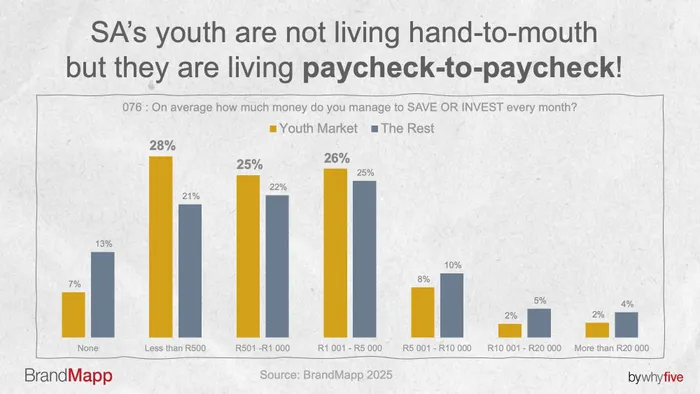
They aren’t living hand to mouth but they certainly are living paycheck to paycheck.
Image: Supplied.
However, financial pressures continue to limit their ability to build wealth.
“You can have a Guardian mindset and still be unable to save, if the economic system won’t cooperate,” Cumming said.
“What emerges is a generation that is financially intentional, but structurally constrained.”
Despite challenges, BrandMapp found that young consumers remain ambitious about their futures. The report showed that 46% are aiming for a new job this year, while 30% plan to start a business.
De Kock said this reflects a resilience story rather than one of hopelessness.
“Younger consumers are generally happier than older generations. They are more likely to feel unsure about South Africa’s future, but crucially, they're not more pessimistic than older generations,” he said.
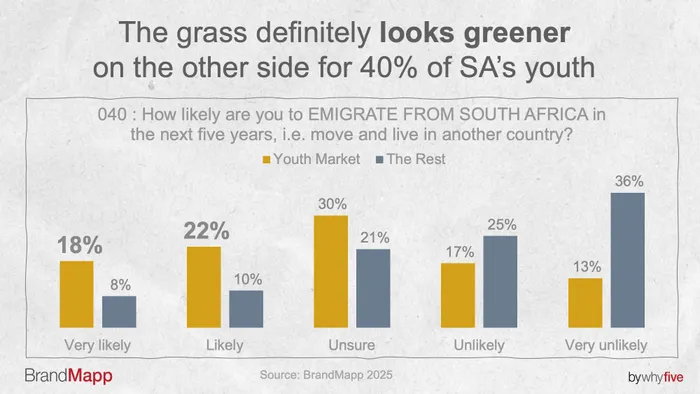
The grass loooking greener for SA youth.
Image: Supplied.
The report also reveals how technology is shaping the way young South Africans live, work and consume.
Young consumers are increasingly using artificial intelligence in everyday learning, work, creativity and decision making. Social media platforms influence how they discover products, build identity and consume information, although traditional media remains important when it comes to trust.
De Kock said brands that want to connect with younger consumers will need to operate across both digital and traditional platforms.
“Younger consumers increasingly encounter news and brands through social platforms and peer networks, but when it comes to trust, traditional media still matters,” he said.
“They encounter stories and products through friends, feeds and algorithms, but they still look to established media to determine what is credible.”
The BrandMapp Youth Report suggests that while South Africa’s young consumers face a difficult economic landscape, they are not standing still.
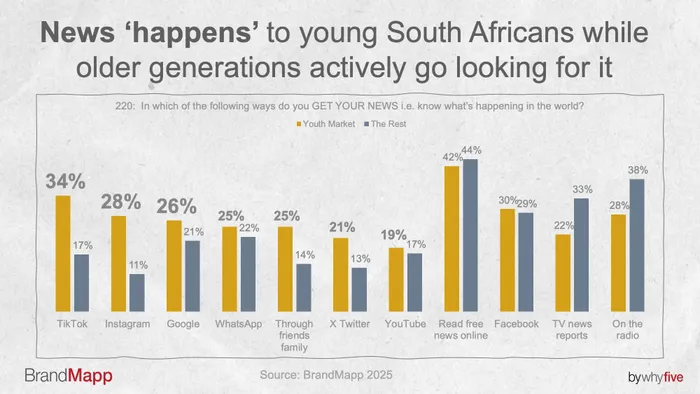
Older generations still search out news.
Image: Supplied.
They are adapting, building businesses, pursuing careers and finding new ways to participate in the economy.
For businesses and policymakers, understanding this generation could prove critical as these young consumers increasingly shape the future of South Africa’s economy.
Follow Business Report on Facebook, X and on LinkedIn for the latest Business and tech news.