


South Africans earning the country's average take-home salary of R21,228 a month sit just below what researchers define as the lower end of the middle class.
Image: Pexels
South Africans earning the country's average take-home salary of R21,228 a month sit just below what researchers define as the lower end of the middle class.
Yet when that salary is broken down using how households actually spend their money, it becomes easier to understand why so many working South Africans say they feel financially stretched.
To test whether South Africa's average salary can still buy what has traditionally been regarded as a middle-class lifestyle, IOL applied Statistics South Africa's latest household expenditure patterns to the latest PayInc Net Salary Index.
The overall annual net income ratio appears to have worsened for many income bands; those taking home R35,000 or more have an overall income ratio of 210%, which is the highest level the debt review company has seen.
According to Statistics South Africa, 75.6% of all household spending goes towards just four categories: housing and utilities, food and non-alcoholic beverages, transport, and insurance and financial services.
Applied to the average monthly take-home salary of R21,228, housing and utilities would take up R7,366. Food and non-alcoholic beverages account for another roughly R3,460. Transport costs about R3,248, while insurance and financial services add a further R1,974.
As a side note, the Pietermaritzburg Economic Justice and Dignity Group pegs the average food basket at R5,479.26 as of May.
Based on the Statistics South Africa's groupings, those four categories consume roughly R16,050 every month, leaving just R5,180.
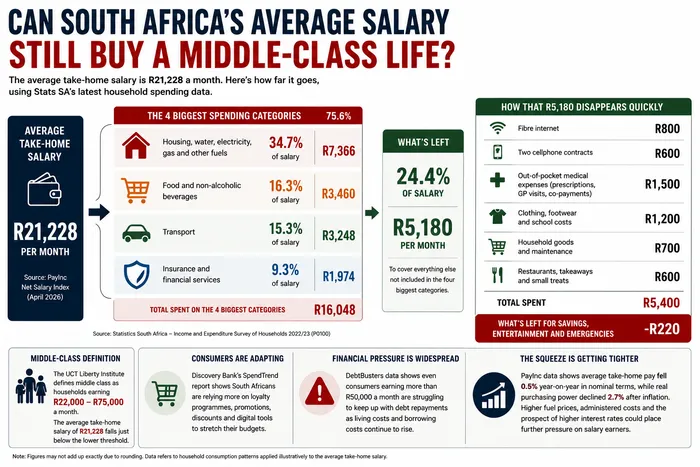
Where your money goes.
Image: ChatGPT
From that, which works out to 24.4% of the average salary, or R5,180, people still have to cover everything else: healthcare costs not covered by medical aid, cellphone and internet, clothing and footwear, and education.
Then there’s household goods, entertainment, restaurants, personal care, savings, emergencies, replacing broken appliances and unexpected car repairs.
Aspects such as R800 for fibre, entertainment, savings and unexpected emergencies would have to be funded from this amount, too.
Research by the UCT Liberty Institute defines South Africa's middle class as households earning between R22,000 and R75,000 a month. The irony is that the country's average take-home salary of R21,228 falls just below that lower threshold.
While many salaried workers would regard themselves as middle class, the numbers suggest that the average income no longer comfortably supports the lifestyle traditionally associated with that definition.
Discovery Bank's latest SpendTrend report suggests consumers are responding by changing how they spend rather than simply spending less.
Households are increasingly relying on loyalty programmes, promotions, rewards and online shopping to stretch their budgets, while shopping around for better prices has become part of everyday financial management rather than occasional bargain hunting.
DebtBusters' latest debt data points to similar pressure, finding that even consumers earning more than R50,000 a month are increasingly seeking debt counselling as rising living costs and higher borrowing costs continue to squeeze disposable income.
The latest PayInc Net Salary Index shows average take-home pay fell to R21,228 in April, down 0.5% from a year earlier in nominal terms, while real purchasing power declined 2.7% after inflation.
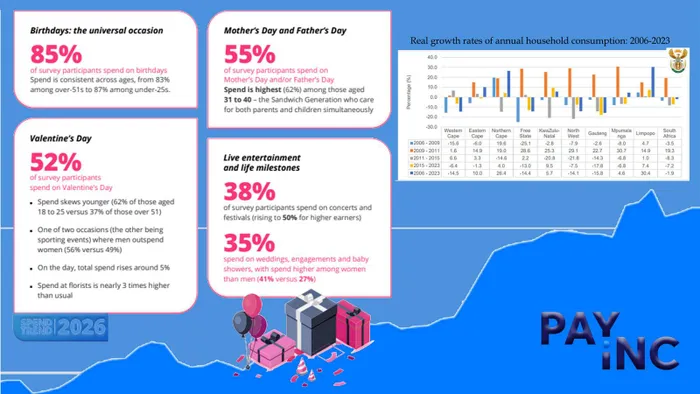
A graphical visualisation of income and expenses.
Image: Various
PayInc warns that higher fuel prices, administered costs such as electricity and medical aid, and the prospect of higher interest rates could place further pressure on salary earners during the remainder of the year.
The exercise is illustrative rather than a household budget. Individual spending patterns differ, and Statistics South Africa's expenditure shares represent national averages rather than fixed allocations. But the picture it paints is telling.
An average salary of R21,228 may still pay the bills. But once the biggest expenses have been covered, there is relatively little room left to build wealth, absorb financial shocks or comfortably afford what has traditionally been regarded as a middle-class life.
IOL BUSINESS