

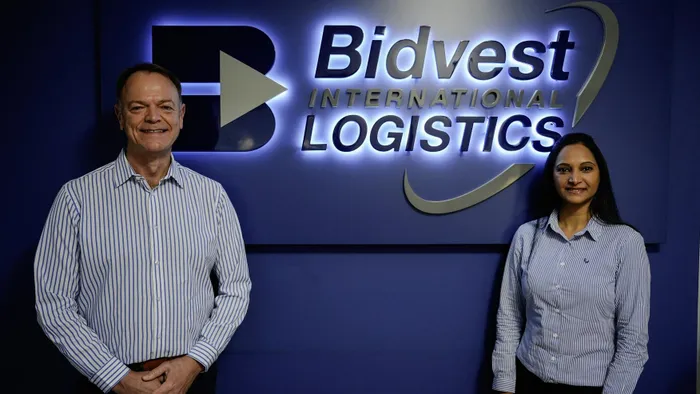
JD Van Der Merwe, Head of Talent, and Shamona Chinnappa, National Training & Compliance Manager; Bidvest International Logistics.
Image: Supplied.
Youth Month draws attention to one of South Africa’s most urgent challenges: how to turn potential into real, sustained employment.
For business, this is not a seasonal conversation. It requires deliberate, long term investment in creating meaningful career pathways for young people, supported by practical experience and ongoing development.
According to Statistics South Africa’s Quarterly Labour Force Survey for the fourth quarter of 2025, youth unemployment stands at 43.8%, underscoring how many young people are still waiting for a first real opportunity. While there have been incremental shifts, the outlook for many remains uncertain.
For the logistics industry, this presents both a constraint and a responsibility.
Skills shortages affect performance, but they also reflect a disconnect between available talent and access to opportunity. Bridging that gap requires intentional, structured development that aligns learning with real business needs and future workforce requirements.
At Bidvest International Logistics (BIL), our approach is rooted in ensuring that development initiatives are linked directly to meaningful employment opportunities.
Training should not be viewed as a compliance exercise, but rather as a strategic investment in capability. When learning programmes are aligned with actual operational demand, they create stronger outcomes for both individuals and businesses.
This shift from training for compliance to training for capability is increasingly important in a rapidly evolving logistics environment.
Developing talent requires more than classroom learning. It depends on creating structured learning environments where theory is reinforced through practical, cross functional exposure that builds both technical skills and operational understanding.
Development, however, only delivers meaningful results when it is supported by clear progression pathways, mentorship and continuous assessment.
Without these critical elements, organisations risk repeating entry level training programmes without building the deeper expertise required to sustain long term growth and competitiveness.
Structured learning remains a cornerstone of successful workforce development.
Programmes offered through the BIL Academy, aligned to recognised Learnership frameworks such as NQF Levels 3, 4 and 5, play an important role in ensuring consistency, quality and industry recognition. However, qualifications alone are not enough.
Learning must be guided by experienced practitioners who can ensure that knowledge remains relevant and applicable in real world environments.
Cross functional exposure is another critical component of effective development.
Providing opportunities for employees to gain experience across different areas of the business strengthens organisational capability while enhancing workforce adaptability. It also creates opportunities for internal mobility, enabling individuals to build broader careers rather than remaining confined to a single function.
Over time, this approach helps reduce reliance on external hiring while strengthening succession planning and leadership pipelines. It creates a workforce that is better equipped to respond to industry changes, customer demands and operational challenges.
Programmes such as the BIL Academy and the Youth Employment Service (YES) initiative play an important role in expanding access to entry level opportunities at scale. However, their success ultimately depends on how effectively they are integrated into structured development pipelines that provide long term growth opportunities.
For many young people, joining an established organisation provides more than a job. It offers a sense of belonging, purpose and confidence. These qualities are often overlooked, yet they play a critical role in long term employability and career success.
As South Africa continues to grapple with the challenge of youth unemployment, businesses have an important role to play in creating opportunities that extend beyond short term placements. Sustainable impact comes from investing in people, building capability and creating environments where young professionals can develop, contribute and thrive.
The future of the logistics sector, and indeed the broader economy, will depend on how effectively we nurture and develop the next generation of talent. Youth Month serves as an important reminder that unlocking potential requires more than good intentions. It requires action, commitment and a shared belief that investing in young people is investing in South Africa’s future.
JD Van Der Merwe, Head of Talent, and Shamona Chinnappa, National Training & Compliance Manager; Bidvest International Logistics.
Follow Business Report on Facebook, X and on LinkedIn for the latest Business and tech news.