

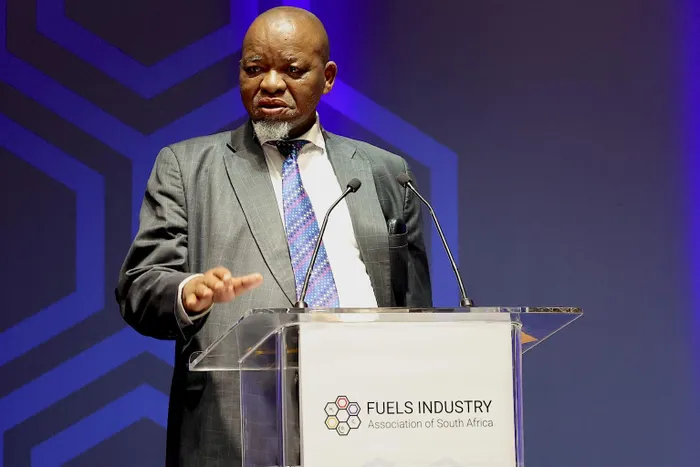
Minister of Mineral and Petroleum Resources Gwede Mantashe speaking at the Fuels Industry Imbizo in Johannesburg on Wednesday.
Image: Supplied
South Africa is preparing to significantly strengthen its energy security through a new Strategic Petroleum Stocks Policy that will require the country to maintain strategic fuel reserves equivalent to 60 days of net imports.
This was announced by Mineral and Petroleum Resources Minister, Gwede Mantashe, at the Fuels Industry Imbizo on Tuesday.
Mantashe said the draft policy is now ready for Cabinet consideration before being released for public comment, marking a major step in government’s efforts to reduce the country’s vulnerability to global fuel supply disruptions.
If approved by Cabinet, the draft policy will be released for public consultation, paving the way for what could become one of the most significant reforms to South Africa’s fuel security framework in decades.
Mantashe said the proposed policy follows a comprehensive vulnerability assessment of strategic petroleum stocks conducted by the Department of Mineral and Petroleum Resources (DMPR) in 2024.
He said the assessment identified critical weaknesses in the country’s fuel security framework, including the need to strengthen stockholding arrangements and increase domestic refining capacity.
“The policy proposes a mixed stockholding model under which the South African National Petroleum Company (SANPC) will maintain strategic reserves equivalent to 60 days of net imports in both crude oil and refined products,” Mantashe said.
When the fuel crisis began on the back of the Middle East conflict in March, South Africa held about eight million barrels of strategic crude oil, which translated to at least 1.3 billion litres of fuel, well below the capacity of the Strategic Fuel Fund (SFF) storage facilities.
South Africa consumes between 60 million and 70 million litres of petrol and diesel per day, demand which is currently being met through diversified import sources.
This means that the country had at least 22 days of fuel capacity if the the country were to be forced to dip into the strategic reserves. While the SFF previously aimed for reserves equivalent to 90 days of net imports, policy proposals and recent verified holdings indicate an actual target and capacity closer to 60 days of total demand.
The proposed 60-day reserve requirement is expected to align South Africa more closely with international best practice, where strategic petroleum stockpiles are used as a buffer against supply disruptions caused by geopolitical conflicts, natural disasters or market instability.
Mantashe described the policy proposal as a significant intervention aimed at bolstering South Africa’s resilience against future energy shocks and supply disruptions.
He said recent geopolitical tensions had once again highlighted the risks faced by fuel-importing countries and demonstrated why energy security can no longer be taken for granted.
“The ongoing conflict in the Middle East has once again reminded us that energy security cannot be taken for granted,” he said. “Events occurring thousands of kilometres away continue to affect fuel prices, supply chains, investment decisions and economic stability across the globe.”
While South Africa has managed to maintain stable fuel supplies despite disruptions in international markets, Mantashe warned that the country remains exposed to external shocks due to its dependence on imported refined petroleum products.
“The geopolitical disruptions we continue to witness have exposed the risks associated with excessive dependence on imported refined petroleum products,” he said.
“If we are serious about improving our energy security, reducing our vulnerability to external shocks and strengthening our economic sovereignty, then we must accelerate exploration and development of our own oil and gas resources.”
Mantashe said South Africa could not continue indefinitely as a price-taker in international energy markets and should position itself to become a producer where commercially viable oil and gas resources exist.
Central to this ambition is the newly established South African National Petroleum Company (SANPC), which government sees as playing a leading role in both maintaining strategic fuel reserves and supporting future exploration and refining projects.
However, the government earlier this year signalled that reopening the country’s closed oil refineries is not a viable short-term solution to rising fuel prices and supply concerns.
Although the SANPC Bill is still before Parliament, Mantashe said the company is already operational and actively participating in the sector.
Ulrich Joubert, an independent economist, said the government has in tghe past expressed satisfaction with the fuel reserves.
“However, most countries since the Middle East tensions started have used some of their reserves and I wouldn't be surprised if South Africa did the same,” he said.
BUSINESS REPORT