

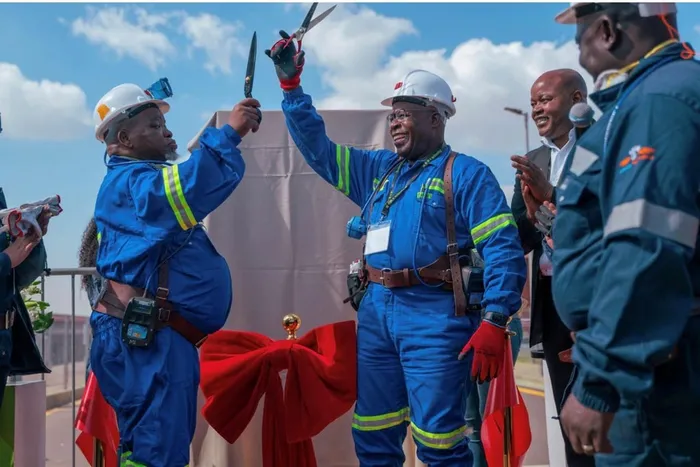
Mineral and Petroleum Resources Minister Gwede Mantashe and Exxaro CEO Ben Magara cut the ribbon at the opening of Exxaro Resources' New Mine 1 operation at its Matla Coal Mine in Mpumalanga on Friday.
Image: Supplied
Mineral and Petroleum Resources Minister Gwede Mantashe has said that South Africa’s coal industry is evolving through innovation, beneficiation and cleaner technologies, rather than facing extinction.
This comes as Exxaro Resources officially opened its New Mine 1 operation at the Matla coal mine in Mpumalanga on Friday.
Speaking at the launch, Mantashe pushed back against claims that coal is a declining industry, arguing that the sector remains central to South Africa’s energy security and industrial development.
“People have often said that coal is a dying industry because of concerns around pollution. However, the industry continues to evolve, particularly through improvements in mining safety and ongoing investment in innovation and research. Coal miners should never be ashamed of the work they do,” he said.
Mantashe, who previously worked at Matla mine as a miner and union organiser, described the opening of the new shaft as symbolic of coal’s continued relevance in the South African economy.
“What makes this return to Matla Coal even more significant, after decades of contributing to the country’s energy needs and economic growth, we are gathered here today not to close the mine, but to expand it - thus advancing energy security and extending its lifespan,” he said.
Mantashe said South Africa still possesses enough coal reserves to sustain production for “at least another 150 years and beyond” at current production levels, adding that coal continues to dominate baseload power generation in major economies such as China, India and Japan.
He also outlined how government and industry are attempting to reposition coal through projects such as carbon capture, utilisation and storage (CCUS), beneficiation and the extraction of critical minerals from coal waste.
“It is within this context that South Africa continues to invest in the Carbon Capture, Utilisation and Storage (CCUS) initiative in Leandra to ensure that we responsibly extend the life of our coal industry while utilising the resources with which our country is endowed,” Mantashe said.
He added that Mintek’s “Coal Reimagined” programme is seeking to turn coal fly ash and coal discards into new industrial products and sources of critical minerals such as rare earth elements and vanadium.
“The opening of this shaft today is a clear demonstration that ‘King Coal is back,’” Mantashe said.
The new mine forms part of Exxaro’s broader Matla Life of Mine Project, a R5.3 billion investment aimed at extending the operation’s lifespan and ensuring coal supply to Eskom’s Matla power station. According to Exxaro, the mine is expected to contribute about 4.2 million tons of coal annually.
Exxaro CEO Ben Magara said the project demonstrated the company’s long-term commitment to South Africa’s energy and economic future.
“The New Mine 1 is far more than an operational milestone, for us it reflects Exxaro’s disciplined execution, long-term vision, and commitment to South Africa’s future,” said Magara.
“Our Matla Mine continues to play a vital role in supporting the country’s energy needs while creating meaningful impact through local investment, job creation, and the development of entrepreneurship.”
Magara added that the project reflected the resilience and commitment of Exxaro employees in delivering complex infrastructure projects “on time, to scope and on budget”.
Eskom Group CEO Dan Marokane said the expansion would help stabilise electricity supply while the country expands renewable energy capacity.
“The expansion of Matla New Mine 1 demonstrates how strategic collaboration secures South Africa’s energy future,” Marokane said.
“The reliable supply from Matla ensures that, as the grid is decongested to enable rapid renewables penetration, Eskom maintains operational consistency and security of energy supply needed to support South Africa’s developmental and industrial needs.”
Marokane also said the project aligned with Eskom’s cost optimisation strategy and came as the utility marked 365 consecutive days without load shedding.
BUSINESS REPORT