


S&P said both life and non-life insurers are well positioned to navigate a challenging operating environment over the next two years, supported by strong capital buffers, prudent risk management and a robust regulatory framework.
Image: File photo.
South Africa’s insurance industry is expected to remain resilient despite mounting geopolitical tensions, economic uncertainty and growing climate-related risks, according to a new report by S&P Global Ratings.
In its latest assessment issued on Wednesday, S&P said both life and non-life insurers are well positioned to navigate a challenging operating environment over the next two years, supported by strong capital buffers, prudent risk management and a robust regulatory framework.
The report comes amid heightened concerns over the economic fallout from the conflict in the Middle East, which has raised uncertainty around commodity prices, inflation, supply chains and global financial markets.
Despite these risks, S&P believes South Africa’s insurance sector remains fundamentally sound.
“We expect the South Africa insurance industry to remain resilient to geopolitical, economic, and climate-related uncertainty,” the ratings agency said.
However, S&P warned that the industry is likely to face slower growth as households grapple with rising living costs and constrained disposable income.
S&P forecasts premium growth for life insurers to slow to between 3.5% and 4.5% over the next two years, down from 8.7% recorded in 2025. The slowdown is expected as consumers come under increasing financial pressure, affecting policy renewals and demand for new insurance products.
The report noted that life insurers have nevertheless demonstrated remarkable resilience over recent years, achieving a compound annual premium growth rate of 6% between 2021 and 2025 despite difficult economic conditions.
Investment income continues to play a crucial role in supporting earnings.
According to S&P, investment income for life insurers increased from R533 billion in 2021 to R782bn in 2025, reflecting a compound annual growth rate of approximately 10%. However, earnings remain vulnerable to fluctuations in equity markets, interest rates and broader financial market volatility.
“Life insurers’ investment income remained a significant but volatile contributor to earnings,” the report said.
Despite exposure to market volatility, the ratings agency highlighted the strong capital position of the life insurance industry. Most insurers maintain solvency levels comfortably above regulatory minimum requirements under South Africa’s Solvency Assessment and Management (SAM) framework.
The average industry solvency coverage ratio stood at approximately 170% in 2025, providing substantial capital headroom to absorb potential shocks.
S&P also dismissed concerns that the ongoing Middle East conflict could significantly undermine the sector’s capital strength.
South Africa’s non-life insurers continue to hold strong capital buffers. The sector’s median solvency coverage ratio stands at approximately 180%, supported by conservative capital management, strong earnings retention and effective reinsurance strategies.
Image: Supplied
“We do not expect the ongoing geopolitical tensions in the Middle East and any secondary macroeconomic effects to have a material impact on life insurers’ capital adequacy,” the report stated.
The outlook for South Africa’s non-life insurance industry is similarly stable.
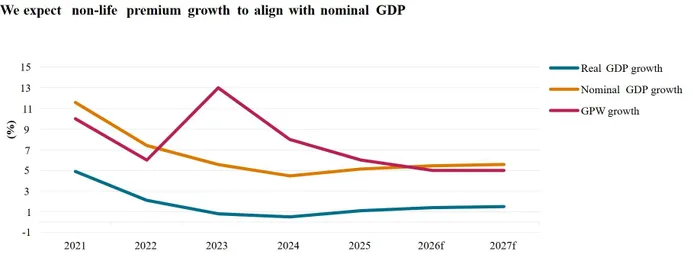
S&P expects premium growth of around 5% annually over the next two years, slightly lower than the 6% growth recorded in 2025 but broadly aligned with nominal GDP growth. Continued pricing adjustments and broader market penetration are expected to support premium growth despite economic headwinds.
The report noted that motor and property insurance remain the dominant segments of the non-life market, accounting for 38% and 30% of net earned premiums respectively.
Climate-related risks remain one of the sector’s most significant challenges. Weather-related events have contributed to earnings volatility in recent years, although losses have been relatively contained since late 2024. S&P expects profitability to remain stable provided insurers maintain underwriting discipline and continue adjusting premiums to reflect rising claims costs.
“Profitability could weaken if claims materially outpace repricing actions, or if weather-related losses revert to above-average levels,” the report warned.
Even so, South Africa’s non-life insurers continue to hold strong capital buffers. The sector’s median solvency coverage ratio stands at approximately 180%, supported by conservative capital management, strong earnings retention and effective reinsurance strategies.
Importantly, S&P said most rated South African insurers would be capable of withstanding a major climate-related catastrophe occurring once every 250 years, underscoring the sector’s resilience.
While economic growth remains subdued and geopolitical uncertainty continues to cloud the global outlook, S&P concluded that South Africa’s insurance industry is well equipped to navigate the challenges ahead.
BUSINESS REPORT