

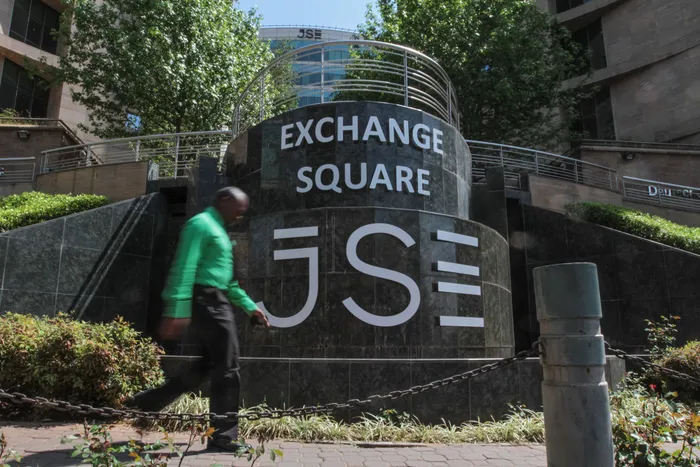
Johannesburg Stock Exchange equities ended June in negative territory over the six-month period, dragged down by falling precious metal mining group prices, following lower prices for the commodities.
Image: Supplied
The JSE fell for a second consecutive month in June, dragged down by the share prices of precious metals miners, which cost the FTSE/JSE Capped All Share Index some 4.5% of performance for the month, said Anchor Capital’s fund manager Peter Little.
He said in a note on Monday that the index had closed 3,7% lower into the month, dragging it into negative territory at the midpoint of 2026, or -2,8% year-to-date.
The gold price fell 12% month on month (MoM), pushing it back towards $4,000/oz, down 25% from its January high. The plunging gold price dragged the miners down (-15% MoM), while platinum miners fared even worse (-23% MoM), with the platinum price falling 19% MoM, having shed a quarter of its value year-to-date (YTD), said Little.
Herman van Papendorp, head of asset allocation at Momentum Investments, said in a statement that although the local financial and industrial companies generated positive returns in the second quarter, the gains were insufficient to offset losses in the resources sector, resulting in negative overall returns for the SA equity market in the period.
“Improving confidence that the Iran conflict would ultimately move towards resolution benefits SA fixed income assets and listed property, with the latter ending the quarter as the best-performing local asset class,” Van Papendorp said.
Little noted that internet investment groups Naspers and Prosus were also a drag on JSE performance in June (down 4% MoM in aggregate).
He said stocks geared towards the domestic economy were the best-performing cohort (+3.4% MoM), leaving them 8% higher YTD at the halfway point.
Even the beleaguered discretionary retailers experienced a bounce (6% MoM), including a 15% MoM jump in Mr Price. The retailer released full-year results with revenue up 4,3% YoY, which investors perceived as resilient in a challenging backdrop.
Despite the strong June performance, the discretionary retailers ended the first half down 10%. Banks (+3% MoM) continued to underpin the performance of the domestically exposed stocks, ending 10,6% higher by the end of the first half, said Little.
On the global markets, Van Papendorp said more bearish global inflation and monetary policy expectations, together with ongoing concerns about fiscal profligacy, drove developed market bond yields to multi-decade highs, producing the weakest returns among global asset classes in the second quarter, while also weighing on precious metal prices.
As a result, the gold and platinum exchange traded funds (ETFs) were the weakest performing investments for South African investors during the quarter.
deVere Group’s CEO Nigel Green predicted in a statement that a mega-rotation out of Big Tech is going to be a major theme for investors for the rest of 2026.
He said a broad shift away from concentrated positions in mega-cap technology stocks and into financials, industrials, healthcare, energy, infrastructure, and value sectors was accelerating, following softer-than-expected US jobs data and growing evidence that market leadership is widening.
The S&P 500 Equal Weight Index was enjoying its strongest relative start to a year since 1992, while equal-weight US equities outperformed their market-cap weighted counterparts in recent months, highlighting a major broadening of participation beyond the largest technology stocks.
The shift comes as the Dow Jones Industrial Average notched its second record closing high last week, rising above 52,900 as investors rotated into economically sensitive sectors, while reducing exposure to parts of the technology and semiconductor complex.
“We believe investors are witnessing the beginning of one of the most important reallocations of capital since the post-pandemic recovery,” Green said.
“For years, returns became increasingly concentrated in a handful of mega-cap technology companies. This trade generated exceptional wealth. It also created extraordinary concentration risk. Investors are now repositioning aggressively because they recognise that opportunity has expanded far beyond the narrow group of stocks that dominated markets over recent years,” he said.
Visit:www.businessreport.co.za