

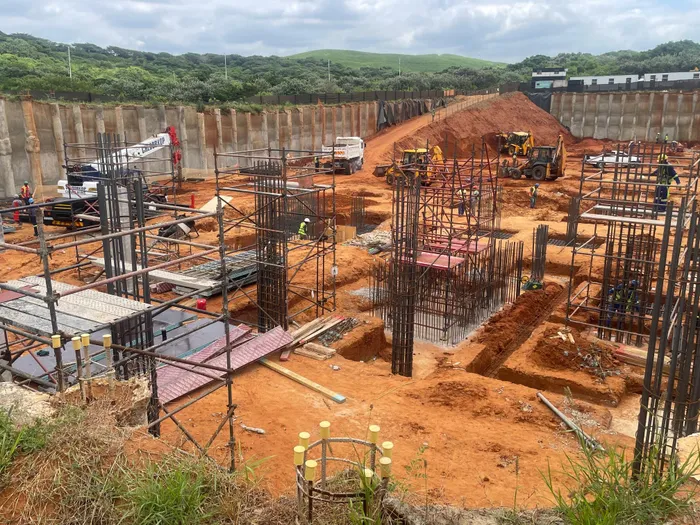
The size of the construction industry has also waned. In 2016, the industry was valued at R156,0 billion (in constant prices), gradually shrinking to R103,6 billion in 2024 and R99,1 billion in 2025.
Image: Vivian Warby
South Africa's construction industry continues to face tight margins, increasingly complex projects, rising costs, skills shortages, safety risks and growing administrative demands.
In an environment like this, better information, faster decision-making and improved efficiency can make a real difference, according to H&l Construction.
The construction company says that, applied correctly, AI can create value across the entire construction business-from estimating and procurement to project delivery, quality, safety, finance, payroll, HR and executive decision-making.
“By automating repetitive tasks and improving access to information, AI enables our people to spend more time solving problems, managing projects and delivering value to our clients.”
The company says it is embracing AI as a practical business tool. It says its focus is not on replacing people or chasing the latest technology.
“It's about equipping our teams with tools that improve efficiency, support better decision-making and free up time to focus on what they do best- delivering successful projects. Construction will always be a people-driven industry.
"The experience, judgement and expertise of our site management, technical teams and support staff remain our greatest asset.”
The company says Al helps organise the content, but the insight, industry knowledge and practical experience behind it are human. It says that's where Al creates its greatest value-not by replacing people, but by empowering them.
“At H&l Construction, we believe innovation is most powerful when it empowers people. Al doesn't build great projects. Great people do - with the right technology behind them.” According to Statistics South Africa (Stats SA), the construction industry in SA has faced numerous challenges over the years.
The statistical agency says some of the key contributing factors, according to Infrastructure South Africa, were slow economic growth, low investment, load-shedding, labour shortages, the Covid-19 pandemic and criminal activity.
According to gross domestic product (GDP) estimates, construction’s contribution to national economic activity peaked at 4,2% of value added (in current prices) in 2008, it says.
“Since then, its contribution has slowly decreased to 2,4% in 2024 and 2,3% in 2025. The size of the construction industry has also waned. In 2016, the industry was valued at R156,0 billion (in constant prices), gradually shrinking to R103,6 billion in 2024 and R99,1 billion in 2025.”
The recent release of the Construction Industry 2024 statistical report provides a detailed update of several indicators.
Based on a large sample survey of enterprises registered for value-added tax (VAT), the report covers data on finances, employment, details of services, details of purchases, the industry’s client base and ICT usage.
Meanwhile, Marcello Raman, the founder of Zeus Black, says the most dangerous thing one can do in SA construction right now is trust last month's numbers.
He says Stats SA just released the latest Construction Material Price Indices (P0151.1), and the data is brutal.
“In a single month, material inflation violently accelerated from 4.5% up to 8.4% year-on-year.”
Inside the micro-categories, the founder says it's a slaughterhouse:
He adds that if one is running a portfolio on fixed-price contracts, a 30-day data lag in their office is not just an inconvenience.
"It's a structural vulnerability. Your net margin is melting before your team even has time to compile the monthly progress claim pack.
"You think you're making money because the earth is moving. But you're actually writing a personal check to finance the client's asset. Activity is not profitability.
"Stop running a multi-million rand enterprise in a rearview mirror. Tighten your control room."