

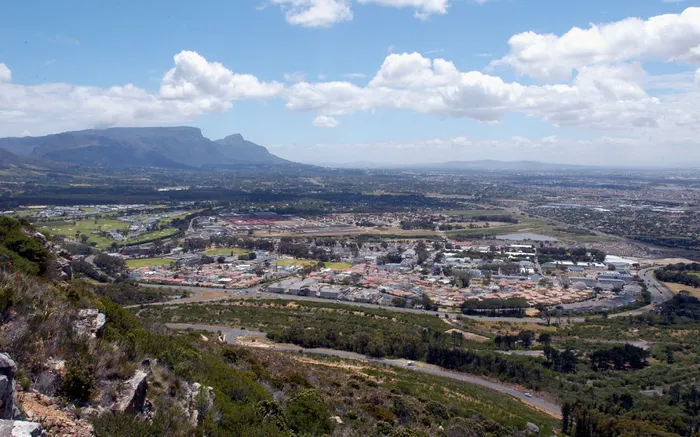
In South Africa, town planners have a significant role in transforming our spatial landscape by addressing historical inequalities, improving access to opportunities, and guiding development in a way that benefits both people and the environment.
Image: Rogan Ward
Cape Town is building exceptional homes at the top end and not nearly enough of what is required in the middle.
These are beautiful, well-designed and high-value spaces.
“I'm developing high-end homes in Constantia, aimed largely at semigrants and foreign buyers. That's where the demand is. That's what the market supports. But it doesn't mean we shouldn't question it,” wrote Julia Finnis-Bedford, the founder of Amazing Spaces, in a LinkedIn post on Wednesday.
She added that this is an uncomfortable topic for her to write about because she was part of this space.
At the same time, the property brand says the region is not building nearly enough in the middle. Not enough for people who live and work here full-time.
“Not enough for families without access to foreign currency or semigration budgets.”
There are reasons for this, Finnis-Bedford says. She says that development is expensive. “Land is expensive. Construction costs are high. And time is expensive. When it takes months to get plans approved, holding costs alone become a deterrent.
“That risk pushes developers toward the higher end, where margins absorb delays. It's not always a choice driven by vision. Often it's driven by viability."
So the cycle continues, says Amazing Spaces. It says that developers build where the numbers work. “That's often at the top. Supply in the middle stays limited. Prices rise.”
The company says the conversation needs to shift.
“We need investment and luxury development. But we also need faster, more efficient planning approvals that make it feasible to build more broadly.
"Cape Town is a global city, and that brings opportunity. But if we want it to remain a city that works for the people who live here, we need to make it easier to build at every level. Not just the top,” Finnis-Bedford says.
Meanwhile, Finella Botes, the high-value property consultant at Seeff Atlantic Seaboard, also wrote that the Constitutional Court ruling on the Tafelberg site was not just about one property. She says it could shape conversations around development and housing in Cape Town for years to come.
“The court found that the sale of the Tafelberg site in Sea Point was unlawful and has instructed both the City of Cape Town and the Western Cape Government to report on how they intend to meet their constitutional obligations around affordable housing in and around the CBD.”
Whether one agrees with the judgment or not, Botes says one thing is certain. “Well-located land has become one of Cape Town's most valuable and most debated assets.
I don't believe this ruling will suddenly change the luxury property market overnight. Demand for quality homes in areas like the Waterfront, Clifton, Bantry Bay and Fresnaye remains exceptionally strong.”
She says that what she thinks this judgment will do is place far greater attention on how strategically located land is developed in the future.
“Property markets don't exist in isolation. Planning decisions, infrastructure, housing policy and development all play a role in shaping the long-term value of an area.
"This is one of those decisions that is likely to influence conversations far beyond the Tafelberg site itself. It will be interesting to see what happens next,” Botes says.
Earlier this week, Zinhle Nkongwane, a town planner, wrote that town planning is more than regulating land use or deciding where development should take place. She says it is about creating communities that are inclusive, sustainable, economically vibrant, and resilient for future generations.
“In South Africa, town planners have a significant role in transforming our spatial landscape by addressing historical inequalities, improving access to opportunities, and guiding development in a way that benefits both people and the environment,” Nkongwane says.
She added that every planning decision influences how people live, work, travel, and interact with their surroundings.
“As our towns and cities continue to evolve, the challenge is to balance growth, environmental sustainability, infrastructure, and the needs of our communities. Town planning shapes the future of our built environment.”
Participating in a panel discussion at the South African Institute of Black Property Practitioners (SAIBPP) Annual Convention at the beginning of this month, Ayanda Xaba, an investment analyst at Development Bank of Southern Africa (DBSA), said discussing the importance of expanding the markets by rewriting the property book was truly important.
She says transformation is ultimately about creating an industry where opportunity is sustainable. “Participation opens the door, but ownership builds resilience, wealth and long-term inclusion. As an industry, our challenge over the next decade is to ensure that more South Africans are not only participating in the property sector, but are building, owning and growing within it.”
The Western Cape's average property price in Q1 2026 was R3 357 917, 72% above the national average of R1 951 230, said Nathan Scott, a Cape Town property strategist, last week.
He said Gauteng now accounts for 50.8% of all property transfers nationally.
The property strategist said to qualify for a bond on a R2.5 million property in the Northern Suburbs - a standard 3-bedroom family home in Bellville, Durbanville or the Winelands corridor - a household needs a net income of approximately R55 000 to R60 000 per month.