

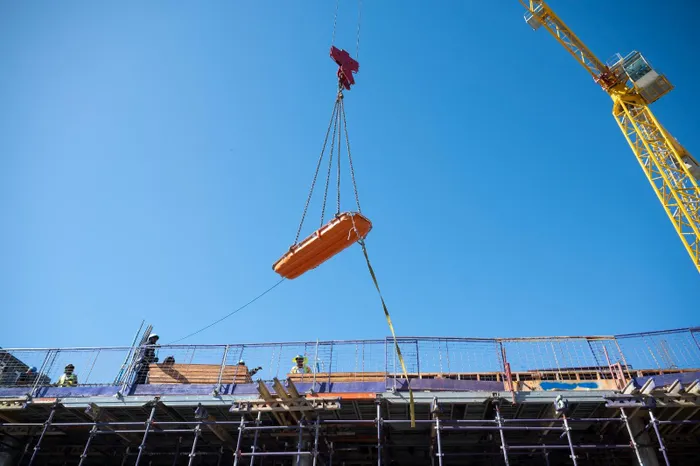
Public Works Minister Dean Macpherson warns of the sophisticated tactics used by the construction mafia in South Africa, which have disrupted over R63bn in infrastructure projects.
Image: Armand Hough / Independent Newspapers
Public Works Minister Dean Macpherson warns of the sophisticated tactics used by the construction mafia in South Africa, which have disrupted over R63bn in infrastructure projects.
The newly approved Integrated Social Facilitation Framework aims to combat this organised crime and protect vital construction efforts.
He said they were incredibly sophisticated, and often they are politically connected.
"They were learning how to embed themselves, not only through open violence, but through subcontracting arrangements, local participation structures, security contracts, front companies and self-appointed community representatives."
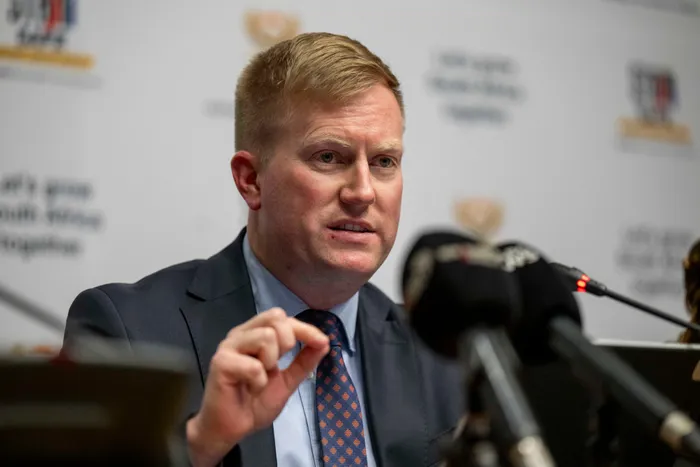
DA MP Dean Macpherson said the launch of the National Built Environment and Construction Safety Framework was an important step towards strengthening safety, accountability and collaboration across the built environment ecosystem.
Image: Henk Kruger / Independent Newspapers
Macpherson was speaking after Cabinet approved the Integrated Social Facilitation Framework (ISFF).
The ISFR is a binding national policy that requires government departments, municipalities and state-owned entities to engage communities before construction projects start.
The so-called construction mafia referred to organised groups that invade construction sites and demand money, jobs or subcontracts under the guise of local participation, often through violence and intimidation.
Macpherson said the framework, almost two years in the making, was aimed at preventing these groups from exploiting community frustration to disrupt projects.
"It is an important tool in the value chain of our efforts to fight back against the construction mafia and extortionists and those that seek to stop our progress on infrastructure sites across the country," he said.
"I am very grateful to Cabinet for approving the Integrated Social Facilitation Framework as a binding national policy instrument, which is a major step in moving forward from policy development to formal government implementation."
He said the construction mafia had been one of the first and clearest threats facing infrastructure delivery when he took office in July 2024.
By then, what had begun in KwaZulu-Natal had spread to most provinces.
"SA cannot turn itself into a construction site if construction sites are controlled by criminals," he said.
"Projects were being stopped, workers were being intimidated, in some cases assaulted, violently so, equipment was being damaged or stolen, and companies were being forced to pay money or surrender work to people who had no lawful claim to it."
He said the syndicates had increased costs for the state, deterred investment and threatened the lives of workers, project managers and construction owners.
"I remember we had that terrible case of a senior executive in Durban who had been shot six times on site, and thank God managed to survive," he said.
"But most importantly and concerningly, they were robbing communities of their infrastructure."
Macpherson said an incident at the uMkhomazi water project in KwaZulu-Natal had been a turning point for him.
The multibillion-rand project, one of the largest water infrastructure schemes in the country, involves the construction of a dam on the uMkhomazi River to secure water supply for Durban and surrounding areas, where demand has outstripped supply for years.
There, a matter linked to the construction mafia had left three people dead and another person assaulted.
"That for me was a defining moment and a wake-up call," he said.
"It confirmed that this was not just about procurement inconvenience, it was not just a community protest, and it was not a labour dispute.
"It was organised criminality and required an organised national response."
He said the old approach had failed because disruptions were treated as isolated incidents.
A contractor would report a problem, a municipality would try to negotiate, police would open a case, but nothing would come of it and the networks behind the disruptions continued.
This had prompted him and KwaZulu-Natal public works MEC Martin Meyer to convene a national summit on construction mafia activity in Durban in November 2024.
The summit produced the Durban Declaration, which committed government, law enforcement, National Treasury, regulators, state-owned entities and the construction industry to one coordinated national response.
"The Durban Declaration was our line in the sand," Macpherson said.
"It said that the state would no longer tolerate criminal disruption at construction sites."
Since the signing of the declaration, he said, there had been measurable progress.
"There have been more than 770 cases of construction-related extortion and intimidation that were reported across the country," he said.
"Of those, 241 arrests were made, and importantly, 176 people were convicted."
In KwaZulu-Natal, historically the hotspot of construction mafia activity, monthly site disruptions had dropped from more than 60 incidents a month to fewer than 10.
"That is a significant improvement," he said.
"It shows what can happen when government, law enforcement, public entities and the private sector work together."
Consequence management had also been strengthened, with 52 contractors blacklisted since September 2025 and a further batch under review.
"Before, we had just two in 22 years. We've done 52 in two years," he said.
But Macpherson cautioned that government was not declaring victory yet, pointing to recent disruptions in Gauteng, including in Randfontein on the West Rand and in the Vaal region south of Johannesburg.
He said those incidents had, however, been escalated through the provincial priority crimes committee and the sites stabilised without prolonged stoppages.
He warned that the syndicates were looking for new ways to infiltrate projects.
"We now have criminals that have their own front companies that pose as contractors, and they manipulate community structures and influence subcontracting opportunities," he said.
"They are still trying to make public infrastructure serve criminal interests instead of public interests."
The ISFF will standardise community engagement across national, provincial and local government, as well as state-owned entities.
Communities will have to be informed about what is being built, why it is being built, what opportunities exist for them and how concerns can be raised lawfully.
The framework will apply throughout the lifecycle of a project, from planning to completion.
It will also establish project liaison committees as formal platforms for communication and conflict resolution, and require continuous monitoring and reporting so that risks are identified early.
"In plain language, this means that communities must no longer be engaged only after conflict begins.
"They must be engaged before a project starts," Macpherson said.
He said community engagement had for too long been inconsistent and fragmented, sometimes treated as a box-ticking exercise or left to unqualified intermediaries.
"In many cases, self-styled community liaison officers step into the vacuum and claim to speak on behalf of communities without any accountability, standards or ethical obligation," he said.
"That vacuum has been exploited by extortionists, and the framework closes that vacuum."
Central to the reform was the professionalisation of social facilitation, led by the South African Council for the Project and Construction Management Professions together with the department and the Council for the Built Environment.
Social facilitators would in future have to be qualified, registered and bound by a code of ethics.
"They must be able to act as a bridge between the community and not as gatekeepers," Macpherson said.
He said implementation would prioritise high-risk projects where conflict, extortion and vandalism were greatest.
The framework did not replace law enforcement but strengthened it, he said.
"Where there are legitimate community concerns, we'll engage. Where local businesses seek lawful participation, we'll create those opportunities," he said.
"But where criminals invade sites, threaten our workers, demand money, or attempt to manipulate outcomes or vandalise infrastructure, we will make sure that they are arrested."
He ended with a warning to the syndicates.
"There can be no negotiation with extortionists or criminals. There will be no compromise with them either," he said.
"And there will be no future for a construction industry where delivery depends on paying protection money."