

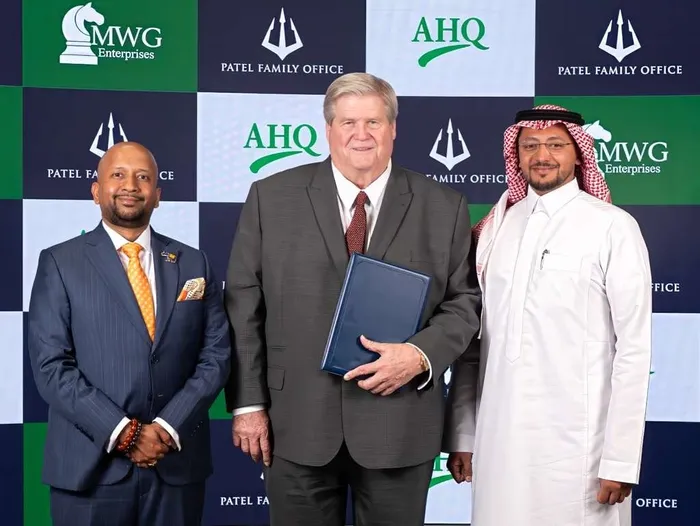
Lakshmi Narayanan, vice chair of Patel Family Office, Marc W. Gunderson, founder of MWG Enterprises, and Abdul Malik Alqahtani, Group CEO of AHQ Group.
Image: Supplied
A consortium comprising US and Saudi investors has entered the final stage of selecting a Gulf host country for a planned $5 billion integrated refinery and energy export corridor, with a final decision expected before the end of 2026.
MERA Oil, a newly launched private consortium backed by Texas-based MWG Enterprises, Patel Family Office and PWS, an associate company of Saudi Arabia's AHQ Group, on Wednesday said it had narrowed its search to three Gulf Cooperation Council (GCC) locations outside the Strait of Hormuz after three years of evaluating potential sites across the region.
The consortium said discussions with the three shortlisted jurisdictions had advanced significantly over the past two years, although it remains open to considering another GCC location should it present a stronger proposal that meets its infrastructure, route resilience and development timetable requirements.
The project is centred on the construction of a 200,000-barrel-per-day integrated refinery linked to deepwater port infrastructure, large-scale crude and refined products storage facilities, and marine export terminals.
By locating the development outside the Strait of Hormuz, the consortium aims to establish an export platform with direct access to international shipping routes while reducing exposure to one of the world's most strategically sensitive maritime chokepoints.
The project also seeks to strengthen regional manufacturing, logistics, technical expertise and energy security through the establishment of a long-term industrial base.
Marc W. Gunderson, founder of MWG Enterprises, said the consortium had reached a critical stage in the process.
"Three years of evaluation across the region and two years of detailed engagement with three outstanding locations have brought us to a clear decision point. The sponsor partnership is assembled, the development concept and capital strategy are defined, and we are now choosing our host."
He said the jurisdiction that moved decisively in the coming months stood to secure "a major new downstream, storage and energy-export platform."
The first phase of the project, valued at up to $5bn, is designed as an energy-efficient refining complex incorporating advanced emissions-control systems. The consortium is also evaluating the future integration of sustainable aviation fuel co-processing and carbon management technologies.
According to the consortium, a pre-feasibility study covering refinery design, product mix, logistics, capital requirements and phased implementation has reached an advanced stage.
Once a host country is selected, the project is expected to proceed to final site due diligence and engineering design. Mechanical completion of the first phase is targeted for the end of 2029, followed by commissioning and the start of commercial operations.
The refinery is expected to produce high-specification middle distillates, including ultra-low sulphur diesel and jet fuel, aimed at selected import-dependent markets in the United States, the Atlantic Basin, the Gulf region and other international destinations, subject to final engineering specifications and offtake agreements.
The announcement comes as Gulf countries continue investing heavily in expanding downstream refining and export infrastructure to capture greater value from hydrocarbon production.
According to the GCC Statistical Centre, the six GCC member states exported approximately 11.5 million barrels of crude oil per day in 2024, accounting for about one-quarter of global crude oil exports.
AHQ Group CEO Abdulmalik Alqahtani said the project was intended to deliver long-term industrial benefits beyond refining operations.
"Expanding domestic value addition remains one of the Gulf's most important industrial opportunities," Alqahtani said.
"More than seven decades of industrial work across the Kingdom have taught us what a project of this kind should leave behind for its host: jobs, local suppliers, technical skill and industrial capacity that endures, in step with the region's national visions."
The development is expected to occupy between 1,200 and 1,500 acres of port-connected industrial land and is designed to support local sourcing, engineering services, workforce development and industrial capability in line with Gulf countries' In-Country Value programmes.
Based on preliminary estimates, the project is expected to create up to 3,000 direct jobs during construction, commissioning and operations, while generating a further 15,000 indirect and induced employment opportunities.
Lakshmi Narayanan, vice chair of Patel Family Office, said the consortium was engaging sovereign wealth funds and institutional investors to support the long-term financing of the project.
"This is multigenerational infrastructure, and it has to be structured to institutional standards from the outset: sound governance, a balanced capital structure built to hold for decades, and a transparent partnership with the host government."
The consortium said financing for the first phase is expected to combine sponsor equity, sovereign and institutional investment, international project finance, export-credit support and Shariah-compliant financing structures.
BUSINESS REPORT