

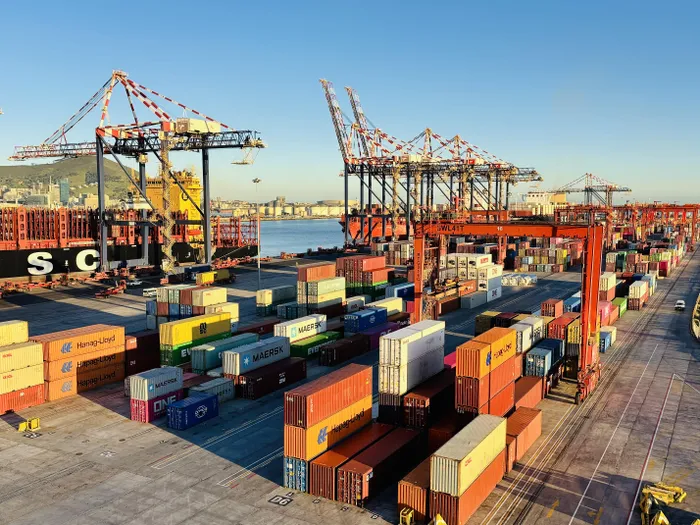
While analysts say the revised tariff is less damaging than initially anticipated, they caution that it still presents an obstacle for exporters at a time when South Africa's economy remains fragile.
Image: File
South African exporters are expected to face renewed pressure after the United States increased tariffs on imports from 60 countries, with economists warning that the move could weigh on export-driven industries even though the final tariff imposed on South Africa is lower than initially feared.
The US recently increased tariffs on South African exports from 10% to 12.5%, significantly below the more than 30% initially proposed under the so-called "Liberation Day" tariff measures.
While analysts say the revised tariff is less damaging than initially anticipated, they caution that it still presents an obstacle for exporters at a time when South Africa's economy remains fragile.
Agbiz chief economist Wandile Sihlobo said the higher tariff was not ideal, although it represented a better outcome than the original proposal.
“The agricultural sector could still do better given where we are coming from: a 30% tariff,” he said.
Sihlobo noted that South Africa's key agricultural competitors, including Australia, Peru and Chile, have also been subjected to similar tariff increases.
“Notably, thce oranges, fruit juices, and nuts are still exempt from these tariffs,” he said.
he United States remains an important destination for South African agricultural exports, accounting for approximately 4% of the country's $15.1 billion (R252 billion) agricultural exports in 2025.
Products exported to the U.S. include citrus, berries, grapes, wine, fruit juices, apples, pears, apricots and nuts.
Sihlobo said South African exporters accelerated shipments during the 90-day suspension of the higher tariffs in the second quarter of 2025 but exports weakened once that temporary reprieve expired.
“South Africa’s agricultural exports to the US decreased by 11% in the third quarter of 2025, compared to the same period in 2024, at $144 million (R2.4 billion). In the last quarter, South Africa’s agricultural exports to the US fell sharply by 39% to $81m (R1.3bn).
Professor Andre Thomashausen, Professor Emeritus of International Law at Unisa, said the revised tariff regime was considerably more favourable than the original proposal.
“Moreover, the most relevant South African exports will benefit from exemptions. South Africa is also seeing a major uptake of American FDI interest, in particular the forthcoming US investments in Eskom debt, in a massive Liquefied Natural Gas (LNG) terminal in Richards Bay, in Transnet and water Public-Private Partnerships (PPPs) and AI industries,” he said.
He added that despite diplomatic tensions between Pretoria and Washington, the United States continues to view South Africa as an important investment destination.
However, economists warned that several sectors remain vulnerable.
Professor Simphiwe Madikizela, an economist at Unisa, said the automotive industry is likely to experience higher export costs, reduced competitiveness and potential declines in production and employment.
“Agriculture and agro-processing will feel the pressure on citrus, wine, macadamias (nuts), fruit, and other value-added exports like fruit juice. Steel and aluminium will have reduced export competitiveness and weaker demand from US buyers,” he said.
He added that manufacturing could experience weaker export orders, slowing factory output and investment, while reduced export volumes may also affect logistics companies, ports and freight operators.
“Logistics and ports will see reduced export volumes which may affect freight, shipping, and related services. The tariffs are unlikely to trigger an immediate economic crisis, but they do represent a significant headwind for South Africa’s export-led industries.
“Their ultimate impact will depend on the duration of the measures, the products affected, and, of most importance, how quickly South African exporters can adapt by improving competitiveness and diversifying into new markets,” he said.
Madikizela concluded that at a time when economic growth remains modest, any additional barrier to exports is unwelcome and underscores the importance of resilient trade policy and market diversification.”
Professor Waldo Krugell, an economist at North-West University, said the revised tariffs primarily affect agricultural exports, while key sectors such as motor vehicles, steel and manufactured products continue to be governed under separate provisions of U.S. trade legislation.
“The end result is that tariffs go up from 10% to 12.5%. 60 economies and it's related to the failure of the economy to impose and effectively enforce a prohibition on the importation of goods produced with forced labour.”
BUSINESS REPORT