

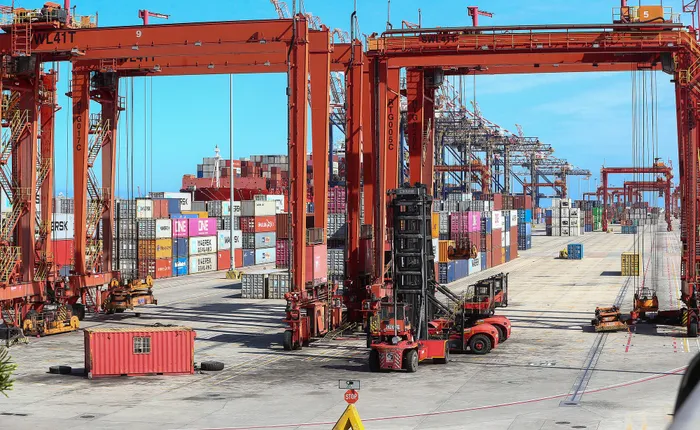
The South Africa report highlighted the need to scale up development financing while addressing long-standing structural constraints.
Image: Leon Lestrade / Independent Newspapers
South Africa must accelerate domestic resource mobilisation and deepen structural reforms to strengthen economic growth and reduce its dependence on external financing in an increasingly fragmented global economy.
This is an assessment of the African Development Bank (AfDB), which came on Tuesday during the launch of the bank's 2026 Regional Economic Outlook Reports and Country Focus Reports.
The South Africa report highlighted the need to scale up development financing while addressing long-standing structural constraints.
Speaking at the launch, Dr Kennedy Mbekeani, the AfDB's director general for the Southern Africa Region, said geopolitical tensions, shifting trade patterns and declining development assistance were forcing African economies to become more financially self-reliant.
"The global economic order is fragmenting, and geopolitical dynamics are reshaping trade, global supply chains, and capital flows," Mbekeani said.
He said the imperative for "strengthening regional economic integration and homegrown development financing options and national sovereignty has become even more urgent today than ever before."
The AfDB's South Africa Country Focus Report shows that while the country's economy has begun to recover, growth remains too weak to tackle unemployment, poverty and inequality.
According to the report, South Africa's economy expanded by an estimated 1.1% in 2025, up from 0.5% in 2024, supported by improved agricultural output and stronger activity in finance, business services, trade and hospitality.
Growth is projected to edge up to 1.2% in 2026 and 1.6% in 2027 as energy supply improves and structural reforms under Operation Vulindlela continue.
However, the bank cautioned that the economy has averaged only 1.1% annual growth between 2022 and 2025, constrained by electricity shortages, logistics bottlenecks, local government failures, weak investment and persistent structural challenges.
Mbekeani warned that headline growth alone was insufficient if it failed to improve living standards.
"No one eats real GDP growth rates or drinks macroeconomic indicators, especially in enclaved economies where the benefits of GDP growth rate do not translate directly to improved well-being for all citizens," he said.
He added that despite Africa's resilience, unemployment, limited access to finance for small businesses, low incomes and high inflation continued to undermine development across the continent.
The bank believes South Africa can strengthen its development financing by improving tax collection, enhancing public financial management, expanding public-private partnerships, mobilising institutional investors and leveraging diaspora capital.
Economist Liandra da Silva said South Africa has made notable progress in addressing electricity shortages and improving rail logistics through reforms, although water infrastructure constraints, governance weaknesses and low investment continue to limit growth.
"The tensions in the Middle East completely disrupted the recovery that we expected both from a growth perspective, from an inflation perspective and also from monetary policy effectiveness as well," Da Silva said.
Beyond South Africa, the AfDB expects Southern Africa's economic growth to moderate this year as the region contends with external shocks.
Mbekeani said Southern Africa's growth is projected to ease to 2.1% in 2026 from 2.3% in 2025, reflecting the impact of global uncertainty and weaker domestic economic activity across several economies.
Despite these headwinds, he said Africa remains one of the world's strongest-performing regions.
"Africa's macroeconomic performance in 2025 remains strong, and the medium-term prospects are encouraging," Mbekeani said.
The continent's economy expanded by an estimated 4.4% in 2025, up from 3.5% in 2024, with 36 countries recording positive growth and 22 expanding by more than 5%.
Mbekeani noted that Africa accounted for 12 of the world's 20 fastest-growing economies in 2025 and projected the continent's growth would remain above 4% in 2026 before strengthening further.
The AfDB argues that Africa has sufficient domestic financial resources to fund its own development if governments implement the right reforms.
Mbekeani said adopting better tax administration could generate an additional $469 billion annually, while stronger non-tax revenue mobilisation could raise another $311.6bn each year.
He added that Africa's institutional investors already manage approximately $4 trillion in assets, yet only 2.7% is invested in productive sectors on the continent.
"Tackling informality could yield $125bn annually in Africa, while improving investment efficiency could save up to $299bn and addressing other forms of financial leakage such as illicit financial flows, corruption, risk mispricing, tax evasion and other forms of leakage could save up to $587bn annually," Mbekeani said.
He called on African governments, development partners and the private sector to work together to strengthen Africa's financial architecture and mobilise capital that supports sustainable, inclusive growth across the continent.
BUSINESS REPORT